
Why Europe for a PhD?
Europe has become one of the most attractive destinations for international PhD students and for good reason. Many positions are fully funded, meaning you receive a salary, not just a scholarship. Research infrastructure is world-class. And the diversity of countries, languages, and academic cultures gives you more options than almost any other region.
But the European PhD landscape is fragmented. Each country has its own system, funding model, and application process. Without a clear strategy, even strong candidates waste months applying to the wrong programs in the wrong way. Once you find the right position, managing your full application journey in one place makes the difference between a scattered process and a structured one.
This guide of the Acatrix cuts through that confusion from finding open positions to starting your application with Acatrix for free.
How the PhD System Works in Europe
Before you search for positions, you need to understand how European PhDs are structured, because it's very different from the North American model. And once applications start coming in, having a clear application tracking system for academic applications is what keeps everything under control.
Structured PhD Programs vs. Individual Supervision
In most European countries, PhD positions are advertised as job vacancies not program admissions. You apply for a specific position under a specific supervisor, not for general admission to a department. This means you need to find an open position and a supervisor whose research matches yours.
Funded vs. Unfunded Positions
Most PhD positions in Northern and Western Europe (Germany, Switzerland, Netherlands, Scandinavia, UK) come with a salary or stipend. Southern and Eastern European countries may have more unfunded opportunities. Always check the funding status before applying.
Duration
Country | Typical Duration | Funding Model |
|---|---|---|
Germany | 3–4 years | Employed (TVöD salary) |
Netherlands | 4 years | Employed (full salary) |
United Kingdom | 3–4 years | Stipend (UKRI, AHRC, etc.) |
Sweden / Norway | 4 years | Employed (full salary) |
France | 3 years | Contract doctoral (stipend) |
Switzerland | 4 years | Employed (high salary) |
Italy / Spain | 3 years | Stipend (varies) |
Best Platforms to Find Open PhD Positions in Europe
These are the most reliable and widely used platforms for finding advertised PhD vacancies across Europe. As you find positions, tracking multiple university applications without missing deadlines becomes critical, especially when positions from different platforms have overlapping timelines.
1. EURAXESS (euraxess.ec.europa.eu)
The official European Commission platform for research jobs and fellowships. Covers all EU countries and beyond. Filter by country, field, and funding type. Updated daily — check it weekly.
2. FindAPhD (findaphd.com)
One of the largest PhD-specific databases globally. Strong coverage of UK, Germany, Netherlands, and Belgium. Allows email alerts for new positions in your field.
3. Academic Positions (academicpositions.com)
Focuses on academic jobs and PhD positions in Northern Europe — particularly strong for Scandinavia and the Netherlands. Positions are often posted directly by universities.
4. ResearchGate Jobs
Many supervisors and research groups advertise positions directly on ResearchGate. Useful for niche fields and for identifying active researchers in your area.
5. University Career Portals
Never underestimate the power of going direct. Most European universities post PhD vacancies on their own websites before they appear on aggregators. Bookmark the careers pages of your target universities and check monthly.
6. LinkedIn
Search "PhD position" + your field + country. Many research groups now advertise directly on LinkedIn. Follow university research labs and professors in your field to see posts as they appear.
Pro Tip: Set up email alerts on EURAXESS and FindAPhD for your keywords. New positions are posted constantly, and being among the first to apply gives you a real advantage.

Country-by-Country Quick Guide
1. Germany
Germany offers some of the most competitive PhD positions in Europe. Most positions are tied to DFG-funded research projects or Max Planck / Helmholtz institutes. Positions are advertised on university websites, DAAD (daad.de), and EURAXESS. The application process is usually direct, you contact the supervisor first.
2. Netherlands
PhD students in the Netherlands are employed, they receive a full salary and social benefits. Positions are highly competitive and internationally advertised. Check academicpositions.com and university HR portals (e.g., Leiden, Utrecht, TU Delft).
3. United Kingdom
UK PhD positions can be funded through UKRI (ukri.org), university scholarships, or industrial partnerships. FindAPhD has the strongest UK coverage. Note that post-Brexit, EU students are treated as international applicants for funding purposes.
4. Scandinavia (Sweden, Norway, Denmark, Finland)
PhD positions are fully employed positions with competitive salaries. Jobs are posted on university websites and academicpositions.com. Norway and Sweden are particularly strong in natural sciences, engineering, and social sciences.
5. France
French PhDs are funded through contrats doctoraux — three-year salaried contracts. Positions are advertised on ABG (association-bernard-gregory.fr) and EURAXESS. Some positions are tied to the CNRS research network.
6. Switzerland
ETH Zurich and EPFL are among the top-ranked universities in the world and offer well-paid PhD positions. Swiss PhD salaries are among the highest in Europe. Positions are posted directly on university portals and EURAXESS.
How to Contact Supervisors Effectively
In many European countries, especially Germany, the Netherlands, and Scandinavia, you can (and should) contact potential supervisors directly, even before a position is formally advertised. Many PhD positions are created because a supervisor found the right candidate.
Before You Email
Read at least two or three of the supervisor's recent papers
Identify a specific research question that connects your background to their work
Check whether their lab has current funding for a new PhD student
Understanding a professor's recent research makes your email immediately stand out. If you need help quickly summarizing complex papers before reaching out, Acatrix Research Summary can break down papers in your field in minutes.
What to Include in Your Email
A specific subject line mentioning the research topic
One paragraph showing you understand their current work
Your research background and what you want to investigate
A clear question: are they accepting PhD students for this project?
Your CV attached (yes, attach it: here's why attaching your CV in the first email matters)
For real examples of what separates emails that get replies from ones that get ignored, read our guide on PhD email examples: accepted vs. ignored in 2026.
Don't send the same email to twenty professors. Supervisors talk to each other. A generic mass-email will damage your reputation before your application even starts.
How to Track Your Applications Without Losing Your Mind
When you're applying to multiple PhD positions across different countries, each with different deadlines, document requirements, and supervisor contacts, managing everything in your head (or a messy spreadsheet) is a recipe for missed opportunities.
Without a Tracking System | With a Tracking System |
|---|---|
Deadlines overlap and get missed | All deadlines visible in one place |
Wrong CV version sent to wrong position | Documents assigned per application |
Follow-up emails forgotten | Communication log per supervisor |
Application status unclear | Status tracked at every stage |
Start Tracking Your Applications Without Losing Your Mind
Common Mistakes When Searching for PhD Positions in Europe
1. Only Using One Platform
Different platforms cover different countries and fields. Using only FindAPhD means you'll miss positions in Scandinavia. Using only EURAXESS means you'll miss UK-specific funding. Use at least three platforms and set alerts on each.
2. Applying Too Late
Many European PhD positions — especially funded ones — close within two to four weeks of being posted. The earlier you apply, the better your chances. This is why real-time alerts matter.
3. Sending a Generic SOP
Your statement of purpose must be tailored to the specific position and supervisor. A general statement that could apply to any PhD program is one of the fastest ways to get rejected. Every SOP should reference the lab's research, the specific project, and why you are the right fit for that position specifically.
4. Not Preparing for the Interview
European PhD interviews are often technical and research-focused. You will be expected to discuss your research proposal in depth, defend your methodology, and demonstrate familiarity with the lab's work. Read our guide on the most common PhD interview mistakes that cost candidates their offer, and learn how interview preparation shapes your first impression from the very first question.
5. Ignoring Unfunded Positions in Strong Research Groups
Sometimes an unfunded position in an exceptional lab, with a strong supervisor who can help you secure external funding is more valuable than a funded position in a weaker research environment. Don't filter exclusively by funding status.
How Acatrix Helps You From Search to Settlement
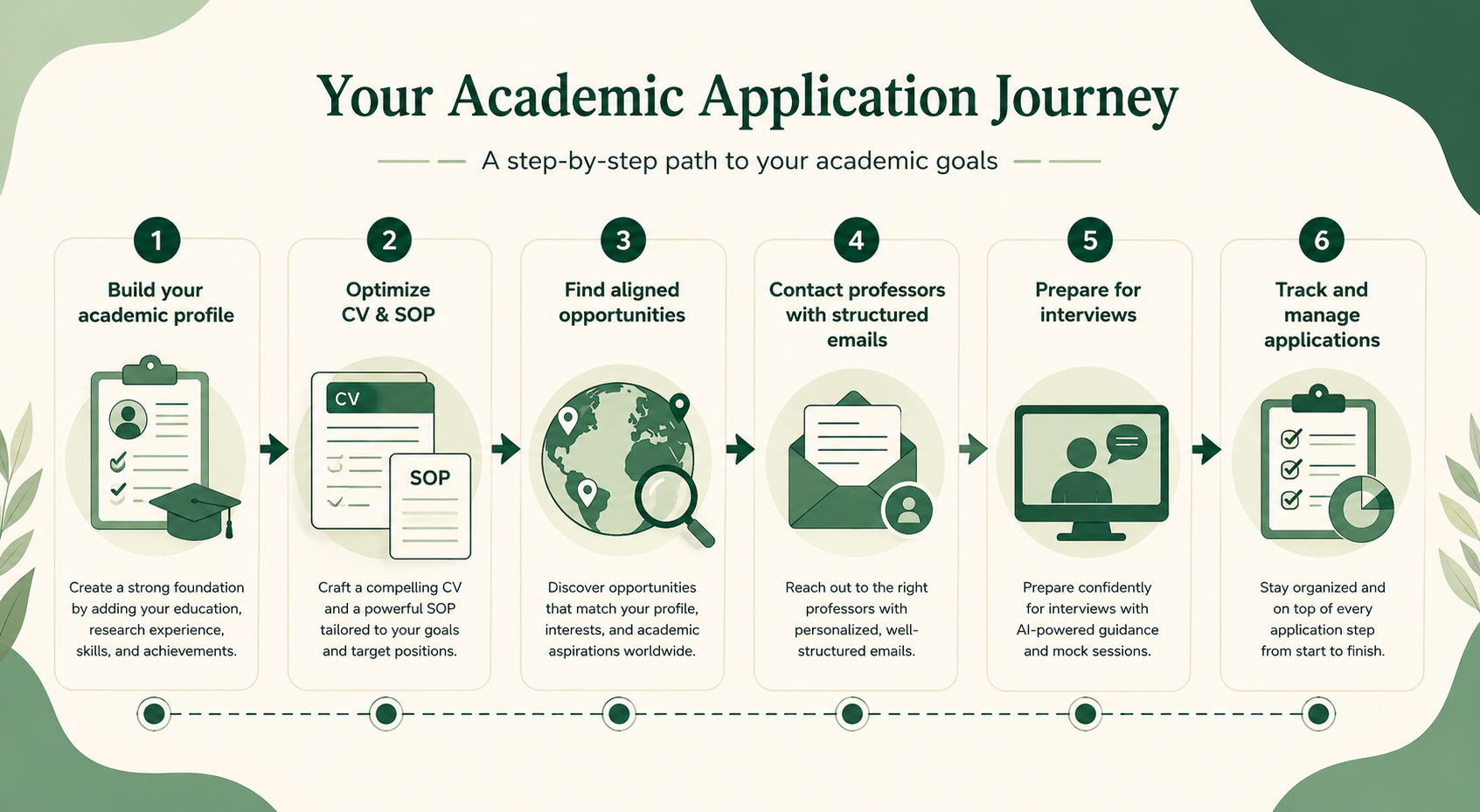
Finding the position is only step one. The application itself , CV, SOP, emails, interview prep, and managing ten deadlines at once is where most candidates lose ground. Acatrix is built to support every step of that journey in one place.
1. Application Tracking System
Manage all your PhD applications, deadlines, documents, and communication in one structured dashboard. Never miss a deadline again.
2. CV Review & Feedback
Get structured feedback on your academic CV, clarity, relevance, and alignment with European PhD standards.
3. SOP & Research Statement
Write a position-specific statement of purpose tailored to your background and the exact program you're targeting.
4. Email Assistant
Draft personalized outreach emails to professors aligned with their actual research publications for higher response rates.
5. Research Summary
Understand complex papers in your target professor's field quickly, so every email and interview answer shows genuine depth.
6. Interview Preparation
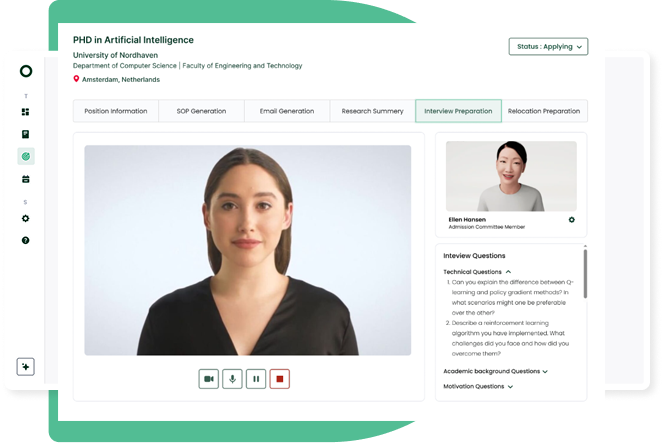
Practice mock PhD interviews tailored to your field and target position. Walk into the interview ready, not rehearsing for the first time.
Ready to Find and Win Your PhD Position in Europe?
Acatrix brings your entire application journey into one place, from opportunity search to final interview.
Start Free on Acatrix
Everything You Need for Academic Applications in One Place
Whether you are preparing your SOP, contacting professors, practicing interviews, or tracking multiple university applications, Acatrix brings your entire academic application workflow into one structured system designed for students, researchers, and PhD applicants worldwide.
Start Today!
Frequently Asked Questions
1. When is the best time to apply for PhD positions in Europe?
It depends on the country and funding cycle. In the UK, many funded positions open between December and March for October starts. In Germany and the Netherlands, positions are advertised year-round as project funding becomes available. Set alerts on EURAXESS and FindAPhD to catch positions as soon as they open.
2. Do I need to speak the local language?
For most STEM and natural science PhD programs, English is the working language. Humanities and social sciences may require local language proficiency depending on the research topic and country. Check the position requirements carefully.
3. Can I apply to multiple PhD positions at the same time?
Yes, and you should. Most successful applicants apply to multiple positions simultaneously. The key is staying organized. Using a structured application tracking system prevents deadlines and documents from getting mixed up across applications.
4. Is it possible to do a PhD in Europe without a Master's degree?
In some countries, particularly the UK and Netherlands, direct entry into a PhD from a Bachelor's is possible for exceptional candidates. However, most European PhD programs expect a Master's degree or equivalent research experience.
5. How long does it take to hear back after applying?
Response times vary. For advertised positions, you may hear within two to four weeks. For unsolicited supervisor emails, professors often respond within one to three weeks, if they respond at all. If you haven't heard back within two weeks, a professional follow-up email is appropriate.
6. Are PhD positions in Europe open to non-EU students?
Yes. Most European PhD positions are explicitly open to international applicants. Many EU-funded programs (like MSCA) specifically require international mobility, meaning you must come from outside the host country.