
How to Email a Professor for PhD and Actually Get a Reply
Most students don’t get rejected by professors, they get ignored. Sending an email to a professor for a PhD position seems simple, but in reality, most emails fail before they’re even read. Poor structure, unclear intent, and weak positioning can cost you valuable opportunities.
In this guide of Acatrix, you’ll learn exactly how to write an academic email that gets noticed, gets opened, and most importantly gets responses.
Most applicants aren't ignored because they're unqualified. They're ignored because their email reads like everyone else's. Getting a reply from a professor isn't about luck, it's about structure, timing, and showing you actually did your research.
That's exactly the gap Acatrix was built to close: helping you write an academic email that sounds like you, sounds informed, and actually gets opened
Why Emailing a Professor Matters for PhD Applications
Emailing a professor is often your first real step into the academic world, long before any formal application form exists. It's the moment a name and a CV turn in to a professor can picture working in their lab.
This one email can:
Show interest in their specific research, not just the field in general
Position you as a serious, informed candidate rather than one of dozens sending the same message
Open doors to funded opportunities that were never publicly advertised
Lead directly to a conversation, and often, straight to an interview
A well-written email can move your entire application forward before you've even submitted anything formal. A weak one can quietly close that door, and you'll rarely know it happened.
Worth remembering: For many PhD programs, especially research-based ones, the professor's response often matters more than the application itself. This email isn't a formality, it's frequently the real first step of the process.
And if that first email doesn't get a response right away, that's not necessarily the end of the story, our guide on how to write a follow-up email to a professor after no response shows how to keep the door open without sounding pushy.
What Professors Actually Look for in Your Email
Before you write a single word, it helps to think like the person reading it. Professors get a lot of these emails, and most of them skim in the first ten seconds. Here's what they're actually checking for in that quick read.
1. Relevance
The first thing a professor is unconsciously asking is: why me, specifically? Not "why this field," not "why academia", why their lab, their research, their name at the top of this email. If your interests don't clearly connect to what they're actually working on, the email reads as mass-sent, even if it wasn't.
2. Clarity
A busy inbox rewards clarity, not eloquence. In the time it takes to skim your email, a professor should be able to answer three questions without re-reading: who is this person, what are they actually asking for, and why should I care enough to reply? If any of those takes real effort to figure out, most emails get closed, not answered.
3. Effort
This one's less about what you write and more about what you clearly didn't skip. A generic email ,no mention of their work, no specific reason for reaching out to them is easy to spot immediately, and just as easy to ignore. Effort is the one thing you can't fake convincingly, but it's also the easiest thing to actually put in.
If you've sent emails before and never heard back, it's worth understanding the other side of this too, our guide on why professors don't reply to emails breaks down exactly what happens on their end when an email gets skipped.
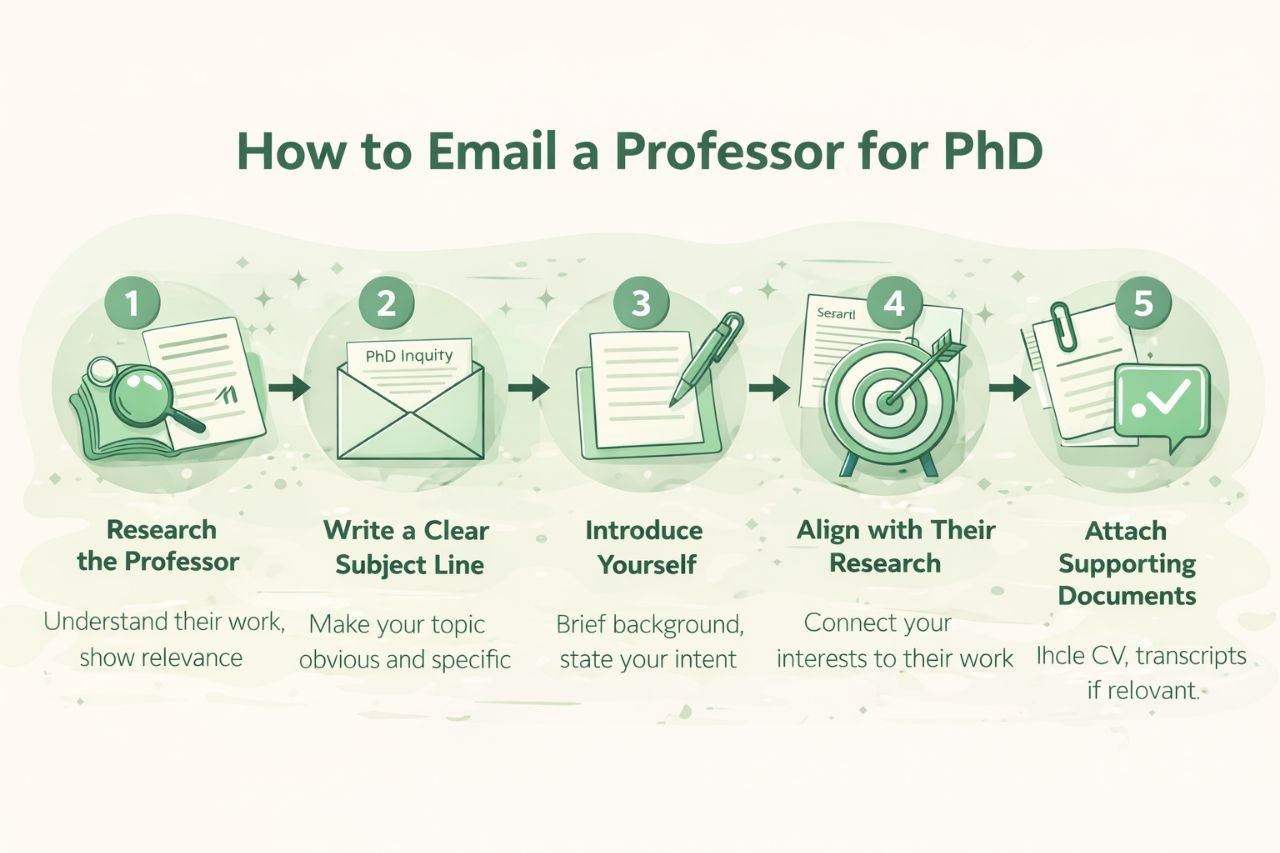
Step-by-Step Guide to Emailing a Professor
Step 1: Research the professor before you write a single word
Skipping this step is the single biggest reason emails get ignored. Before you open a blank draft:
Read at least 2–3 of their recent publications, not just the abstract
Understand where their current research is actually heading — not just their general field
Figure out exactly how your background connects to that specific direction
Pro tip: Mentioning one specific paper or project can be the difference between a reply and silence. Acatrix helps you find and summarize the relevant research in minutes instead of hours. Start now →
Step 2: Write a subject line that actually gets opened
Your subject line decides whether the rest of your email gets read at all. Keep it specific, not generic:
"Prospective PhD student – interest in [research area]"
"Inquiry about PhD opportunities in [field]"
"Research interest in [specific topic]"
Step 3: Open with a strong, clear introduction
In your first 2–3 lines, a professor should immediately know who you are, where you stand academically, and why you're writing. No warm-up needed.
Example: "I am a Master's graduate in Computer Science with a strong interest in machine learning, and I am writing to inquire about potential PhD opportunities in your research group."
Step 4: Show real alignment with their research
This is the part that separates a real email from a template. Don't just say you're interested, explain what specifically caught your attention, how it connects to your own background, and why their lab, out of every lab, is the one you're writing to.
Step 5: Briefly show what you bring to the table
You don't need a full CV in the email body. A couple of lines highlighting your academic background, relevant research experience, and key skills is enough to make your case.
Step 6: End with one clear, respectful ask
Don't leave the professor guessing what happens next. Close with something simple and specific, asking if they're currently accepting students, or requesting a short conversation.
Step 7: Attach the right supporting documents
Keep this light. Usually, a CV is enough. Transcripts or a short research summary can be added if they're genuinely relevant, but don't overload the email with attachments.
Not sure if a CV even belongs in this first email? Our guide on should you attach your CV in the first email to a professor breaks down exactly when it helps and when it's better left out.
Acatrix is an AI-powered application system that helps you navigate every step of your academic journey from research and writing to interviews and final decisions.
Sample Email to Professor for PhD
Example:
Subject: Prospective PhD Student – Interest in AI Research
Dear Professor [Last Name],
I hope this message finds you well. My name is [Your Name], and I recently completed my Master’s degree in [Field] at [University].
I am particularly interested in your work on [specific research topic], especially your recent paper on [mention briefly]. My background in [your experience] aligns closely with this area, and I would be very interested in contributing to your research group.
I would like to ask if you are currently accepting PhD students or if there may be opportunities to collaborate.
I have attached my CV for your review.
Thank you for your time and consideration.
Best regards,
[Your Name]
Once you've got the structure down, the real skill is turning it into a message that sounds like you, not a template. Our guide on how to write a cold email to a professor walks through exactly how to do that, with real examples.
Common Mistakes to Avoid
Most rejected or worse, ignored, emails aren't rejected because the applicant wasn't qualified. They fail because of small, avoidable mistakes that are easy to fix once you know to look for them:
Writing a generic email that could be sent to any professor, in any department, at any university
Making it too long, burying the actual point somewhere in paragraph three
Never mentioning the professor's work, which is the fastest way to signal this email wasn't really about them
Being unclear about what you actually want, leaving the professor unsure whether to reply at all
None of these mistakes come from a lack of effort, usually the opposite. Most applicants care a lot and end up overwriting, over-explaining, or trying to sound impressive instead of clear. Fixing this is less about writing more, and more about cutting down to what actually matters.
Want the full breakdown, with real examples of what to avoid? Our guide on 5 mistakes to avoid when emailing professors goes deeper into each one.
Start Writing Emails That Get Responses
Stop guessing what works. Start building emails that actually open opportunities.
Generate Your Academic Email With Acatrix
What to Do If You Don't Get a Response
Silence is far more common than rejection, and it rarely means what applicants assume it means. Professors are busy, inboxes get buried, and a missed email doesn't automatically mean "no." Here's how to handle it without overthinking it:
Give it 7–10 days before doing anything. Reaching out again too soon can come across as impatient rather than interested.
Send one polite follow-up, not a string of them. A single, well-timed nudge is usually all it takes.
Keep it short and professional — a line or two is enough. This isn't the moment to repeat your entire first email.
Most applicants either give up too early or follow up in a way that feels pushy. Neither helps. A calm, well-timed follow-up is often what actually gets the reply the first email didn't.
Timing matters even before you send that first email, not just when you're following up, our guide on the best time to contact a professor for PhD breaks down when your message is most likely to actually get read.
How Acatrix Helps You Write Better Academic Emails
Writing a great email to a professor isn't really about grammar or polish, it's about positioning yourself as someone worth replying to. That's a harder skill than it sounds, especially when you're doing it for the fifth or sixth professor in a row.
This is where Acatrix comes in. Instead of starting from a blank page every time, it helps you:
Generate tailored academic emails based on the professor's actual research, not a generic template
Align your email with your CV and research goals, so every message sounds consistent with who you are
Catch the common mistakes before they cost you a reply
Send emails that are genuinely more likely to get a response — because they're built around fit, not just formatting
You still sound like you. Acatrix just makes sure the email actually reflects the work you've already put in.
How ACATRIX Supports Your Complete PhD Application
Your SOP is only one part of a successful PhD application. You may also need to identify suitable opportunities, research potential supervisors, review relevant papers, prepare your CV, contact professors, prepare for interviews, and keep track of multiple deadlines.
ACATRIX brings these steps together through its AI-powered Application Assistant, helping you manage your academic application journey from opportunity discovery through application preparation and follow-up.
This is particularly useful when you are applying to multiple programs and need to keep each application organized and appropriately customized.
Build Your Application!
This module is part of the Acatrix Application System, which also includes:
Research Statement & SOP Drafting
For a complete step-by-step guide, learn how to use Acatrix for academic applications and manage everything from finding opportunities to preparing your documents and interviews.
Read More about Academic Apply
1. What Should I Put in a PhD Email Subject Line?
2. 10 PhD Email Examples: Accepted vs. Ignored (2026)
3. Acatrix vs. ChatGPT: Which AI Tool Is Better for Applications?
4. How to Make Your SOP More Specific and Personal
5. Personal Statement vs SOP: What’s the Difference?
7. How to Turn Any Research Paper into a High-Quality Summary in Minutes
8. 5 Red Flags in a Graduate Application
9. AI in Academic Applications: Boost or Risk?
10. What If You Don’t Know the Answer to a Question in a PhD Interview?
Frequently Asked Questions (FAQ)
1. How long should my email to a professor be?
Keep it between 150–250 words. Professors skim before they read, so a short, well-structured email performs far better than a long, detailed one.
2. Should I attach my CV in the first email?
Usually yes, but not always. If your email is strong on its own and the program doesn't expect one upfront, it can sometimes be left for a follow-up instead of the first message.
3. How many professors should I email?
Reach out to multiple professors, but personalize every single email. Sending the same message to five people in the same department is easy to spot.
4. What if I don’t have research experience?
Focus on what you do have coursework, relevant projects, technical skills, and a clear sense of why their research interests you. Motivation and fit matter more than a long CV.
5. When should I follow up?
Wait 7–10 days. A short, polite follow-up is completely normal and won't hurt your chances, silence rarely means rejection.
6. What's the single biggest reason these emails get ignored?
Sounding generic. If the email could be sent to any professor without changing a word, it usually gets treated that way, skimmed and skipped.
7. Should I mention funding in my first email?
Not usually. Lead with your research interest and fit first. Funding is a better fit for a follow-up conversation once there's real interest on both sides.