
How to Prepare for an Academic Interview (Complete Guide)
Academic interviews are one of the most important stages in the application process for PhD programs and research positions.
This is your opportunity to demonstrate not only your knowledge, but also your motivation, communication skills, and fit with the research group.
Many candidates underestimate this stage and focus only on their CV or application documents. However, even strong applicants can fail if they are not properly prepared for the interview.
This guide of Acatrix will walk you through everything you need to know about academic interviews, from understanding what to expect to answering questions effectively and avoiding common mistakes.
You can use Acatrix’s interview preparation tools to simulate real academic interviews, practice personalized questions, and improve your answers through continuous feedback, helping you prepare more effectively and with greater confidence.
What Is an Academic Interview?
An academic interview is a structured conversation between you and a professor, admissions committee, or research team. Its purpose is to assess your academic background, research potential, motivation, and overall fit for the position.
Strong interview preparation can significantly influence your first impression. It helps you communicate your experience clearly, demonstrate confidence, and present your academic profile in a structured and compelling way from the very beginning. Learn more about how interview preparation shapes first impressions.
Types of Academic Interviews
1. PhD Interviews
Focused on:
Research interests
Academic background
Long-term goals
2. Research Position Interviews
Focused on:
Technical skills
Project experience
Collaboration ability
3. University Admission Interviews
Focused on:
Motivation
Communication skills
Overall profile
Ready to ace your academic interview?
Practice personalized mock interviews with ACATRIX and prepare for the questions that matter most.
What Makes Academic Interviews Different from Other Interviews
Most interview advice is written for job seekers. Academic interviews, whether for a PhD program, a postdoc position, or a scholarship, operate by completely different rules.
In a corporate interview, you are evaluated on your ability to fit into an existing role. In an academic interview, you are evaluated on your potential to contribute to original research, your intellectual independence, and your ability to think critically under pressure.
The committee is not just asking: "can this person do the job?"
They are asking "is this the person we want to work with for the next four to six years?"
That distinction changes everything about how you should prepare.
A strong first impression in an academic interview is not about being polished or rehearsed. It is about demonstrating genuine intellectual curiosity, clear research direction, and the confidence that only comes from knowing your own work inside and out.
What Interviewers Actually Evaluate in an Academic Interview
Evaluation Area | What Interviewers Are Looking For |
|---|---|
Research Clarity | Clear definition of interests, questions, and scope |
Academic Fit | Alignment with supervisor, lab, or department |
Critical Thinking | Ability to analyze, justify, and defend ideas |
Methodological Awareness | Understanding of research methods and limitations |
Communication Skills | Clear, structured academic explanations |
Motivation | Realistic and credible academic goals |
For a complete breakdown of the mistakes that cost candidates their offer, read our guide on the most common PhD interview mistakes.
What Professors Look For in an Interview?
Clear understanding of your field
Ability to explain your research
Genuine interest in the position
Communication skills
Critical thinking
To walk in fully prepared, make sure you also know the top 10 most common PhD interview questions professors ask in 2026, so no question catches you off guard.
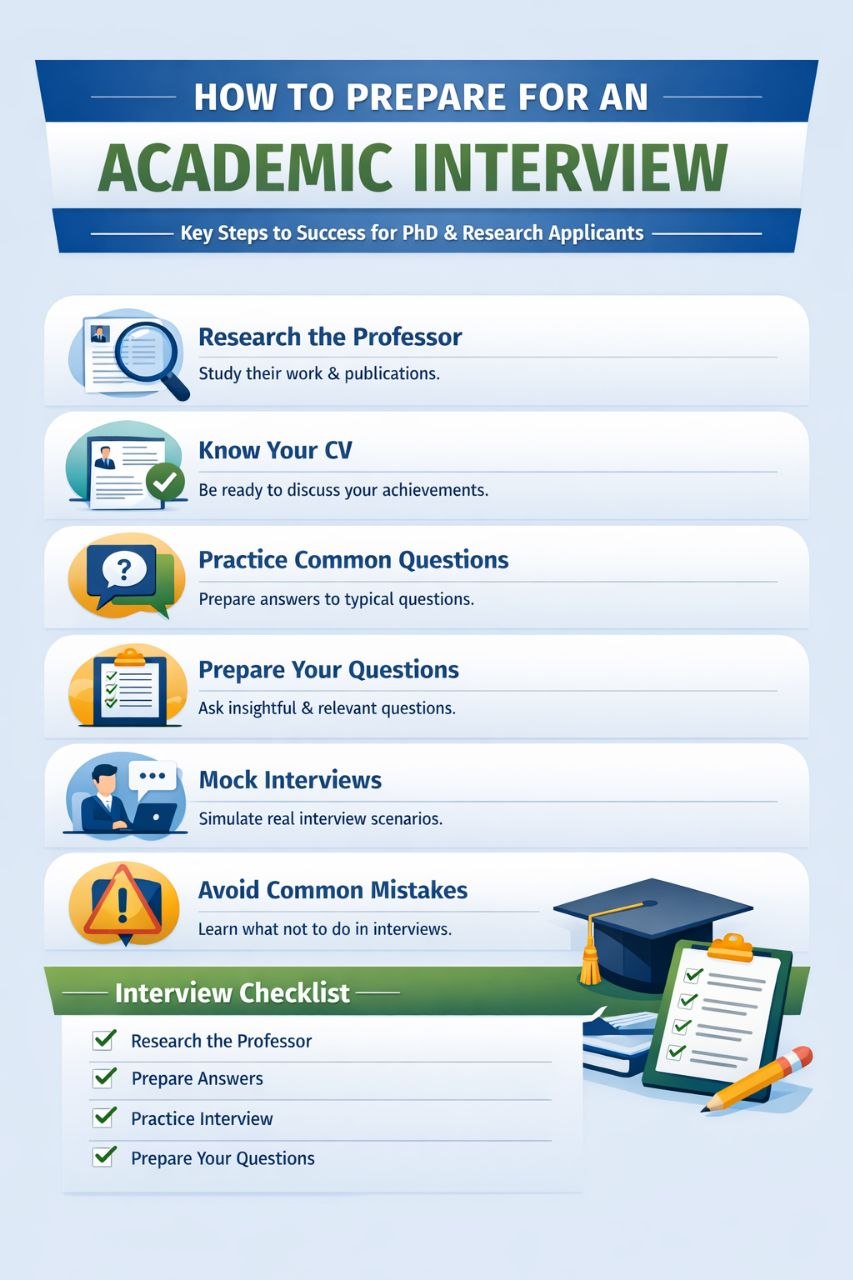
How to Prepare for a PhD Interview: A Step-by-Step Checklist
Strong first impressions do not happen by accident. Here is exactly what you should do before walking into your academic interview:
Read at least two recent publications from your target supervisor
Prepare a two-minute summary of your research background
Practice answering "Why this lab?" and "What are your future research goals?"
Prepare three thoughtful questions to ask the committee
Run at least two full mock interview sessions out loud
Review your SOP and CV the night before know every line
Plan your outfit, route, and timing the day before
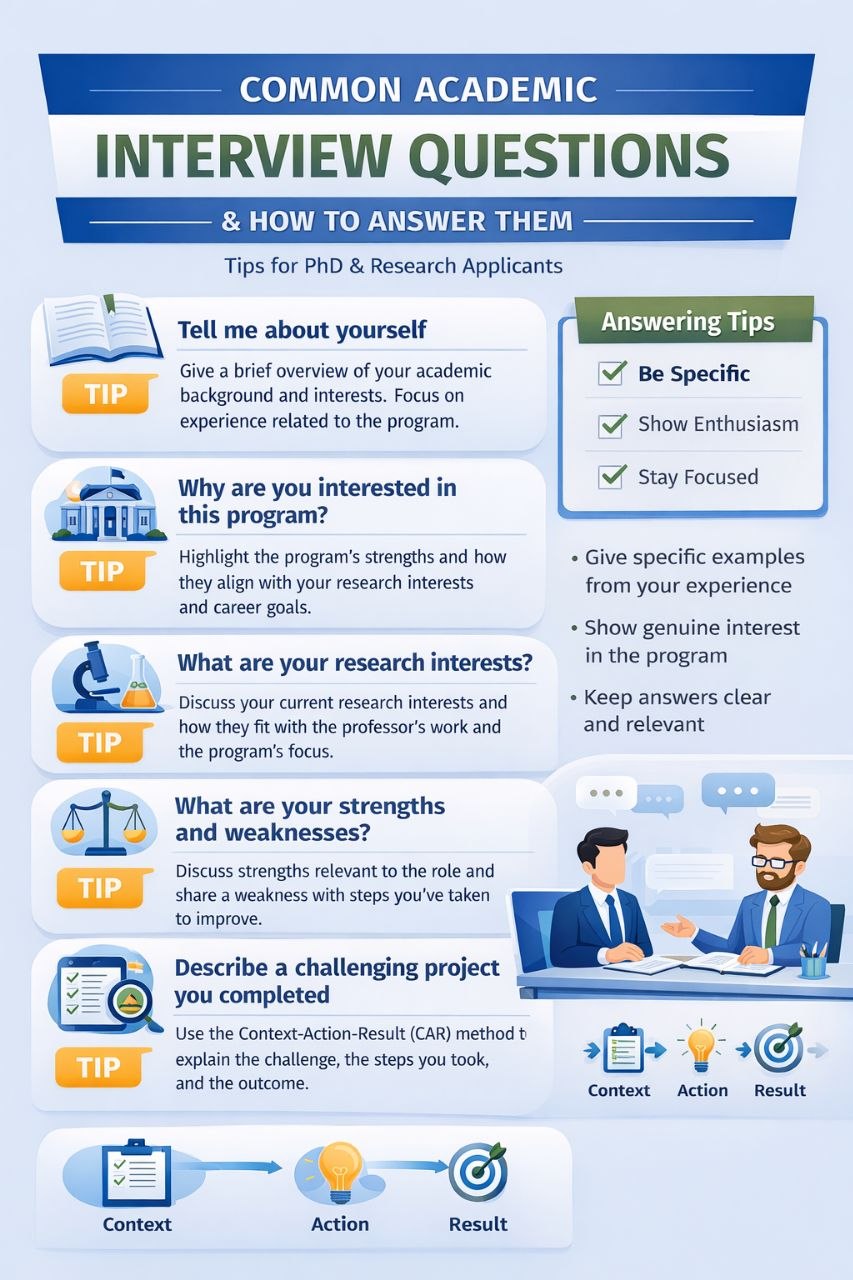
Common Academic Interview Questions
Question | What They Want to Know |
|---|---|
Tell me about yourself | Your academic story |
Why this program? | Your motivation |
What are your research interests? | Alignment |
What are your strengths? | Self-awareness |
What are your weaknesses? | Honesty |
Ready for Your Academic Interview?
Preparing for an academic interview is more than knowing what to say, it’s about being confident, clear, and ready to think on your feet.
With Acatrix, you can practice with personalized mock interviews based on your academic background and target position, improve your answers, and prepare for the questions that matter most.
Don’t wait until the real interview to start practicing.
Start Your Interview!
Step-by-Step Preparation for an Academic Interview
1. Analyze the Interview Type
Academic interviews vary depending on purpose:
Master’s admission interviews
PhD supervisor interviews
Scholarship or fellowship interviews
Research assistant or academic position interviews
2. Prepare Your Research Narrative
You must be able to explain your academic profile as a coherent story, not disconnected achievements. Prepare clear answers to:
What problem interests you academically?
Why does it matter?
What have you done so far?
What do you want to explore next?
3. Study the Supervisor and Department
Before any academic interview, review:
Recent publications of the interviewer
Current research projects
Departmental focus areas
Funding structures and collaborations
4. Prepare for Common Academic Interview Questions
Typical academic interview questions include:
Why do you want to pursue this program?
What are your research interests?
Why this university or supervisor?
What methodologies are you familiar with?
What challenges did you face in previous research?
What are your long-term academic goals?
5. Practice Academic Communication (Not Memorization)
An academic interview tests how you think aloud. Focus on:
Logical structure (problem → method → outcome)
Clear definitions
Avoiding unnecessary jargon
Admitting uncertainty professionally
Over-rehearsed answers often sound shallow.
No matter how well you prepare, nerves can still get in the way, which is why knowing how to stop feeling nervous before academic interviews is just as important as knowing your research.
Academic Interview Preparation Area
Academic Interview Preparation Area | What the Interview Panel Evaluates |
|---|---|
Research Interest Definition | Ability to clearly and logically explain research focus and motivation |
Supervisor & Department Knowledge | Familiarity with recent publications, projects, and research direction |
Methodological Readiness | Understanding of research methods, tools, and their limitations |
Response Structure | Clear, analytical, and well-organized answers to questions |
Academic Communication Skills | Precise, professional, and confident academic language |
Long-Term Academic Goals | Realistic and credible academic and research trajectory |
Meet Your Application Assistant, helping you navigate every step of your academic journey, from finding the right opportunity to preparing for the interview.
How to Stand Out in an Academic Interview
To differentiate yourself:
Ask thoughtful, research-based questions
Connect your interests to existing projects
Show adaptability and openness to feedback
Demonstrate long-term academic commitment
First impressions start before you say a word, find out exactly what to wear to a PhD interview to make sure your appearance works in your favor from the moment you walk in.
After the Academic Interview: What to Do Next
After your academic interview:
Reflect on weak answers
Prepare for follow-up communication
Send a concise professional thank you email (if appropriate)
Be ready for second-round interviews
Knowing how long PhD interviews usually last helps you pace your answers, manage your energy, and avoid the mistake of rushing through responses that deserve more depth.
Common First Impression Mistakes in Academic Interviews
Even well-prepared candidates make avoidable mistakes in the first few minutes of an academic interview.
The most damaging ones are not obvious they are subtle signals that quietly undermine credibility before you have even answered your first question.
Arriving without knowing the supervisor's current research focus sends an immediate signal of low motivation.
Giving a vague or unfocused answer to "tell me about yourself" wastes the most valuable moment of the interview.
Failing to make eye contact or speaking too quietly signals a lack of confidence, regardless of how strong your qualifications are.
Knowing how long PhD interviews usually last helps you pace your answers, manage your energy, and avoid the mistake of rushing through responses that deserve more depth.
Common Mistakes to Avoid
Not researching the professor
Giving generic answers
Lack of preparation
Overconfidence or nervousness
Poor communication
Prepare for Your Interview with Acatrix
Preparing alone can be difficult. Acatrix helps you simulate real interview scenarios and improve your performance through structured practice.
With Acatrix, you can:
Practice personalized interview questions
Simulate real interview conditions
Improve your answers with feedback
Practice multiple times without limits
Everything You Need for Academic Applications in One Place
Whether you are preparing your SOP, contacting professors, practicing interviews, or tracking multiple university applications, Acatrix brings your entire academic application workflow into one structured system designed for students, researchers, and PhD applicants worldwide.
Start Your Interview!
If you want to get the most out of every tool available to you, check out the complete guide to using Acatrix for academic applications from interview prep to application tracking, all in one place.
Related Guides for Academic Applications
1. Pros and Cons of writing SOP with AI
2. Best Way to Track Multiple University Applications Without Missing Deadlines
3. How to Write a Successful CV
4. How to Write an Academic Email
5. Application Tracking System for Academic Applications
6. Top Personal Statement Mistakes and How to Avoid Them
7. How to Write a Follow-Up Email to a Professor After No Response
Frequently Asked Questions
1. How long should I prepare for an academic interview?
Ideally, you should begin preparing at least one to two weeks before your interview. This gives you enough time to research the professor or institution, review your academic background, practice common questions, and refine your answers through multiple mock sessions.
2. What are the most common academic interview questions?
Most academic interviews include questions about your academic background, research interests, motivation for applying, future goals, and your understanding of the professor’s research area. You may also be asked to explain previous projects or discuss how your experience aligns with the position.
3. How can I make a strong first impression during an academic interview?
A strong first impression comes from being prepared, confident, and professional. Clear communication, thoughtful answers, familiarity with the position, and genuine enthusiasm for the research opportunity can significantly influence how you are perceived.
4. Is it acceptable to take notes in the interview?
Yes, especially for online interviews. Having brief notes about the professor’s research, key talking points, or prepared questions can be helpful. However, avoid reading directly from your notes, as this can make your responses feel unnatural.
5. What should I do if I do not know the answer to a question?
It is better to respond honestly than to guess. You can acknowledge the gap in your knowledge and explain how you would approach finding the answer. This demonstrates critical thinking and intellectual honesty, both of which are highly valued in academic settings.
6. How important is researching the professor before the interview?
It is extremely important. Demonstrating familiarity with the professor’s recent publications, projects, and research direction shows initiative and genuine interest. It also allows you to explain more effectively how your background aligns with their work.
7. How can mock interviews improve my performance?
Mock interviews help you become more comfortable answering challenging questions under pressure. They improve clarity, confidence, response structure, and overall communication skills, allowing you to perform more naturally and effectively during the real interview.