
Why Preparation Is the Key to Academic Interview Success
Getting an academic interview invitation is exciting, but it can also be overwhelming. Whether you are applying for a PhD program or a postdoc position, the interview is often the final and most critical step in the selection process. Your CV and SOP got you to this point. Now, your performance in the interview determines whether you get the offer.
The difference between candidates who succeed and those who don't often comes down to one thing: preparation. That's exactly what Acatrix was built for to help academic applicants prepare smarter, not harder.
Specifically, personalized preparation means practicing the right questions, in the right format, tailored to your specific position and background. If you want a full overview of the process, check out our complete guide on academic interview preparation. In this article, we focus on one of the most powerful methods: mock interviews.
Get Started For Free!
What to Expect in a PhD vs. Postdoc Interview
Not all academic interviews are the same. Understanding the differences between a PhD and a postdoc interview helps you prepare more effectively.
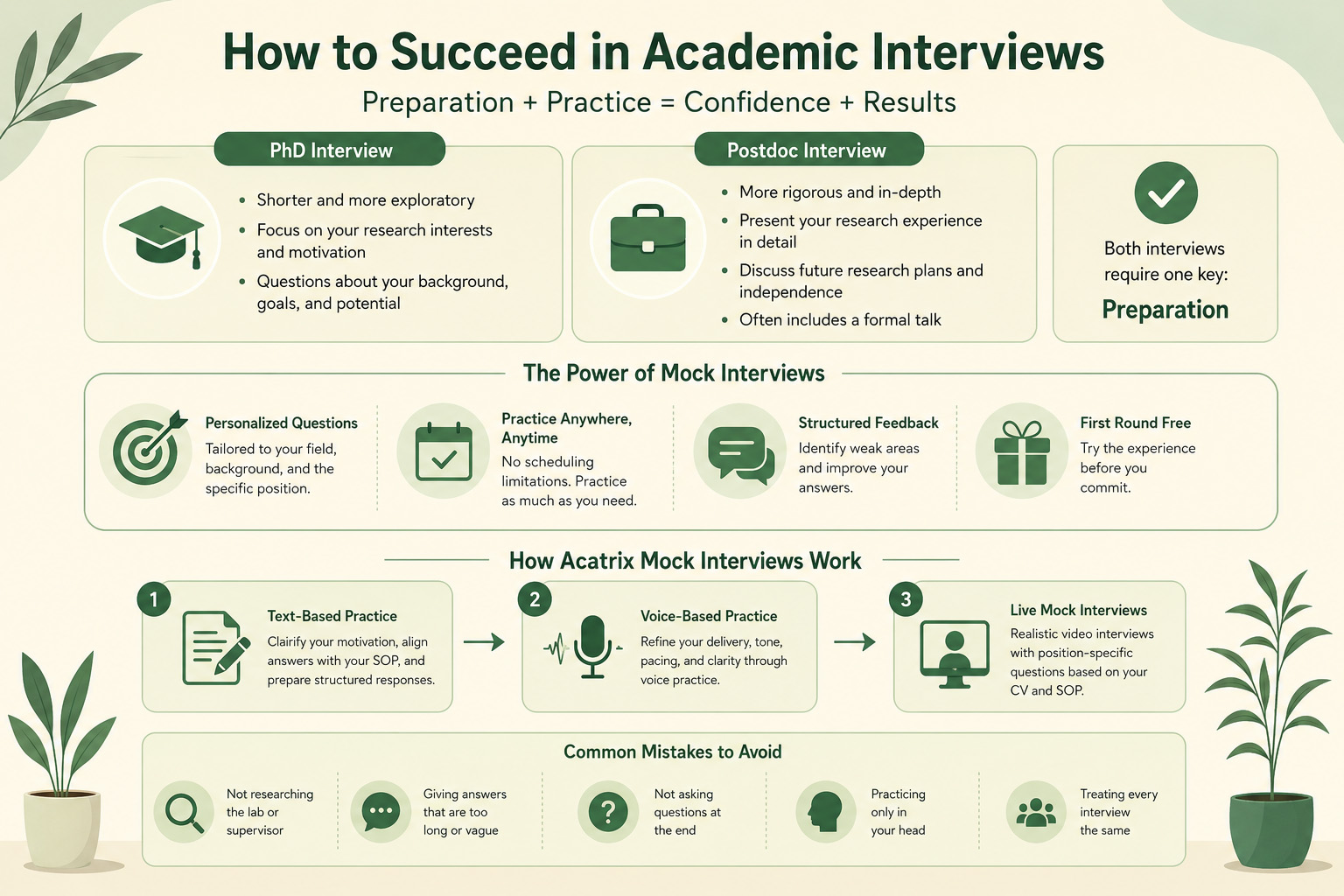
A PhD interview is typically shorter and more exploratory. The committee wants to understand your research interests, your motivation for pursuing a doctorate, and whether you are a good fit for the program. Expect questions about your background, your goals, and your ability to think critically.
A postdoc interview, on the other hand, is more rigorous. You are expected to present your previous research in depth, discuss your future research plans, and demonstrate that you can work independently. In many cases, you will also be asked to give a formal talk to the lab or department.
Despite these differences, both interviews share one common challenge: most candidates underestimate how much preparation they require.
How to Practice for Academic Interviews with Mock Sessions
Knowing what to expect is not enough! You need to practice out loud, under realistic conditions, and with feedback tailored to your specific background and target position.
This is where mock interviews make the biggest difference. Research shows that candidates who practice with realistic, personalized questions perform significantly better than those who only read about interview techniques. Understanding how your interview preparation shapes the first impression you make is the first step toward building real confidence.
Acatrix offers an AI-powered mock interview system designed specifically for PhD and postdoc applicants. Here's what makes it different from generic interview tools:
Questions are tailored to your field, academic background, and the specific position you're applying for:
You can practice as many times as needed, without scheduling limitations
You receive structured feedback to identify weak areas and refine your answers
The first round is completely free, so you can test the experience before committing
Unlike traditional coaching sessions that are expensive and time-limited, this approach lets you build confidence at your own pace, on your own schedule.
Before your interview day, make sure you also know what to wear to a PhD interview because first impressions start before you say a word.
How Acatrix Shapes Personalized Mock Interviews?
1. Personalized Text-Based Practice
Acatrix guides you in clarifying your motivation, aligning your answers with your SOP, and preparing structured responses. This foundational stage ensures you can confidently answer questions specific to your target position.
2. Personalized Voice-Based Practice
Once your responses are structured, voice practice helps you refine delivery, tone, pacing, and clarity ensuring your spoken answers are professional and engaging.
3. Personalized Live Mock Interviews
Acatrix offers live video mock interviews that simulate real professors or evaluators. Every question is position-specific, tailored to your CV, SOP, and the role you are applying for. This makes practice realistic and results-oriented.
Get Started For Free!
Common Mistakes to Avoid in Academic Interviews
Even well-prepared candidates make avoidable mistakes that cost them the offer. Here are the most common ones:
1. Not researching the lab or supervisor
Walking into an interview without knowing the PI's recent publications or the lab's current research direction is one of the fastest ways to lose credibility. Before any interview, read at least two or three recent papers from your target supervisor and be ready to discuss them.
2. Giving answers that are too long or too vague
Academic candidates often over-explain. Committees want clear, focused answers — not a full lecture. Practice keeping your responses concise without losing depth.
3. Not asking questions at the end
Saying "I have no questions" signals a lack of genuine interest. Always prepare two or three thoughtful questions about the research direction, lab culture, or next steps.
4. Practicing only in your head
Reading about interview questions is not the same as answering them out loud. Your voice, pacing, and confidence under pressure only improve through actual practice — which is exactly what mock interviews are designed for.
5. Treating every interview the same
A PhD interview and a postdoc interview require different approaches. So does an interview for a lab in your exact field versus one in a related area. Generic preparation leads to generic answers.
If nerves are holding you back, learning how to stop feeling nervous before academic interviews is a great place to start before your first mock session.
Preparation Is What Separates Good Candidates from Great Ones
An academic interview is not just a formality. For most PhD and postdoc positions, it is the moment where everything comes together, your research background, your communication skills, and your ability to think under pressure.
The candidates who succeed are not always the most qualified on paper. They are the ones who prepared specifically, practiced repeatedly, and walked in knowing exactly what to expect.
Whether you are days away from your first PhD interview or preparing for a competitive postdoc position, the time you invest in structured, personalized practice will directly impact your result.
Start with a free mock interview on Acatrix and experience the difference that targeted preparation makes.
Get Started For Free!
Everything You Need for Academic Applications in One Place
Whether you are preparing your SOP, contacting professors, practicing interviews, or tracking multiple university applications, Acatrix brings your entire academic application workflow into one structured system designed for students, researchers, and PhD applicants worldwide.
Start Today!
Related Guides for Academic Applications
1. Personal Statement vs SOP: What’s the Difference?
2. Best Way to Track Multiple University Applications
3. How to Write a Follow-Up Email to a Professor After No Response
4. Why Professors Don’t Reply to Emails
5. How to Turn Any Research Paper into a High-Quality Summary in Minutes
6. Top Personal Statement Mistakes and How to Avoid Them
Frequently Asked Questions
1. What is the difference between a PhD interview and a postdoc interview?
A PhD interview focuses on your research interests, motivation, and academic potential. A postdoc interview is more rigorous — you are expected to present your previous research in depth, discuss future plans, and often give a formal talk to the lab or department.
2. How long should I prepare for an academic interview?
Ideally, start at least two to three weeks before your interview. Use the first week to research the lab and position, the second week to practice answers out loud, and the final days to do full mock interview sessions.
3. What questions are asked in a PhD interview?
Common questions include: Why do you want to pursue a PhD? What are your research interests? What is your biggest academic achievement? How do you handle failure or setbacks in research?
4. How can I practice for an academic interview on my own?
The most effective method is mock interviews practicing with realistic questions tailored to your specific field and position. Acatrix offers AI-powered mock interview sessions that simulate real academic interviews and provide structured feedback.
5. Is one mock interview enough to prepare?
No. Confidence and fluency under pressure come from repeated practice. Most successful candidates do multiple sessions, focusing on different question types each time.