
How to Reply to a Professor’s Email: 10 Common Scenarios & Examples
Getting an email from a professor is an important step in your academic journey. But knowing how to reply can be just as important as writing the first email.
A professor might ask for your CV, invite you to an interview, discuss potential PhD supervision, or explain that they currently have no available positions. Each situation requires a different response.
Your reply should be professional, clear, and relevant to the professor’s message. It should also make the next step easy for both of you.
If you are still learning the basics of academic communication, start with our guide on how to write an academic email. It explains the structure, tone, and essential elements of a professional email to a professor.
In this guide of Acatrix, you will find 10 common situations with practical email examples. You will also learn what to include, what to avoid, and how to respond without sounding too formal or too casual.
How Should You Reply to a Professor’s Email?
Before writing your reply, read the professor’s message carefully. Identify what they expect from you. Are they asking a question, requesting a document, suggesting a meeting, or simply acknowledging your interest?
A good academic email reply should generally include five elements:
A professional greeting: Address the professor using their appropriate academic title and last name.
An acknowledgment: Thank them for their message or the information they shared.
A direct response: Answer their question or address their request clearly.
Relevant details: Include any documents, dates, or information they need.
A polite closing: Thank them again and use an appropriate sign-off.
For example:
"Dear Professor [Last Name],
Thank you for your response. I appreciate your time and the opportunity to discuss potential research opportunities in your group.
I would be happy to provide any additional information you may need.
Best regards,
[Your Full Name]"
Keep your reply focused. You do not need to repeat your entire academic background if the professor already has your CV or previous email. The goal is simple: respond to the message, show professionalism, and move the conversation forward.
If you haven't received a response from a professor, knowing when and how to follow up is just as important as writing your initial email. Learn how to write a follow-up email to a professor after no response to increase your chances of continuing the conversation professionally.
How to Reply When a Professor Shows Interest in Your PhD Application
A positive response from a potential supervisor is encouraging. The professor may express interest in your research background, ask about your plans, or suggest discussing a possible PhD opportunity.
Your reply should acknowledge their interest and show that you are genuinely interested in continuing the conversation. Avoid sounding overly excited or making assumptions about admission. A positive email does not necessarily mean you have been accepted.
Email Example:
Subject: Re: PhD Opportunities in [Research Area]
Dear Professor [Last Name],
Thank you very much for your positive response. I am glad to hear that my research interests align with your group's work.
I would be very interested in exploring potential PhD opportunities under your supervision. My previous experience in [specific research area] has strengthened my interest in [related research topic], and I would welcome the opportunity to discuss how my background could contribute to your research group.
Please let me know if there is any additional information or documentation I can provide.
Thank you again for your time and consideration.
Best regards,
[Your Full Name]
Why This Reply Works
It acknowledges the professor's interest.
It reinforces your research motivation.
It does not assume that you have received an offer.
It encourages further communication.
Practical Tip: If the professor mentions a specific project, refer to it in your reply. A relevant detail makes your response more personal and meaningful.
Before sending your reply, make sure you are not repeating common communication mistakes. Read our guide on 5 mistakes to avoid when emailing professors for research positions to make your academic emails more professional and effective.
How to Reply When a Professor Requests Your CV or Additional Documents
Professors may ask for your CV, academic transcripts, publications, research statement, or other supporting documents after reviewing your initial email.
In this situation, respond promptly and attach exactly what they requested. Do not send unnecessary files. If a document is not ready, explain when you expect to provide it.
Email Example:
Subject: Re: PhD Inquiry – Requested Documents
Dear Professor [Last Name],
Thank you for your response and for considering my inquiry.
As requested, I have attached my updated CV and academic transcripts for your review.
I would also be happy to provide additional information about my previous research experience or academic background if needed.
Thank you for your time. I look forward to hearing from you.
Best regards,
[Your Full Name]
What If You Need More Time to Prepare the Documents?
Do not ignore the request while preparing your files. Send a short acknowledgment and provide a realistic timeline.
For example: "Thank you for your message. I am currently preparing the requested research statement and expect to send it by [date]. I appreciate your patience."
Before Sending Your Reply:
Check that every requested document is attached.
Use clear file names, such as
FirstName_LastName_CV.pdf.Make sure the files open correctly.
Confirm that the attachments contain the correct information.
How to Reply to a Professor Who Invites You to an Interview
An interview invitation is a meaningful step in the PhD application process. It gives you an opportunity to discuss your academic background, research interests, and potential fit with the professor's group.
Your reply should confirm your interest and availability. If the professor suggests a specific date and time, confirm whether it works for you. If it does not, offer a few alternatives.
Email Example:
Subject: Re: Invitation to Discuss PhD Opportunities
Dear Professor [Last Name],
Thank you very much for your invitation. I would be delighted to have the opportunity to discuss my research background and potential PhD opportunities with you.
The proposed time, [Date and Time], works well for me.
I look forward to our conversation and learning more about your research group.
Thank you again for your consideration.
Best regards,
[Your Full Name]
What If You Are Not Available at the Suggested Time?
Be polite and suggest alternatives instead of simply declining.
Alternative Example:
"Unfortunately, I have a prior commitment at the proposed time. However, I would be available on [Alternative Date] or [Alternative Date]. Please let me know if either option would be convenient for you."
What Should You Do After Confirming the Interview?
Once the meeting is scheduled:
Review the professor's recent publications.
Prepare a short explanation of your research experience.
Understand the research group's current projects.
Prepare thoughtful questions about the position and supervision.
Test your internet connection if the interview is online.
Seeing real examples can help you understand what makes academic communication effective. Explore these 10 PhD email examples that compare accepted vs. ignored emails to learn how to make your messages clearer, more relevant, and more engaging to professors.
How to Reply When a Professor Asks About Your Research Interests
Sometimes, a professor may ask you to explain your research interests in more detail. This is an opportunity to demonstrate that you understand their work and have a clear academic direction.
Avoid sending a long explanation of everything you have studied. Focus on two or three relevant research interests and explain how they connect to the professor's work.
Email Example:
Subject: Re: Research Interests and Potential PhD Supervision
Dear Professor [Last Name],
Thank you for your response and for your interest in my academic background.
My primary research interests are in [Research Area 1] and [Research Area 2], particularly [Specific Research Topic].
During my previous studies at [University Name], I worked on [Brief Description of Research Experience]. This experience helped me develop skills in [Relevant Methods or Technical Skills].
I am particularly interested in your research on [Specific Topic or Publication], as it closely relates to my academic interests and future research goals.
I would be grateful for the opportunity to discuss potential research directions within your group.
Best regards,
[Your Full Name]
How Can You Make This Reply Stronger?
Mention a specific publication, methodology, or project from the professor's research group.
For example, instead of saying: "I am interested in your research."
Write: "I was particularly interested in your recent work on machine learning applications in medical imaging, especially its approach to improving diagnostic accuracy."
How to Reply When a Professor Asks About Your Funding or Financial Situation
Funding is an important part of many international PhD applications. A professor may ask whether you have external funding, whether you need financial support, or whether you can apply for a scholarship. Be honest and direct. Do not claim that you have funding if you have not secured it.
If you need financial support, explain your situation professionally and ask whether funded opportunities are available.
Email Example:
Subject: Re: PhD Opportunity and Funding Availability
Dear Professor [Last Name],
Thank you for your response and for providing information about the potential PhD opportunity.
Regarding funding, I would require financial support to pursue doctoral studies. I would therefore be interested in learning whether there are any funded PhD positions, research assistantships, or scholarship opportunities available within your group or department.
I would also be happy to explore relevant external funding opportunities if applicable.
Thank you again for your time and consideration.
Best regards,
[Your Full Name]
What If You Already Have External Funding?
Make that clear in your reply.
For example: "I currently hold a [Scholarship Name] scholarship that covers [Tuition/Living Expenses]. I would be happy to provide further details about the funding arrangement if needed."
Important: Funding arrangements differ across universities and countries. Some PhD positions include a salary, while others rely on scholarships or external grants. Ask for clarification about the specific position rather than assuming all opportunities follow the same structure.
If you are still at the beginning of your academic outreach journey, learning how to write a cold email to a professor can help you make a strong first impression and start meaningful academic conversations.
How to Reply When a Professor Says They Are Not Accepting New PhD Students
Not every response leads to an immediate opportunity. A professor may explain that they are not accepting new students, have no available funding, or cannot supervise additional candidates.
The best approach is to thank them and maintain a professional relationship. If their research is still relevant to your interests, you can politely ask whether they recommend another researcher or expect to have openings in a future application cycle.
Email Example:
Subject: Re: Inquiry About PhD Opportunities
Dear Professor [Last Name],
Thank you for letting me know. I appreciate your time and consideration.
Although I understand that there are currently no available PhD positions in your group, I remain interested in your research area.
If possible, I would be grateful if you could recommend another faculty member or research group that may be looking for prospective PhD students with a similar background.
Thank you again for your helpful response. I wish you and your research group continued success.
Best regards,
[Your Full Name]
Should You Ask About Future Opportunities?
Yes, if the professor's response suggests that they may accept students in the future.
You can add: "If you expect to have any PhD openings in the next application cycle, I would appreciate it if you could let me know."
Do not pressure the professor to reconsider their decision. A respectful reply leaves a better impression and keeps the possibility of future contact open.
How to Reply When a Professor Refers You to Another Researcher
A professor may not be accepting students but might recommend another faculty member, colleague, or research group.
This is a valuable opportunity. Thank the professor for the recommendation and, if appropriate, ask whether you may mention their name when contacting the suggested researcher.
Email Example:
Subject: Re: PhD Opportunities and Research Group Recommendation
Dear Professor [Last Name],
Thank you very much for your helpful suggestion and for recommending Professor [Recommended Professor's Name].
I appreciate your guidance. I will review their research and explore whether my academic background aligns with their work.
Would it be appropriate for me to mention that you recommended I contact them?
Thank you again for your time and assistance.
Best regards,
[Your Full Name]
What Should You Do Next?
Before contacting the recommended professor:
Review their research interests and recent publications.
Identify a specific connection between their work and your background.
Mention the referral, if you have permission.
Adapt your original email to the new professor.
Timing can play an important role in academic communication. Before reaching out to a potential supervisor, learn about the best time to contact a professor for a PhD to improve your outreach strategy and make your first contact more effective.
How to Reply When a Professor Suggests a Meeting or Research Discussion
A professor may suggest an informal meeting to learn more about your background, discuss research interests, or explore possible collaboration.
This is different from a formal interview. Still, you should treat the meeting professionally. Confirm your availability and ask whether they prefer an online meeting or an in-person discussion if that has not been specified.
Email Example:
Subject: Re: Meeting to Discuss Research Opportunities
Dear Professor [Last Name],
Thank you for suggesting a meeting. I would be very happy to discuss my research interests and learn more about the ongoing projects in your group.
I am available on [Date] between [Time Range] and on [Alternative Date]. Please let me know which time would be most convenient for you.
If you prefer an online meeting, I would be happy to join via Zoom or another platform.
I look forward to speaking with you.
Best regards,
[Your Full Name]
What Questions Should You Prepare?
Depending on the purpose of the meeting, consider asking:
What research projects are currently active in your group?
What skills are most important for this position?
What would be the main responsibilities of a prospective PhD student?
Are there any expected funding opportunities?
What are the next steps in the application process?
With ACATRIX’s AI-powered Application Assistant, you can simplify every stage of your academic application journey, from finding opportunities and drafting emails to preparing for interviews and managing your applications.
How to Reply When a Professor Gives You a Positive but Uncertain Response
Not every positive response includes a clear offer. A professor might say that your profile looks interesting but that they need more time to review your application or confirm funding.
Do not interpret this as an acceptance. Instead, acknowledge their response and ask about the next steps if necessary.
Email Example:
Subject: Re: Potential PhD Supervision
Dear Professor [Last Name],
Thank you for reviewing my background and considering my inquiry.
I understand that further discussions may be needed regarding potential opportunities and funding availability. I remain very interested in the possibility of joining your research group.
Please let me know if there is any additional information I can provide to support the evaluation of my application.
I appreciate your time and look forward to hearing from you when there are further updates.
Best regards,
[Your Full Name]
Should You Ask When You Will Receive a Decision?
If the professor has not provided a timeline, it is reasonable to ask politely.
For example: "May I ask whether you have an estimated timeline for the next steps in the selection process?"
Avoid sending repeated messages asking for an update. Give the professor reasonable time to respond.
How to Reply When a Professor Rejects Your Application
Receiving a rejection can be disappointing, especially after spending time researching the professor and preparing your application.
However, a professional response is still worthwhile. You do not need to argue with the decision or explain why you believe you deserve the position. Acknowledge the response, thank the professor, and move forward.
Email Example:
Subject: Re: PhD Application Inquiry
Dear Professor [Last Name],
Thank you for taking the time to review my inquiry and inform me of your decision.
Although I am disappointed that there is no opportunity to work with your group at this time, I appreciate your consideration and the opportunity to learn more about your research.
If you have any suggestions regarding other research groups or potential opportunities that may align with my background, I would be grateful for your advice.
Thank you again for your time. I wish you and your team all the best.
Best regards,
[Your Full Name]
Should You Ask for Feedback After a Rejection?
You can ask, but keep your request brief and respectful.
For example: "If you have any brief feedback on my academic profile or research experience that might help me improve future applications, I would sincerely appreciate it."
Not every professor will have time to provide individual feedback. If they do not respond to this request, respect their decision and focus on other opportunities.
A clear subject line can make your email easier for a professor to identify and understand. Check out our guide on what to put in a PhD email subject line for practical tips and examples to make your first impression more professional.
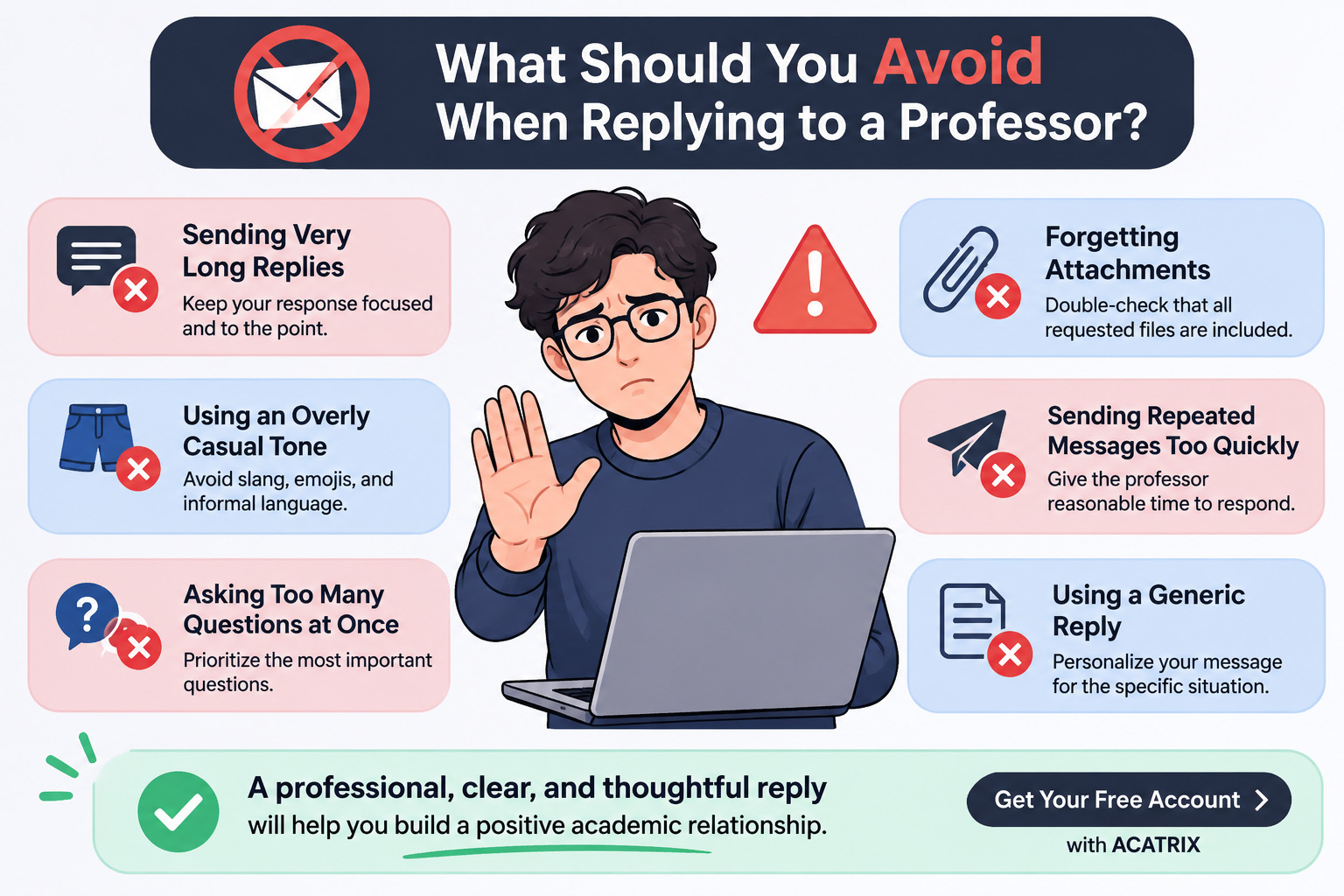
What Should You Avoid When Replying to a Professor?
1. Sending Very Long Replies
Your reply should address the professor's message directly. Avoid repeating your entire academic history or including information that is not relevant to the discussion.
2. Using an Overly Casual Tone
Avoid slang, emojis, and informal expressions when communicating with a professor you do not know well. Use a professional greeting and a suitable closing.
3. Asking Too Many Questions at Once
If you have several questions, prioritize the most important ones. Group related questions into short bullet points when necessary.
4. Forgetting Attachments
If the professor requests your CV or another document, make sure it is attached before sending the email.
5. Sending Repeated Messages Too Quickly
Do not send multiple reminders immediately after receiving a response or while waiting for additional information. Give the professor reasonable time to reply.
6. Using the Same Generic Reply for Every Situation
A response to an interview invitation should not look like a response to a rejection. Adapt your message to the professor's actual communication.
How Long Should You Wait Before Replying to a Professor?
There is no universal deadline for replying to a professor. The appropriate response time depends on the nature of the message and what the professor expects from you.
However, these general guidelines can help:
Situation | Suggested Response Time |
|---|---|
Interview invitation | As soon as reasonably possible |
Request for documents | Promptly, or acknowledge the request and provide a timeline |
Meeting invitation | Within 1–2 business days when possible |
Research-related question | Within a few business days |
Funding discussion | Promptly, especially if a deadline is involved |
General acknowledgment | Within a few business days |
Continue your academic journey with ACATRIX!
Create your account and use the Email Assistant to draft, refine, and organize your academic communication.
How Can You Write a More Personalized Reply to a Professor?
A strong reply should sound like a real conversation, not a copied template.
Before writing, consider these questions:
What exactly did the professor ask?
What information do they already have about you?
What is the next step you want to achieve?
Is there a specific research topic or project you should mention?
Does your reply require an attachment or a clear deadline?
Can AI Help You Write Better Academic Email Replies?
Yes. AI tools can help you organize your thoughts, improve grammar, adjust the tone, and create a first draft.
However, the quality of the final email depends on the information you provide and how carefully you review the result.
A useful workflow is:
Read the professor's original email carefully.
Identify the main question or request.
Provide the relevant context about your academic background.
Ask an AI tool to draft a concise, professional response.
Check every detail and personalize the final message.
Verify names, dates, attachments, and research references before sending.
Avoid sending an AI-generated email without reviewing it. Your response should accurately represent your experience, intentions, and availability.
Make Your Academic Email Replies Easier with ACATRIX
Writing to professors can become time-consuming when you are communicating with multiple universities and potential supervisors.
ACATRIX helps simplify academic communication through its Email Assistant. You can use it to develop structured email drafts, refine your wording, and improve the clarity and professionalism of your messages.
Whether you are replying to a professor, discussing a research opportunity, or preparing a follow-up, a structured drafting process can help you communicate more confidently.
Ready to improve your academic communication?
Create your free ACATRIX account and start organizing your academic application journey.
This module is part of the Acatrix Application System, which also includes:
Research Statement & SOP Drafting
For a complete step-by-step guide, learn how to use Acatrix for academic applications and manage everything from finding opportunities to preparing your documents and interviews.
Frequently Asked Questions (FAQs)
1. How do you politely reply to a professor's email?
Start with a professional greeting, thank the professor for their message, and respond directly to their question or request. Keep your reply concise and finish with a polite closing such as "Best regards" or "Sincerely," followed by your full name.
2. Should I reply to every email from a professor?
If the professor sends you a personal message, asks a question, requests information, or suggests a next step, you should generally respond. Even when you do not have a complete answer yet, a brief acknowledgment can be helpful.
3. How quickly should I respond to a professor's email?
Reply as soon as reasonably possible. For interview invitations, document requests, or time-sensitive questions, a prompt response is particularly important. If you need more time, acknowledge the message and provide an estimated response date.
4. How do I reply to a professor who is interested in supervising me?
Thank them for their interest, briefly explain why you are interested in their research group, and ask about the next steps if these have not been discussed. Do not assume that a positive response means you have been formally accepted.
5. How do I respond when a professor asks for my CV?
Thank them for considering your inquiry and attach your updated CV in PDF format. Use a clear file name and make sure the attachment opens correctly. If they request additional documents, include those as well.
6. How should I reply to a professor who invites me for an interview?
Express your appreciation, confirm your availability, and ask for clarification if the meeting details are incomplete. If the proposed time does not work, politely suggest alternative dates and times.
7. What should I say if a professor tells me they have no PhD positions available?
Thank them for their response and acknowledge their situation. If appropriate, ask whether they expect future openings or can recommend another researcher whose work matches your interests.
8. Should I reply to a professor after receiving a rejection?
Yes. A short and polite acknowledgment is a professional way to close the conversation. You can thank the professor for their time and, if appropriate, ask for brief feedback or recommendations for other opportunities.
9. Can I use the same email template to reply to different professors?
You can use a basic structure, but you should personalize each reply. Refer to the professor's actual message, research interests, and the specific situation. Avoid sending identical responses that do not address the conversation.
10. Can AI write an email reply to a professor?
Yes. AI can help create a first draft, improve grammar, and adjust the tone. However, you should always review the final message to ensure that it accurately reflects your academic background, answers the professor's questions, and does not include incorrect information.