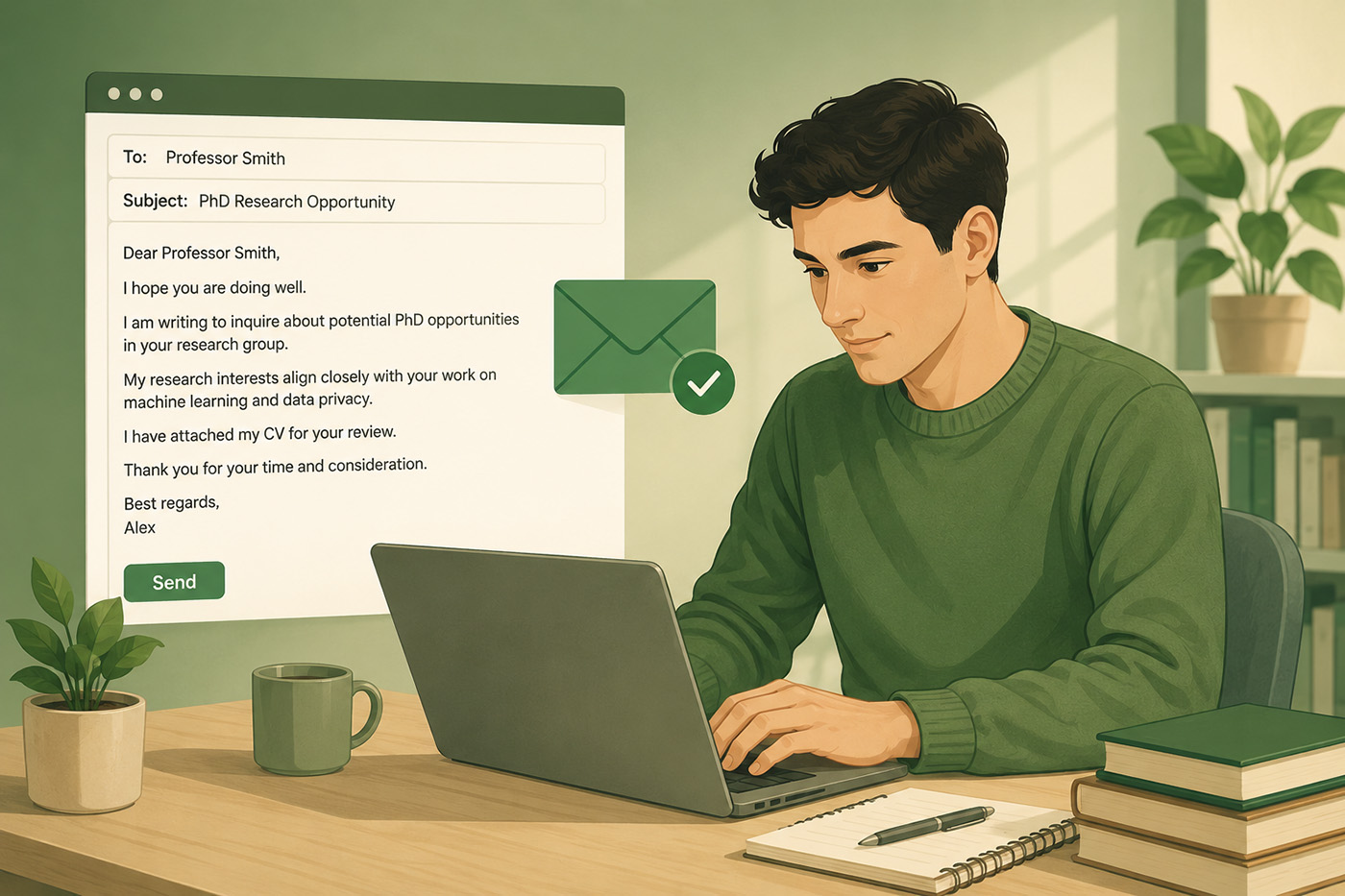
What Makes a Professor Reply?
Every year, thousands of applicants send nearly identical messages that begin with "Dear Professor, I hope you are doing well..." and end with "I would be grateful for your response."
Most never receive one!
At Acatrix, we've analyzed what makes academic emails effective and what causes them to fail. If you're searching for PhD email examples or learning "How to Write an Academic Email", this guide focuses on what matters most: real examples, clear analysis, and practical improvements you can apply today.
Want to write a stronger email in minutes? Create your free Acatrix account and get AI-powered feedback before you hit Send.
Professors don't have time to read long introductions or generic messages.
A successful email usually has four characteristics:
It is personalized.
It clearly explains why you contacted that professor.
It demonstrates familiarity with their research.
It ends with a simple, reasonable request.
If your email misses any of these points, your chances of receiving a reply drop significantly.
If you haven't contacted professors before, read our guide on How to Email a Professor for a PhD before writing your first message.
10 Real PhD Email Examples
Good Example 1: Specific and Personalized
Subject: Prospective PhD Applicant Interested in Your Work on Graph Neural Networks
Dear Professor "X",
I recently read your paper on graph neural networks for molecular property prediction and found your approach to uncertainty estimation particularly interesting.
My master's research focuses on machine learning for drug discovery, and I believe my background aligns well with your current projects.
If you expect to recruit PhD students next year, I would appreciate the opportunity to discuss whether my research interests could fit your group.
I've attached my CV for your reference.
Thank you for your time.
What works?
References a specific publication.
Connects the applicant's experience to the professor's work.
Ends with a realistic request.
Mentioning one recent paper is more effective than complimenting the professor's research in general.
Good Example 2: Short and Direct
Subject: Prospective PhD Applicant Interested in Sustainable Wastewater Treatment Research
Dear Professor X,
I hope you are doing well.
My name is ... , and I am currently completing my MSc in Environmental Engineering at ABC University. My research focuses on water treatment technologies, with a particular interest in sustainable approaches for wastewater management.
I recently came across your research on advanced wastewater treatment systems and found your work on improving treatment efficiency particularly relevant to my academic background. I am interested in continuing my research in this area and would like to ask whether you are accepting new PhD students for Fall 2027.
I have attached my CV for your reference and would appreciate any information regarding potential opportunities in your research group.
Thank you for your time.
Best regards,
What works?
Under 120 words.
Easy to scan.
Clear purpose.
Many professors prefer concise emails over long personal stories.
Good Example 3: Demonstrates Research Fit
Subject: Prospective PhD Applicant Interested in Explainable AI Research
Dear Professor "X",
I hope you are doing well.
My name is ..., and I am currently completing my master's degree in Computer Science at ABC University. My research focuses on medical image analysis using deep learning methods.
I recently read your work on explainable AI in healthcare and was particularly interested in your approach to improving the interpretability of AI models for clinical applications. My current research explores similar challenges in medical imaging, and I believe there is a strong connection between my background and your research interests.
I am interested in pursuing a PhD in this area and would like to ask whether you are planning to accept new students in the upcoming admission cycle. I have attached my CV and would appreciate the opportunity to discuss potential research opportunities.
Thank you for your time and consideration.
Best regards,
What works?
Demonstrates research alignment.
Shows the email was written specifically for this professor.
Professors hire researchers, not just students. Focus on research compatibility.
Good Example 4: Confident, Not Desperate
Subject: Prospective PhD Applicant Interested in Renewable Energy Optimization Research
Dear Professor "X",
I hope you are doing well.
My name is ..., and I am currently completing my master's degree in Electrical Engineering at ABC University. I am interested in joining your research group because of your work on renewable energy optimization and data-driven approaches for improving energy systems.
During my recent research project, I worked on optimizing solar forecasting models using deep learning techniques. This experience helped me develop skills in machine learning, data analysis, and energy system modeling, which I believe could contribute to your ongoing research projects.
I would like to ask whether you are planning to accept new PhD students in the upcoming admission cycle. If appropriate, I would appreciate the opportunity to discuss potential research opportunities within your group.
Thank you for your time and consideration.
Best regards,
What works?
Focuses on value instead of asking for help.
Maintains a professional tone.
Avoid phrases like "Please give me a chance." Show why you're a good fit instead.
Good Example 5: Uses Evidence
Subject: Prospective PhD Applicant Interested in Privacy-Preserving Machine Learning Research
Dear Professor "X",
I hope you are doing well.
My name is ..., and I am currently completing my master's degree in Computer Science at ABC University. I recently attended your presentation at the IEEE Conference on privacy preserving machine learning and later read your article on federated learning.
I was particularly interested in your discussion of improving data privacy while maintaining model performance, as my current research also focuses on developing secure machine learning approaches. Through my recent projects, I have worked on machine learning models designed for sensitive data environments, which closely aligns with the research direction of your group.
I would like to ask whether you expect to recruit PhD students in the upcoming admission cycle. I would appreciate the opportunity to discuss whether my background could be a good fit for your research team.
Thank you for your time and consideration.
Best regards,
What works?
Shows genuine engagement.
Establishes credibility.
Whenever possible, refer to conferences, talks, or recent publications instead of generic compliments.
Poor Example 1: Generic Mass Email
Subject: PhD Application Request
Dear Professor,
I hope you are doing well.
My name is John, and I am interested in pursuing a PhD at your university. I have completed my master's degree and would like to apply for a PhD position under your supervision.
I am looking for a fully funded PhD opportunity and would appreciate it if you could consider my application. Please let me know if there are any available positions.
I have attached my CV for your review. I look forward to your positive response.
Thank you.
Best regards,
❌ What doesn't work?
No professor's name.
No research interest.
No context.
No reason to respond.
If your email could be sent to 500 professors without changing a single word, it isn't personalized enough.
Poor Example 2: Too Long and Unfocused
Subject: PhD Application Inquiry
Dear Professor,
I hope you are doing well.
My name is John Smith, and I am writing this email to introduce myself and express my strong interest in pursuing a PhD under your supervision. Since I was young, I have always been passionate about science and learning. My family has always supported my education, and I have worked hard throughout my academic journey to become a successful researcher.
During my bachelor's degree, I studied engineering and developed an interest in technology. Later, during my master's program, I learned many different skills and participated in several projects. I also enjoyed working with my classmates and improving my communication skills. Outside academics, I enjoy reading, traveling, and learning about different cultures.
I believe studying with you would be a great opportunity for my personal and professional growth. I have always dreamed of becoming a researcher and contributing something meaningful to society. I would be very grateful if you could consider me for any available PhD positions.
I have attached my CV and would appreciate your feedback regarding my application.
Thank you very much for your valuable time.
Best regards,
❌ What doesn't work?
Much too long.
Important information is buried.
Busy professors will likely stop reading.
Aim for 120–180 words. Respect the reader's time.
Poor Example 3: No Research Fit
Subject: Inquiry About Funded PhD Positions
Dear Professor,
I hope you are doing well.
My name is John Smith, and I am looking for a fully funded PhD opportunity. I would like to know if you currently have any funded positions available for international students.
I have completed my master's degree and I am interested in pursuing a PhD at your university. Please let me know if there are any scholarships, assistantships, or research opportunities available.
I have attached my CV for your reference. I would appreciate any information you can provide.
Thank you for your time.
Best regards,
❌ What doesn't work?
Focuses only on funding.
Shows no interest in the professor's research.
Sounds transactional.
Funding is important, but research fit should always come first in your first email.
Poor Example 4: Overly Formal and Robotic
Subject: Respectful Request for PhD Supervision Opportunity
Respected Honorable Distinguished Professor Williams,
I hope this email finds you in the best of health and highest spirits.
It is my utmost privilege and honor to humbly approach you with the sincere request of considering me as a potential PhD candidate under your exceptional supervision. I am deeply impressed by your remarkable achievements and outstanding contributions to the field of science.
I would be extremely grateful if your esteemed self could provide me with the valuable opportunity to become a member of your prestigious research group. I assure you that I will work with complete dedication and commitment.
I kindly request you to consider my humble application and provide me with a positive response at your earliest convenience.
Thank you very much for your precious time.
Yours faithfully,
❌ What doesn't work?
Sounds unnatural.
Excessive formality can feel insincere.
Professional English is simple English.
Poor Example 5: Copy-Paste Personalization
Subject: PhD Opportunity Inquiry
Dear Professor,
I hope you are doing well.
I have read your excellent research and found your work very inspiring. Your contributions to your field are impressive, and I would like to have the opportunity to work with you as a PhD student.
I am very interested in your research area and believe that joining your group would be a great opportunity for my academic future. Please let me know if you have any available PhD positions.
I have attached my CV for your consideration.
Thank you for your time. I look forward to your response.
Best regards,
❌ What doesn't work?
Doesn't mention any actual research.
Feels copied from a template.
Even mentioning one paper title is far more convincing than three generic compliments.
Not getting replies from professors? Before sending another email, let Acatrix review it with AI-powered feedback and identify weak points that may be costing you responses and make it perssonlized based on CV, SOP and the position that you are applying for.
Start your application profile!
If you've already contacted a professor and haven't heard back, don't rush to send another message. First, learn how to write a follow-up email after no response and understand why professors don't reply to emails. Many unanswered emails can be improved with better timing, stronger personalization, and a more clear research fit rather than simply sending reminders.
Common Reasons Professors Ignore Emails
Sending the same email to multiple professors.
Writing long, unfocused introductions.
Talking only about funding.
Showing no evidence of reading the professor's work.
Using weak subject lines.
Following up too aggressively.
Before sending your next message, review these common pitfalls in our guide on 5 Mistakes to Avoid When Emailing Professors for Research Positions.
Email Checklist Before Sending
Correct professor name
Clear subject line
Mentioned a recent paper or project
Explained your research fit
Kept the email under 200 words
Attache your CV (if appropriate)
Used a professional email address
Proofread for grammar and spelling
Included one clear call to action
Double-checked all links and attachments
Ready to send with confidence? Create your free Acatrix account and let AI review your email before it reaches a professor.
Start Your Free Trial Today!

Write Better Professor Emails with Acatrix
With Acatrix, you can:
Generate personalized professor emails in minutes.
Receive AI-powered feedback on tone, clarity, and research fit.
Improve subject lines for higher response rates.
Rewrite generic emails into personalized outreach messages.
Prepare follow-up emails if you don't receive a response.
Whether you're contacting your first professor or your fiftieth, Acatrix helps you write emails that are professional, relevant, and easy to read.
Start improving your academic emails today by creating your free Acatrix account.
For a deeper look at the platform, explore How Acatrix Simplifies Every Step of Your Academic Application Journey.
Everything You Need for Your Academic Application
Acatrix also helps you:
Draft and improve Statements of Purpose (SOPs)
Review academic CVs
Prepare for PhD interviews
Generate personalized application documents
Track applications in one dashboard
Organize deadlines and university requirements
Receive AI-powered writing assistance throughout the application process
If you're planning multiple applications, discover everything the platform offers in The Complete Guide to Using Acatrix for Academic Applications.
Create your free account and start building stronger applications, from your first email to your final interview.
Start Your Free Trial Today!
Everything You Need for Academic Applications in One Place
Whether you are preparing your SOP, contacting professors, practicing interviews, or tracking multiple university applications, Acatrix brings your entire academic application workflow into one structured system designed for students, researchers, and PhD applicants worldwide.
Start Today!
Related Guides for Academic Applications
1. Personal Statement vs SOP: What’s the Difference?
2. Best Way to Track Multiple University Applications
3. 10 PhD Interview Mistakes That Hurt Your Chances
4. Should I Attach My CV in the First Email to a Professor?
5. Top Personal Statement Mistakes and How to Avoid Them
6. What to Wear to a PhD Interview
7. AI in Academic Applications: Boost or Risk?
Frequently Asked Questions
1. How long should a PhD email be?
Ideally between 120 and 200 words. Professors appreciate concise emails that quickly explain who you are and why you're contacting them.
2. Should I attach my CV in the first email?
Yes, if the professor's website doesn't state otherwise. A one- or two-page academic CV is usually appropriate.
3. Is it okay to email multiple professors?
Yes, provided every email is personalized. Avoid sending identical messages to different professors.
4. How long should I wait before following up?
Wait 7–14 days before sending a polite follow-up.
5. Should I mention funding in my first email?
You can ask about available positions, but your primary focus should be research fit—not funding.
6. Can AI help me write a better professor email?
Yes. AI can improve clarity, grammar, structure, and personalization. However, always review the final version to ensure it accurately reflects your research interests and matches the professor's work.