
Why Most PhD Applicants Fail at the Final Step
You spent months crafting the perfect CV. You rewrote your SOP five times. You emailed professors, collected references, and finally got the interview invitation. And then the interview did not go as planned.
This is more common than you think. The PhD interview is where strong candidates lose their spot to prepared ones. Not because they lacked the qualifications, but because they made avoidable mistakes that cost them the offer.
At Acatrix, we have worked with hundreds of PhD applicants and identified the mistakes that come up again and again. In this guide, we break down the 10 most common PhD interview mistakes — and exactly how to avoid them. If you want a full overview of the process first, start with our complete guide on How to Prepare for an Academic Interview.
10 PhD Interview Mistakes
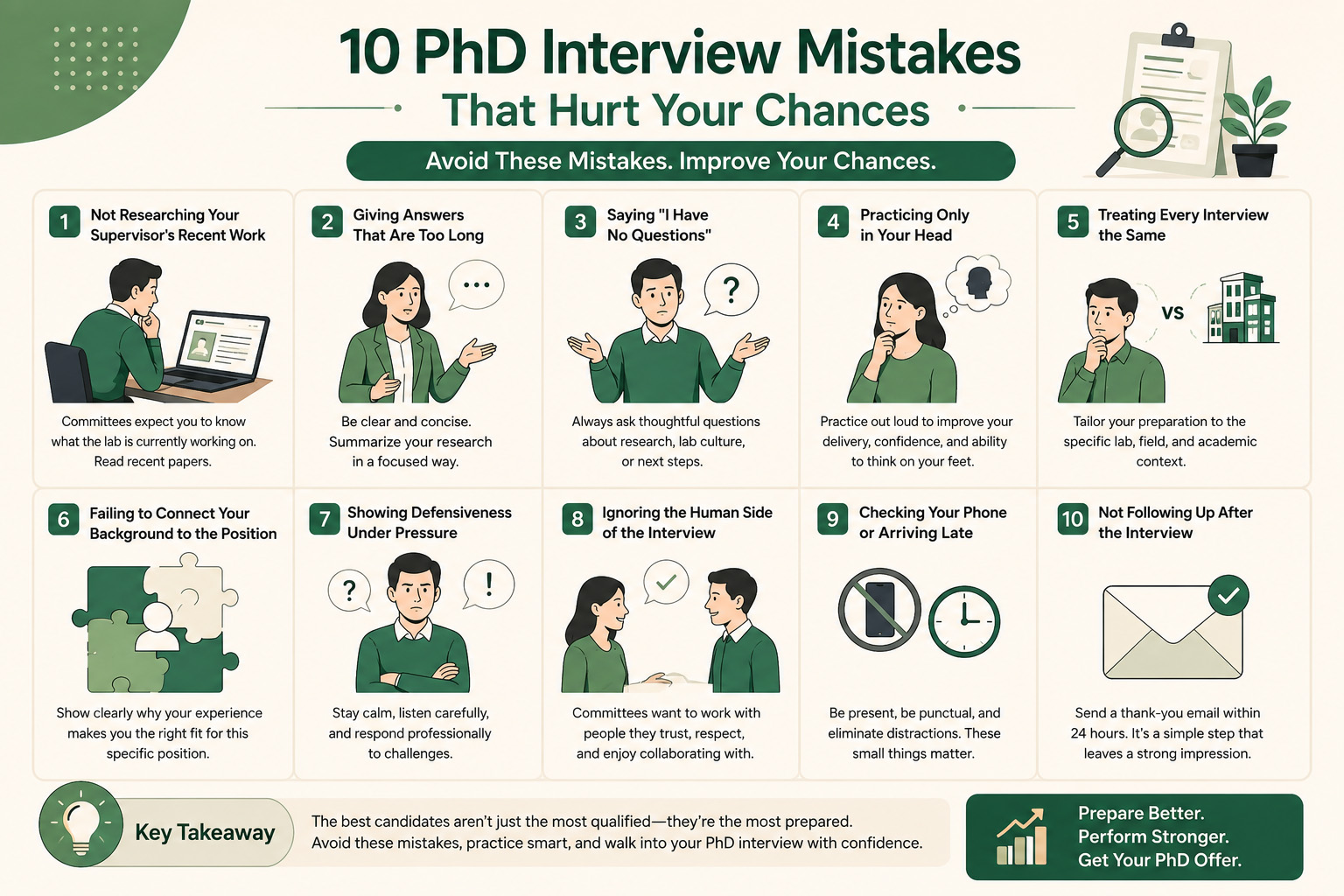
Mistake 1: Not Researching Your Supervisor's Recent Work
Walking into a PhD interview without reading your potential supervisor's recent publications is one of the fastest ways to lose credibility. Committees expect you to know what the lab is currently working on not just what attracted you to the program two months ago. Before any interview, read at least two recent papers from your target PI and be ready to discuss them naturally.
Mistake 2: Giving Answers That Are Too Long
Academic candidates tend to over-explain. Committees want clear, focused answers not a full lecture. If you cannot summarize your research in two minutes, you are not ready. Practice keeping your responses concise without losing depth.
Mistake 3: Saying "I Have No Questions"
There will always be a moment at the end where the interviewer asks if you have questions. Saying no signals a lack of genuine interest. Always prepare at least three thoughtful questions about the research direction, lab culture, or next steps and always ask what the timeline looks like before you leave.
Mistake 4: Practicing Only in Your Head
Reading about interview questions is not the same as answering them out loud. Your voice, pacing, and confidence under pressure only improve through actual practice. Candidates who rehearse silently often freeze or ramble when it matters most.
Mistake 5: Treating Every Interview the Same
A PhD interview for a computational biology lab requires a completely different approach than one for a humanities program. Generic preparation leads to generic answers and committees notice immediately when a candidate could be talking to anyone.
Mistake 6: Failing to Connect Your Background to the Position
One of the most common reasons strong candidates get rejected is failing to clearly connect their past experience to the specific research direction of the lab. Do not assume the committee will make that connection for you. It is your job to show explicitly why your background makes you the right fit for this particular position.
Mistake 7: Showing Defensiveness Under Pressure
Faculty often challenge your research ideas, question your methodology, or push back on your assumptions not to intimidate you, but to see how you think under pressure. Candidates who become defensive or shut down send a clear signal: they will be difficult to supervise. The right response is to stay calm, acknowledge the challenge, and think out loud.
Mistake 8: Ignoring the Human Side of the Interview
PhD interviews are not just academic evaluations, they are the beginning of what could be a five-year working relationship. Committees are quietly asking themselves: "Can I realistically imagine supervising this person?" If you come across as rigid, unenthusiastic, or socially withdrawn, that question becomes harder to answer in your favor.
Mistake 9: Checking Your Phone or Arriving Late
This sounds obvious but it still happens. Checking your phone during an interview signals disinterest. Arriving late signals disrespect. Both are eliminators, regardless of how strong your CV is. Plan your route the day before, arrive early, and keep your phone silent and out of sight for the entire duration.
Mistake 10: Not Following Up After the Interview
Most candidates walk out of the interview and wait. The ones who stand out send a short, professional thank-you email within 24 hours referencing something specific from the conversation. It takes five minutes and leaves a lasting impression that very few of your competitors will bother to make.
Research consistently shows that how your interview preparation shapes the first impression you make can be the difference between getting the offer and walking away empty-handed.
How Practicing Out Loud Reduces Every One of These Mistakes
Reading this list is a good start. But awareness alone does not change performance under pressure.
The only way to actually reduce these mistakes is to practice out loud, repeatedly, and in conditions that feel as close to the real interview as possible.
This is exactly where most candidates fall short. They read about common mistakes, feel prepared, and then freeze or ramble the moment a professor asks an unexpected question.
When you practice with realistic, specific questions tailored to your CV and research background, something shifts. Your answers become sharper.
Your delivery becomes more natural. And when a committee member pushes back on your methodology, you respond with confidence instead of panic, because you have been there before.
The candidates who walk into PhD interviews without making these mistakes are not necessarily smarter or more qualified. They are simply more prepared!
Start your free mock interview on Acatrix today!
How Acatrix Helps You Avoid These Mistakes
Most interview tools give you a list of questions to memorize. Acatrix works differently because the mistakes above are not fixed by better answers. They are fixed by better preparation.
Acatrix is an AI-powered interview preparation system built specifically for academic applicants. Here is what sets it apart:
1. Professor-Specific Simulation
Forget generic questions. Acatrix analyzes your target professor's research background and publication history to recreate their actual questioning logic, so you practice for the interview you are really going to have, not a generic version of it.
2. Personalized to Your CV and SOP
Every question is generated from your own documents. Your background, your research goals, your weak spots, all of it is built into the simulation. Nothing will catch you off guard.
3. Unlimited Sessions, Available 24/7
Practice at 2 AM the night before your interview if you need to. No scheduling, no limits. Real confidence comes from repetition, and Acatrix lets you repeat as many times as it takes.
4. Multilingual Support
Practice in your native language to build your logic, or in your target language to sharpen your professional vocabulary. Geography should not limit your preparation.
5. Your First Session Is Free
No commitment, no risk. Just a realistic preview of what your actual interview might look like and a clear picture of exactly where you need to improve.
Start your free mock interview on Acatrix today!
Before your interview day, it also helps to know how long PhD interviews usually last so you can pace your answers and manage your energy from start to finish.
The Interview Is Winnable. If You Prepare Right!
A PhD interview is not designed to trick you. It is designed to find out who you really are as a researcher, how you think, how you communicate, and whether you are someone worth investing five years in.
The 10 mistakes in this guide are not rare. The good news is that every single one of them is avoidable, not by being smarter, but by being more prepared.
Start your free mock interview on Acatrix today. Practice with questions tailored to your actual profile, identify your weak spots before they matter, and walk into your PhD interview as the most prepared candidate in the room.
If nerves are holding you back, learning how to manage academic interview anxiety is the next step before your first mock session.
Everything You Need for Academic Applications in One Place
Whether you are preparing your SOP, contacting professors, practicing interviews, or tracking multiple university applications, Acatrix brings your entire academic application workflow into one structured system designed for students, researchers, and PhD applicants worldwide.