
How to Summarize Research Papers with AI Without Losing Academic Depth
Have you ever spent hours reading a research paper and still felt unsure about its key contribution?
Summarizing research papers is one of the most essential but time-consuming tasks in academic work. Whether you are writing a literature review, preparing a thesis, or applying for a PhD program, you need to extract structured insights from dense academic content.
AI tools have made this process faster, but speed alone is not enough. The real challenge is maintaining academic accuracy, context, and interpretability.
This guide explains how to properly summarize research papers using AI, where it works, where it fails, and how to apply it within a structured academic workflow.
If you are looking for a more reliable, end-to-end solution, you can also explore how Acatrix supports this process through its integrated research tools and dedicated Research & Paper Summarization service, designed specifically for academic use cases.
Start Today!
What Is Research Paper Summarization?
Research paper summarization is the process of extracting and condensing the most important information from an academic paper into a shorter, structured, and understandable format without losing its core meaning. Unlike general text summarization, it requires preserving the logical flow of the study, including the research problem, methodology, key findings, and overall contribution.
In an academic context, summarization is not just about shortening content. It is about identifying what actually matters within the research. This includes understanding the research gap, interpreting how the methodology supports the findings, and recognizing the significance of the results within a broader field of study.
A high-quality research paper summary typically includes:
The main research question or objective
The methodology used in the study
Key findings and results
The primary contribution to the field
Limitations and potential future research directions
With the rise of AI, this process has become faster and more scalable. However, automated summarization must still follow academic structure and context to be truly useful, especially for tasks like literature reviews, thesis writing, and PhD applications.
Why Does Research Paper Summarization Matter?
Research paper summarization plays a critical role in how efficiently and accurately academic work is conducted. In an environment where thousands of papers are published every day, researchers and students cannot afford to read everything in full. The ability to extract key insights quickly is no longer a convenience. It is a necessity!
At its core, summarization helps reduce cognitive overload. Instead of spending hours navigating dense academic language, a well-structured summary allows you to understand the purpose, approach, and contribution of a paper in a fraction of the time. This becomes especially important during literature reviews, where identifying relevant studies and comparing them is essential.
More importantly, summarization directly impacts the quality of academic output. A weak or incomplete understanding of sources can lead to:
Misinterpretation of findings
Poorly constructed literature reviews
Weak research positioning
Missed research gaps
On the other hand, effective summarization enables you to:
Identify patterns across multiple studies
Evaluate the strength of different methodologies
Build stronger arguments in your writing
Position your research within existing literature
In contexts such as thesis writing, research proposals, and PhD applications, this ability becomes even more critical. It is not just about understanding individual papers, but about connecting them into a coherent academic narrative.
As the volume of research continues to grow, structured summarization, especially when supported by AI becomes a key skill for maintaining both speed and academic accuracy.
Start your application profile!
Real-World Academic Workflow (How Researchers Actually Read Papers)
In real academic practice, researchers do not read papers line by line from start to finish. Instead, they interact with research in a non-linear and goal-oriented way.
A typical workflow starts with scanning multiple papers to identify relevance, followed by selective deep reading of specific sections depending on the research objective. For example, methodology is prioritized when evaluating experimental validity, while introduction and conclusion are more important for understanding positioning and contribution.
In literature reviews, researchers are not trying to understand a single paper in isolation. They are trying to build a comparative understanding across multiple studies, identifying patterns, contradictions, and research gaps.
This is why simple summarization is often insufficient. What matters is structured interpretation across multiple sources.
Why Research Paper Summarization Is Challenging
Academic papers are not designed for quick reading. They are structured for precision, not simplicity.
Key reasons include:
Dense academic language
Multi-layered structure
Heavy use of domain-specific terminology
Implicit (not explicit) contributions
Data-heavy explanations instead of narrative
Typical structure of a research paper
Section | Purpose | Difficulty in Summarization |
|---|---|---|
Abstract | Overview of study | Medium |
Introduction | Problem framing | High |
Methodology | Research design | Very High |
Results | Findings & data | High |
Discussion | Interpretation | Very High |
Conclusion | Summary & implications | Medium |
How AI Helps in Summarizing Research Papers
AI tools can significantly improve the speed and efficiency of reading academic papers.
Core capabilities:
Identifying structural sections automatically
Extracting key findings
Simplifying complex academic language
Generating quick overviews for screening papers
Comparison: Manual vs AI Summarization
Factor | Manual Reading | AI Summarization |
|---|---|---|
Speed | Slow | Very fast |
Depth | High | Medium |
Scalability | Low | High |
Context understanding | High | Medium |
Risk of missing nuance | Low | Medium–High |
Limitations of AI in Academic Summarization
AI is powerful but not perfect, especially in academic contexts.
Main limitations:
Loss of contextual meaning
Oversimplification of findings
Misinterpretation of methodology
Weak handling of implicit contributions
Lack of academic reasoning depth
Common failure patterns:
Treating correlation as causation
Ignoring limitation section
Flattening multi-step arguments
Missing research gap signals
Why Finding Relevant Papers Is More Important Than Just Summarizing
Summarizing random papers has limited value if those papers are not directly aligned with your research goals. In academic work especially for PhD applications. The real challenge is not just understanding papers, but identifying the right papers in the first place.
A targeted selection of research articles allows applicants to focus on the most relevant theories, methods, and discussions within their intended field. Without this filtering step, even high-quality summaries can lead to scattered understanding and weak academic positioning.
This is particularly critical when building a literature review or preparing for a research proposal, where relevance and alignment matter more than volume.
Why Understanding a Professor’s Research Can Make or Break Your Application
One of the most overlooked aspects of PhD and research applications is alignment with a supervisor’s work. Many applicants fail not because they lack qualifications, but because they do not demonstrate a clear understanding of the professor’s research direction.
Analyzing and summarizing the publications of a target professor allows applicants to:
Understand ongoing research themes
Identify methodological preferences
Detect potential research gaps
Align their interests with the supervisor’s work
This level of insight significantly increases the chances of writing a compelling SOP or research proposal.
Why Structured Summaries Improve Literature Review Quality
A literature review is not a collection of summaries—it is a structured argument built on existing research. Poor summarization leads to fragmented understanding, while structured summaries enable comparison, synthesis, and critical analysis.
When summaries are aligned, consistent, and focused on key academic elements such as research gaps and contributions, it becomes easier to:
Compare multiple studies
Identify trends and contradictions
Build a coherent academic narrative
Where AI Summarization Fails in Academic Workflows
While AI tools have significantly improved access to information, they introduce limitations when used without academic structure. One major issue is loss of methodological nuance. AI often simplifies research design in a way that removes important details about experimental conditions or theoretical assumptions.
Another common problem is misrepresentation of research contributions. Academic papers rarely state their novelty in a single sentence, but AI systems tend to force conclusions into simplified statements.
AI also struggles with cross-paper synthesis. It can summarize individual papers effectively, but fails to connect insights across multiple studies, which is essential for literature review development.
Because of these limitations, AI should be treated as a supportive tool rather than a complete academic solution.
How Acatrix Finds and Summarizes Relevant Research Papers for You
Acatrix goes beyond basic summarization by first identifying the most relevant papers in your intended research area. Instead of working with random or manually selected sources, the system curates a focused set of academic papers aligned with your field and goals.
Once identified, these papers are processed into structured summaries that highlight:
Core research questions
Methodological approaches
Key findings
Research gaps
Your Academic Journey: From Search to Settlement From Search to Settlement. Start Now For Free!
How Acatrix Analyzes and Summarizes a Professor’s Publications
In addition to general research papers, Acatrix specifically analyzes the published work of your target professor or research supervisor. This feature is designed to help applicants understand exactly what a professor is working on and how they can align with it.
By summarizing a professor’s publications, Acatrix helps you:
Identify dominant research themes
Understand preferred methodologies
Detect gaps or future research directions
Prepare more targeted SOPs and research proposals
How Acatrix Improves the Research Paper Workflow
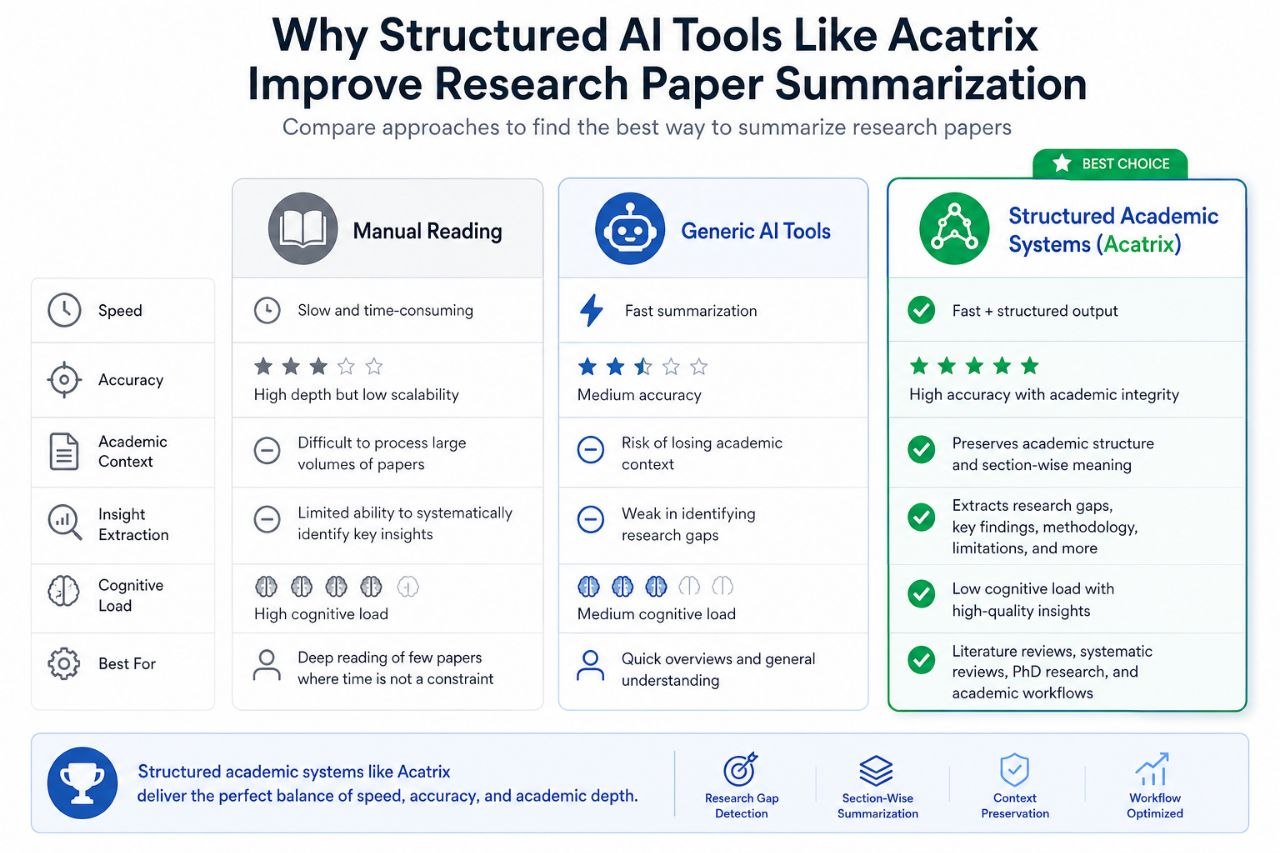
Acatrix is designed to address the limitations of traditional AI summarization by focusing on structured academic interpretation rather than simple text reduction.
Instead of processing isolated papers, Acatrix first identifies research papers that are directly relevant to the user’s academic goal or intended field of study. This ensures that the input itself is aligned with the research direction.
Once relevant papers are identified, Acatrix generates structured outputs that include research objectives, methodology breakdown, key findings, and identified research gaps.
In addition to general paper analysis, Acatrix also enables users to analyze the publication history of a target professor. This helps applicants understand research direction, methodological preferences, and potential alignment opportunities for PhD applications.
This transforms the workflow from passive reading into structured academic positioning.
Start your application profile!
Build a Winning Academic Application Strategy with Acatrix
If you are serious about studying abroad or applying for competitive academic positions, your application needs more than just writing, it needs strategy.
👉 Start using Acatrix to build a complete academic application system
👉 Transform your CV, SOP, and emails into admission-ready documents
👉 Increase your chances of getting responses, interviews, and offers
Start Your Free Trial now!
Everything You Need for Academic Applications in One Place
Whether you are preparing your SOP, contacting professors, practicing interviews, or tracking multiple university applications, Acatrix brings your entire academic application workflow into one structured system designed for students, researchers, and PhD applicants worldwide.
Start Today!
Explore More Academic Insights
Academic Application Tracking System: The Complete Guide for Smarter Applications
How to Write an Academic Email: A Complete Guide for Students and Researchers
How to Write a Successful CV: A Complete Professional Guide (2026 Update)
How to Prepare for an Academic Interview
How Interview Preparation Shapes First Impressions?
Personalized Mock Interviews: A Smarter Way to Prepare for Academic and Career Success
Top Personal Statement Mistakes and How to Avoid Them
How to Write a Follow-Up Email to a Professor After No Response
Frequently Asked Questions (FAQ)
1. What is the best way to summarize a research paper using AI?
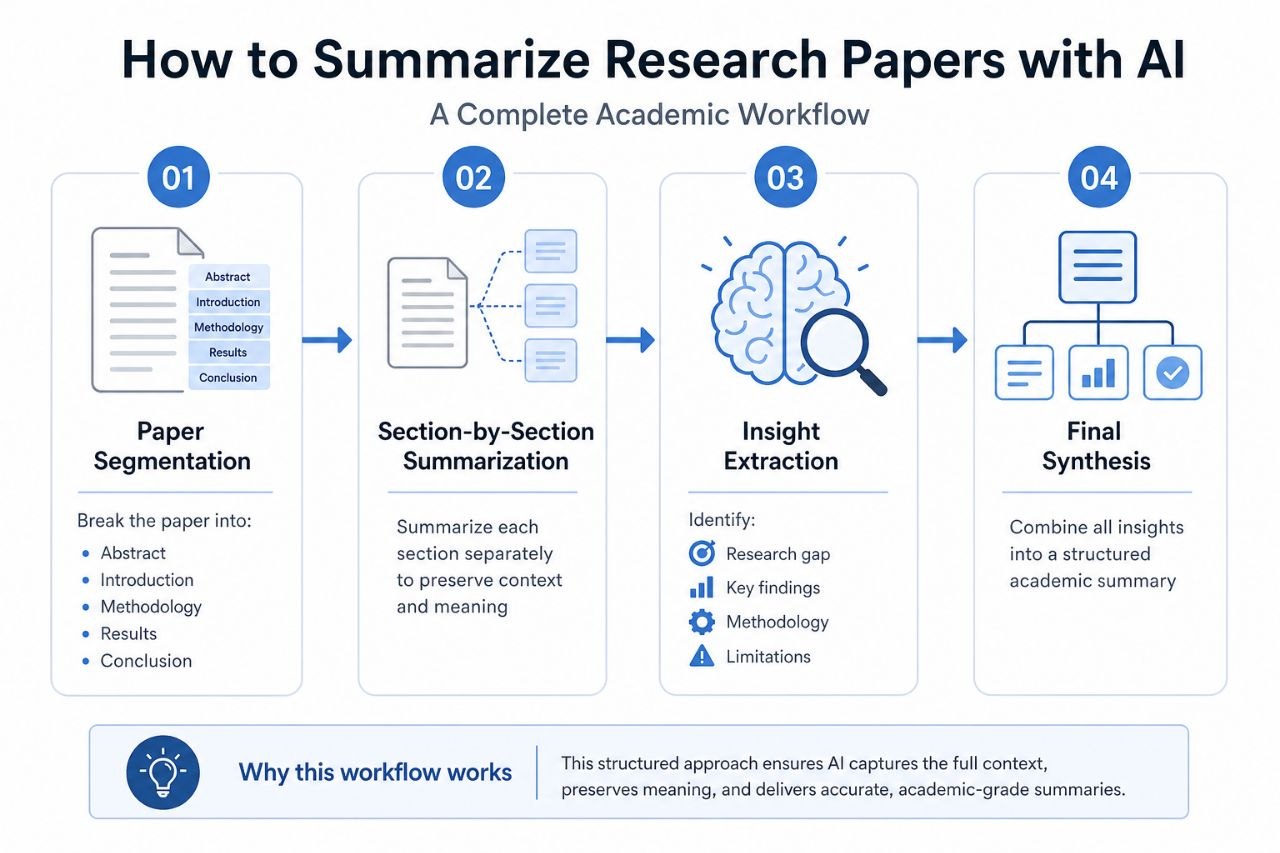
The most effective method is to first break the paper into sections (introduction, methodology, results, and conclusion), then summarize each part separately before combining them into a structured overview. This prevents loss of context and improves accuracy.
2. Can AI tools fully replace manual research paper reading?
No. AI can significantly speed up the process, but it cannot fully replace critical reading. Human judgment is still required to interpret context, evaluate methodology, and understand research implications.
3. What are the common mistakes when using AI for summarizing papers?
Common mistakes include relying on full-paper summaries, ignoring research context, failing to verify outputs, and not separating sections before summarization. These issues often lead to incomplete or misleading interpretations.
4. What makes Acatrix different from general AI summarization tools?
Acatrix focuses on structured academic outputs rather than simple text reduction. It extracts research gaps, analyzes methodology, and organizes insights specifically for literature reviews, PhD applications, and academic writing.