
Are You Ready to Write an SOP That Gets You Noticed?
Why do some applicants with impressive academic records still get rejected, while others with less conventional profiles receive offers from highly competitive universities?
Because admissions committees are not simply looking for high grades. They want to understand who you are, what drives your academic journey, why you chose this program, and what you plan to do with the opportunity.
That is where your Statement of Purpose becomes critical. An SOP is more than another application requirement. It is your chance to connect your academic background, research experience, motivation, goals, and future plans into a story that makes sense to the admissions committee.
A generic SOP can make even a strong candidate look forgettable. A focused, well-structured, and genuinely personal SOP can make your application stand out.
What should you include? What should you leave out? How do you structure your story? And how do you make your SOP sound personal without becoming overly informal?
This guide of Acatrix answers those questions step by step. You’ll learn how to plan, structure, write, and refine a compelling SOP, what admissions committees look for, the mistakes that can weaken your application, and how to make your statement more specific and persuasive.
And if you don’t want to start with a blank page, you can use Acatrix’s SOP Writing Assistant to build a personalized statement around your academic background, goals, and target program, turning your ideas and experiences into a clear, structured application narrative.
Ready to turn your academic journey into an SOP that admissions committees remember?
What Is a Statement of Purpose (SOP)?
A Statement of Purpose (SOP) is more than an essay you submit with your university application. It is your opportunity to answer one of the most important questions an admissions committee has:
Why should we choose you?
Your transcript shows your grades. Your CV shows your experience. Your certificates show your achievements. But your SOP brings these pieces together and explains the story behind your application.
It tells the admissions committee why you chose your field, what experiences shaped your academic interests, what you want to achieve, and why a particular program is the right next step for you.
A strong SOP doesn't simply list everything you've done. It creates a clear connection between your past experiences, current interests, and future goals, while showing why those goals make sense for the specific university and program you're applying to.
Learning how to find a PhD supervisor can help you focus on research alignment, funding, supervision style, and availability before reaching out.
Your first email to a professor needs to be concise and relevant, so knowing which documents to attach can help you make a stronger impression.
What Should a Strong SOP Include?
There is no single formula that works for every applicant, but a compelling SOP usually brings together several key elements:
A strong opening that immediately communicates your motivation and academic direction
Your academic background and the experiences that prepared you for the program
Relevant research or professional experience that demonstrates your skills and interests
Your short-term and long-term goals and what you hope to achieve
A specific explanation of why this university and program fit your academic plans
A clear conclusion that brings your story and future ambitions together
If you're unsure how many words your PhD SOP should contain, this guide explains how to choose the right length without sacrificing important details.
Common SOP Mistakes That Can Hurt Your Application
Even strong candidates can weaken their applications with an SOP that feels generic, unfocused, or disconnected from their goals.
Watch out for these common mistakes:
Writing a statement that could be sent to any university
Turning your SOP into a summary of your CV
Including too many details that don't support your main story
Using complicated language instead of writing clearly and naturally
Failing to explain how your past experiences led to your current goals
Talking about the university without explaining why it is the right fit for you
Submitting the first draft without thorough editing and proofreading
And you don't have to figure out the entire process from a blank page. Acatrix's SOP Writing Assistant can help you develop and structure your statement around your academic background, goals, and target program, so you can focus on telling your story rather than struggling with where to begin.
Start building your SOP with Axatrix today!
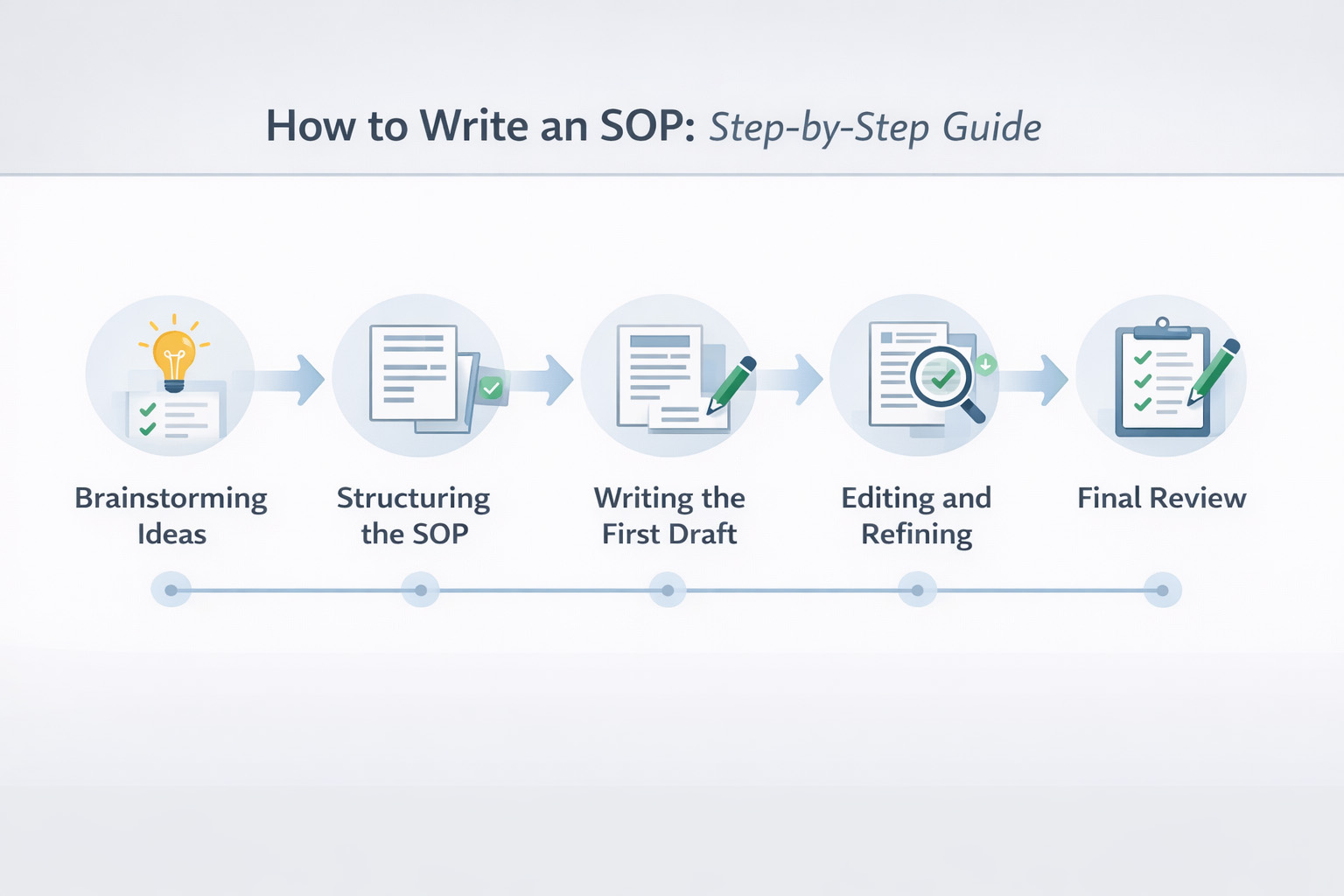
How to Write a Winning SOP Step by Step
Writing a strong SOP becomes much easier when you follow a structured process instead of trying to write everything at once.
1. Planning Your Story
Before writing, take time to reflect on:
Your academic journey so far
Key experiences that influenced your decision
Your long-term career vision
2. Structuring Your SOP
A well-structured SOP typically follows a logical flow:
Introduction: your motivation and background
Academic journey: education and achievements
Experience: internships, projects, or research
Goals: short-term and long-term plans
Conclusion: why this program and university
3. Editing and Refining
The first draft is never the final version. Editing is where your SOP becomes strong.
Focus on:
Clarity and simplicity
Logical flow between paragraphs
Removing repetition
Improving grammar and tone
Knowing the best time to contact a professor can improve your chances of getting a response and starting a meaningful academic conversation.
Why SOP Is Crucial for Academic Applications
A Statement of Purpose (SOP) plays a critical role in the university admissions process, particularly for competitive academic programs. While transcripts, test scores, and CVs demonstrate what you have achieved, the SOP gives admissions committees a clearer picture of who you are, why you are applying, and where you want your academic journey to lead.
Role in Admissions Decisions
Admissions committees use the SOP to evaluate more than academic performance. It helps them understand:
Your motivation for pursuing the program
Your understanding of your chosen field
Your ability to communicate ideas clearly and effectively
Your readiness for advanced academic study
The connection between your past experience and future goals
When several applicants have similar academic qualifications, the SOP can become an important factor in distinguishing one candidate from another. A well-written statement can provide the context and purpose that grades and credentials alone cannot fully communicate.
Learning how to write a follow-up email to a professor after no response can help you stay professional while keeping the conversation open.
Your Application Assistant turns every part of your academic application into a clear, personalized, and compelling story.
How an SOP Differentiates Candidates
In highly competitive admissions, many applicants may have similar GPAs, degrees, research experience, or professional backgrounds. What often makes an application more memorable is how clearly and convincingly the applicant connects their experiences to their future goals.
A strong SOP highlights:
Unique academic, research, or personal experiences
A clear sense of academic and career direction
Genuine interest in the chosen field
Specific research interests or areas of focus
A well-defined reason for choosing the programThe goal is not simply to summarize your CV. Instead, your SOP should tell a coherent story about where you have been, what you want to study, why it matters, and why the program is the right place to pursue those goals.
Common Challenges Students Face in SOP Writing
1. Language Barriers
Non-native English speakers often find it difficult to express complex ideas clearly and naturally, which can affect the overall quality of the SOP.
2. Lack of Clarity
Many applicants are unsure how to connect their academic background with their future goals, resulting in a vague or unfocused statement.
3. Weak Storytelling
An SOP without a clear narrative feels like a list of achievements rather than a compelling personal story. This reduces its impact on admissions committees.
Start using Acatrix today and take full control of your university applications, before deadlines take control of you.
What a High-Impact SOP for Academic Applications Actually Looks Like (Structure Explained)
A powerful SOP is usually built like a narrative, not a list. It moves the reader from:
who you are → what you’ve done → where you’re going.
strong structure SOPs
Opening (Hook + Motivation): Why this field? Why now? What sparked your interest?
Academic Background: Your education, focus areas, and key achievements that shaped your direction
Experience (Academic or Professional): Projects, internships, research, or relevant practical exposure
Career Direction: A clear explanation of your short-term and long-term goals
Closing Statement: Why this program, why this university, and how it fits your journey
Learning how to get a PhD offer without work experience can help you focus on the academic and research strengths that matter most.
A Strong SOP in Action: From Academic Background to Future Goals
Understanding the structure of an SOP becomes much easier when you can see how the different elements work together. The following example shows how a strong academic application can develop into a clear and convincing narrative:
1. Opening: Motivation and Research Interest
“My interest in artificial intelligence began when I first saw how data-driven technologies could influence real-world decision-making. This experience sparked my desire to understand how intelligent systems can be designed to solve complex problems.”
2. Academic Background: Building the Foundation
“During my undergraduate studies in Computer Science, I developed a strong foundation in machine learning, data analysis, and computational methods. Through advanced coursework and independent projects, I became particularly interested in how data-driven models can be applied to real-world challenges.”
3. Relevant Experience: Turning Knowledge into Practice
“I further developed these skills during an internship focused on large-scale data processing, where I worked on improving processing efficiency and gained practical experience in designing solutions for complex technical problems.”
4. Future Goals: Defining the Direction
“My long-term goal is to contribute to AI research, particularly in developing intelligent systems that can support better decision-making in areas such as healthcare and education.”
5. Program Fit: Connecting the Journey
“Pursuing this program will allow me to build on my academic and practical experience while developing the advanced research skills needed to explore these questions further. The program’s research environment and opportunities for interdisciplinary work make it a strong fit for my academic goals.”
Notice how each section naturally leads to the next. The opening introduces the motivation, the academic background establishes preparation, the experience provides evidence, and the goals explain where the applicant wants to go next.
If you’re applying to multiple PhD programs, learning how to organize your PhD application documents can help you stay on top of every deadline and requirement.
Pros and Cons of Using AI for Writing an SOP for Academic Applications
Artificial intelligence has changed the way students approach writing their Statement of Purpose (SOP). Today, many applicants use AI tools to speed up the process, generate ideas, or even create full drafts. However, while AI can be extremely helpful, it also comes with clear limitations.
Advantages of Using AI for SOP Writing
Helps you quickly generate ideas and structure
Saves time during the initial drafting process
Improves grammar, clarity, and readability
Provides templates and examples for guidance
Disadvantages of Using AI for SOP Writing
May produce generic or non-personal content
Lacks of deep understanding about your personal story
Can reduce authenticity if used without editing
Often fails to align content with specific university expectations
What makes a real difference is personalization and strategic alignment. you can read this article to discover more: SOP with AI: Pros and Cons / What Should We Do?
More Than an SOP Writer: Your Personalized Academic Assistant
That’s where Acatrix stands apart. It is not simply an AI tool that generates SOPs, it is a personalized academic assistant designed to help you build a stronger application around your unique academic profile, target program, and career goals.
Instead of producing generic, one-size-fits-all content, Acatrix uses your CV, academic background, target position, and program requirements to help you develop an SOP that is relevant, structured, and tailored to each application. You can generate, edit, refine, and rewrite your statement with precision, making it easier to adapt your story for different universities and programs without starting from scratch every time
Start building your stronger academic application with Acatrix and get the tools you need to personalize your SOP, strengthen your application materials, and submit with confidence—before deadlines take control of your application.
How Much Does an SOP Really Impact Your Academic Application?
Your Statement of Purpose is often one of the most influential components of your university application. While grades, test scores, and certificates show your academic ability, the SOP explains your motivation, clarity of purpose, and long-term vision.
A strong SOP can:
Highlight your uniqueness beyond academic scores
Demonstrate clarity in your academic and career goals
Show your readiness for advanced study
Build a strong narrative around your profile
If you are planning to study in Europe, this guide on how to find open PhD positions in Europe can help you discover the right opportunities in 2026.
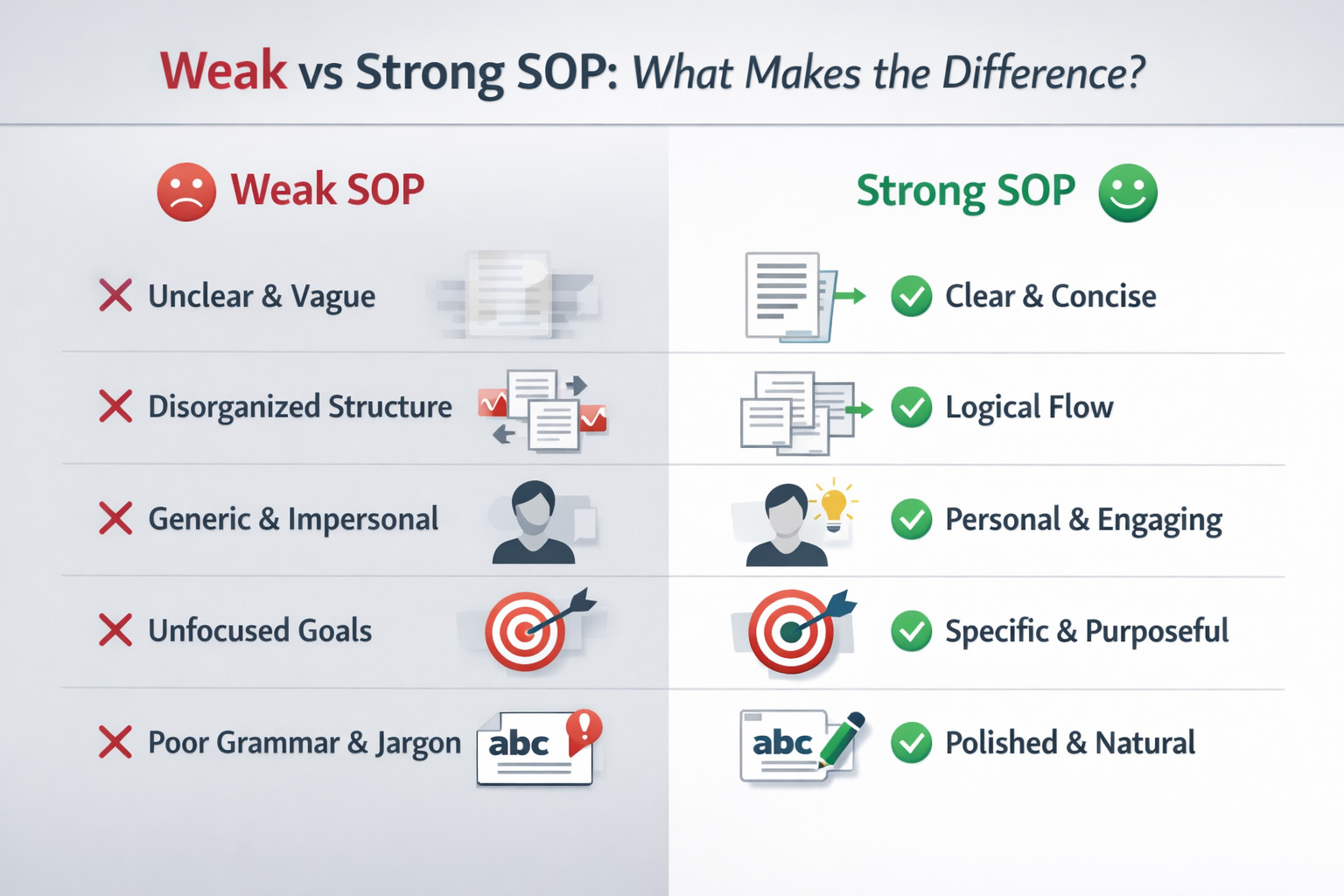
What Makes a Strong SOP Stand Out: Key Elements Compared
Element | Weak SOP | Strong SOP |
|---|---|---|
Structure | Random and unclear | Logical and well-organized |
Personalization | Generic content | Tailored to program and goals |
Language | Overcomplicated or unclear | Clear, natural, and professional |
Storytelling | List of achievements | Coherent academic journey |
Impact | Low engagement | Strong and memorable narrative |
Goal Clarity | Vague or missing | Clearly defined academic and career direction |
Build a Stronger Application with Acatrix
A strong SOP is importantو but a strong application takes more than one document. Acatrix helps you build, personalize, and strengthen your entire academic application in one place.
Stop sending generic applications. Start building one that stands out.
What Acatrix Helps You With
Acatrix supports the key stages of your academic application journey, helping you move from discovering opportunities to submitting a stronger, more personalized application.
1. CV Analysis and Optimization
Identify the strengths and gaps in your academic profile and optimize your CV to present your experience more effectively.
2. SOP and Academic Email Support
Create personalized SOPs and professional emails tailored to specific programs, professors, positions, and application goals.
3. Academic Paper Summarization
Save time by quickly understanding the key ideas, methods, findings, and concepts in research papers relevant to your field.
4. Application Tracking System
Keep your applications organized with a structured system for tracking deadlines, documents, tasks, and application progress.
6. Interview Preparation
Practice realistic academic interviews through text, voice, and video simulations designed around your CV, SOP, research interests, target position, and academic goals.
7. Email Assistant
Write clear, professional, and personalized academic emails for contacting professors, following up on applications, asking research-related questions, and communicating with universities.
If you want to understand how Acatrix simplifies every step of your academic application journey, this guide explains how the platform brings everything together in one place.
Start Your Application for Free!
Related Guides on Academic Writing
1. How to Summarize Research Papers with AI
2. Best Way to Track Multiple University Applications Without Missing Deadlines
3. How Interview Preparation Shapes First Impressions?
4. How to Prepare for an Academic Interview
5. How to Write an Academic Email
Frequently Asked Questions (FAQ) About SOP Writing for Academic Applications
1. How long should an SOP be?
Most universities expect an SOP to be between 800 to 1500 words. However, the ideal length depends on the program and university requirements, so it is always important to follow their specific guidelines.
2. What should I include in my SOP?
A strong SOP should include your academic background, relevant experience, career goals, reasons for choosing the program, and a clear explanation of how the program fits your future plans.
3. Can I use AI to write my SOP for academic applications?
Yes, AI can help with structure, ideas, and editing. However, your SOP must remain personal and authentic. Overusing AI without customization can make your statement sound generic and less convincing. It’s also important to remember that AI-generated content is not always fully reliable or context-aware, especially when it comes to capturing your unique academic story and aligning it with specific program expectations.
4. What makes a strong SOP stand out?
A strong SOP is clear, well-structured, and highly personalized. It tells a coherent story, connects your past experiences with your future goals, and shows genuine motivation for the chosen field.
5. How important is the SOP in the admission process?
The SOP is extremely important, especially for competitive programs. It can often be the deciding factor between candidates with similar academic backgrounds, as it reflects motivation, clarity, and fit for the program.
Can Acatrix help me write or improve my SOP?
Yes. Acatrix helps you create personalized SOPs based on your CV, target program, and academic goals. It also supports editing, rewriting, and improving your SOP for each application, acting as a full academic application assistant rather than just a writing tool.