Before You Apply: Research and Preparation
Most applicants rush to write their SOP before they've done the foundational work. Everything that comes after depends on how well you've done this first stage.
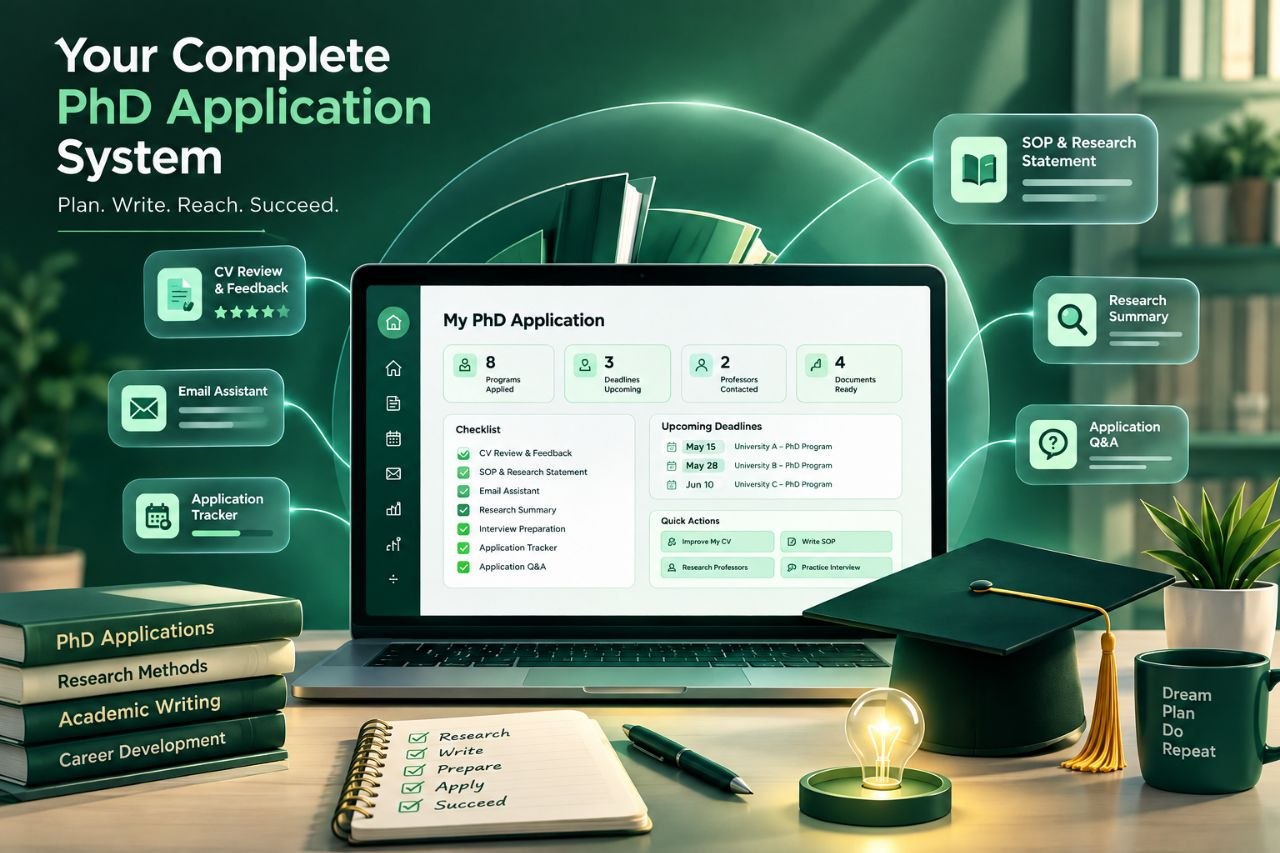
Acatrix is built as an application assistant, that guides you through every step.
1. Research & Preparation Checklist
Define your research interest clearly: one specific question, not a broad field
Identify 8–15 target programs or positions that match your research focus
Research each potential supervisor: read at least 2–3 of their recent papers. Use research paper summaries to understand complex publications faster
Check funding status of each position: salary, stipend, or unfunded
Note all application deadlines in a centralized system
Check language requirements: IELTS, TOEFL, or equivalent
Check if the program requires GRE or GMAT scores
Identify 3–5 referees who can write strong letters of recommendation
Request letters of recommendation early: at least 6–8 weeks before deadlines
These are the documents every PhD application requires. Each one needs to be tailored not recycled from a previous application. Acatrix helps you build each of these documents in one place, so they're consistent and position-specific.
2. CV
Your academic CV is not a job CV. It follows different conventions depending on your field and the country you're applying to. Read our complete guide on how to write a professional CV for academic applications.
CV Checklist
Academic education listed in reverse chronological order
Research experience: thesis, lab work, internships, independent projects
Publications, conference presentations, or posters (if any)
Technical skills relevant to the position
Awards, grants, or fellowships
Teaching or supervisory experience (if applicable)
Tailored to the specific position, not a generic template
Reviewed for clarity, formatting, and academic conventions
3. Statement of Purpose (SOP) / Research Statement
Your SOP is the most important document in your application. It tells the committee who you are as a researcher, what you want to investigate, and why this specific program.
Make sure you understand the difference between a personal statement and an SOP before you start writing. For a complete writing guide, read how to write an SOP for academic applications.
SOP Checklist
Opens with your specific research question, not your life story
Connects your background directly to your research interest
References the supervisor's work specifically by paper, by finding
Explains why THIS program, not any program
Addresses any gaps in your profile honestly and confidently
Clear, concise, and free of academic jargon
Tailored for each individual application,not recycled
4. Letters of Recommendation
Letters of Recommendation Checklist
At least 2–3 letters from academic supervisors who know your research work directly
Referees briefed on the specific position and your research direction
Referees provided with your updated CV and SOP
Submission instructions shared with each referee clearly
Deadlines confirmed with each referee, with a buffer of at least one week
Follow-up reminder sent one week before the deadline
5. Transcripts and Academic Records
Transcripts Checklist
Official transcripts from all universities attended
Translated into English (or the application language) if required
Certified copies prepared if originals are required
GPA or grade equivalency calculated for international programs
6. Research Proposal (if required)
Research Proposal Checklist
Clear research question with defined scope
Brief literature review showing familiarity with the field
Proposed methodology, realistic and appropriate for PhD level
Expected outcomes and timeline
Within the page or word limit specified
Aligned with the supervisor's current research direction
Contacting Supervisors
In many European and Asian programs, contacting the supervisor before applying is not just recommended, it's expected!
A well-timed, personalized email can open a door that a formal application alone never would. Read our complete guide on how to email a professor for PhD admission and review real PhD email examples that get replies vs. ones that get ignored.
Supervisor Email Checklist
Read at least 2 of the supervisor's recent papers before writing
Email references a specific paper, finding, or open question
Your research interest is clearly stated in 2–3 sentences
Subject line is specific not, "PhD Inquiry" or "Research Opportunity"
CV attached (check first: should you attach your CV in the first email?)
Email is under 250 words
Follow-up scheduled if no reply within 2 weeks. Read our guide on how to write a follow-up email after no response
Not sure how long your PhD Statement of Purpose should be? Check out our guide on how long a PhD SOP should be to find the right word count and avoid unnecessary content.
Application Submission
This is where most checklist mistakes happen, not in the documents themselves, but in the submission process. Managing all of this across multiple programs without a structured system leads to errors.
Using a proper application tracking system for academic applications is what keeps everything visible and in order.
Submission Checklist
All required documents uploaded in the correct format (PDF, Word, etc.)
Application fee paid (if required)
All forms completed, including optional sections
Correct version of CV and SOP submitted, not a version meant for another program
References notified that the submission portal invitation has been sent
Confirmation email received and saved
Application status logged in your tracking system
After Submission: Follow-Up and Interview Prep
Submitting the application is not the end. What you do after submission, how you follow up and how you prepare for the interview can be the difference between an offer and a rejection.
Read our full guide on how to prepare for an academic interview and make sure you know how interview preparation shapes your first impression.
Post-Submission Checklist
Application status updated in your tracking system
Follow-up email scheduled if no acknowledgment within 2–3 weeks
Interview invitation response sent promptly
Re-read the supervisor's key papers before the interview
Practiced answering the most common PhD interview questions
Prepare your self-introduction 90–120 seconds, specific and confident
Reviewed common PhD interview mistakes to avoid
Mock interview completed before the real one
Thank-you email sent within 24 hours after the interview
Don't Manage This Checklist Alone
Acatrix is your application assistant for PhD, one platform that handles every item on this checklist, from CV to final interview.
Checklist Mistakes That Cost Applications
1. Using the Same SOP for Every Program
A generic SOP that doesn't mention the supervisor, the lab, or the specific research question is one of the fastest ways to get filtered out.
Every SOP must be tailored. Read our guide on how to write an SOP for academic applications for a complete approach.
2. Missing the Referee Deadline
Your application can be complete and still rejected, because a referee submitted their letter a day late. Set reminders and follow up. Always.
3. Not Tracking Application Status
When you're applying to ten programs, losing track of which ones you've submitted, which are pending, and which have responded is easy. Acatrix gives you a dashboard where every application status is visible and updated in real time.
Read how Acatrix simplifies every step of your academic application journey.
4. Skipping Interview Preparation
Interview prep is always the last thing applicants get to. It shouldn't be. A strong application that collapses in the interview loses to a weaker application with a confident, prepared candidate. Start your mock interview practice on Acatrix before you get the invitation.
How Acatrix Helps You Complete Every Step
Acatrix is the only application assistant for PhD that covers every item on this checklist in one structured platform. Instead of managing documents in Word, deadlines in a spreadsheet, and emails in your inbox, everything lives in one place. Read the complete guide to using Acatrix for academic applications to see how it works end to end.
1. CV Review & Feedback
Get structured feedback on how to present your research experience clearly, even without publications. Make sure your thesis, lab work, and skills are positioned to their full advantage.
2. SOP & Research Statement
Write a position-specific statement of purpose tailored to your background and the exact program. Make the committee focus on your research direction, not on what's missing.
3. Email Assistant
Draft personalized outreach emails to professors that reference their actual research. Show genuine intellectual engagement before your application even arrives.
4. Research Summary
Understand your target professor's recent papers quickly, so your emails and interview answers demonstrate real familiarity with their work.
5. Interview Preparation
Practice mock PhD interviews tailored to your field, your CV, and the specific position. Walk in confident, not hoping for easy questions.
6. Application Tracker
Manage all your applications, deadlines, documents, and supervisor communication in one structured dashboard. Apply to more programs without losing control.
7. Application Q&A
Q&A Service helps you understand and answer every question in university, scholarship, and research application portals with confidence. Whether you're asked about your eligibility, technical skills, research experience, or previous qualifications, our AI assistant explains exactly what's being asked and drafts clear, accurate responses that stay fully consistent with your CV, SOP, and other application documents helping you submit a stronger, more professional application in less time.
Build your application dashboard
Transform Your Academic Profile into a Complete Application System
Your academic journey should not feel scattered or overwhelming.
With Acatrix, every step from CV to interview becomes part of one structured system.
Start your application journey with Acatrix today
Frequently Asked Questions
1. What documents do I need for a PhD application?
The core documents are: academic CV, statement of purpose (SOP) or research statement, letters of recommendation (usually 2–3), official transcripts, and a research proposal (if required). Some programs also require language test scores (IELTS, TOEFL) and GRE results.
2. How many programs should I apply to?
Most advisors recommend 8–15 programs for a competitive PhD application a mix of reach, match, and safety options. Applying to fewer than five significantly limits your chances, especially in competitive fields. Use a tracking system to stay organized across multiple applications.
3. When should I start my PhD application?
At least 6 months before your target start date. Many funded PhD positions in Europe and North America have deadlines 8–12 months before the program begins. Starting early also gives your referees enough time to write strong letters.
4. Do I need to contact the supervisor before applying?
In most European countries, especially Germany, the Netherlands, and Scandinavia yes. In North America, it's less required but still recommended. In the UK, it depends on the program. When in doubt, a well-crafted email never hurts.
5. Can I apply for a PhD if I have no publications?
Yes. Most PhD programs especially at the Master's-to-PhD transition level, do not require publications. Read our full guide on how to apply for a PhD with no publications for a complete strategy.
6. How do I keep track of multiple PhD applications?
A structured application tracking system is essential once you're applying to more than three programs. Read our guide on how to use an application tracking system for academic applications or start tracking on Acatrix for free.