How to Apply for a PhD in Denmark as an International Student (2026)
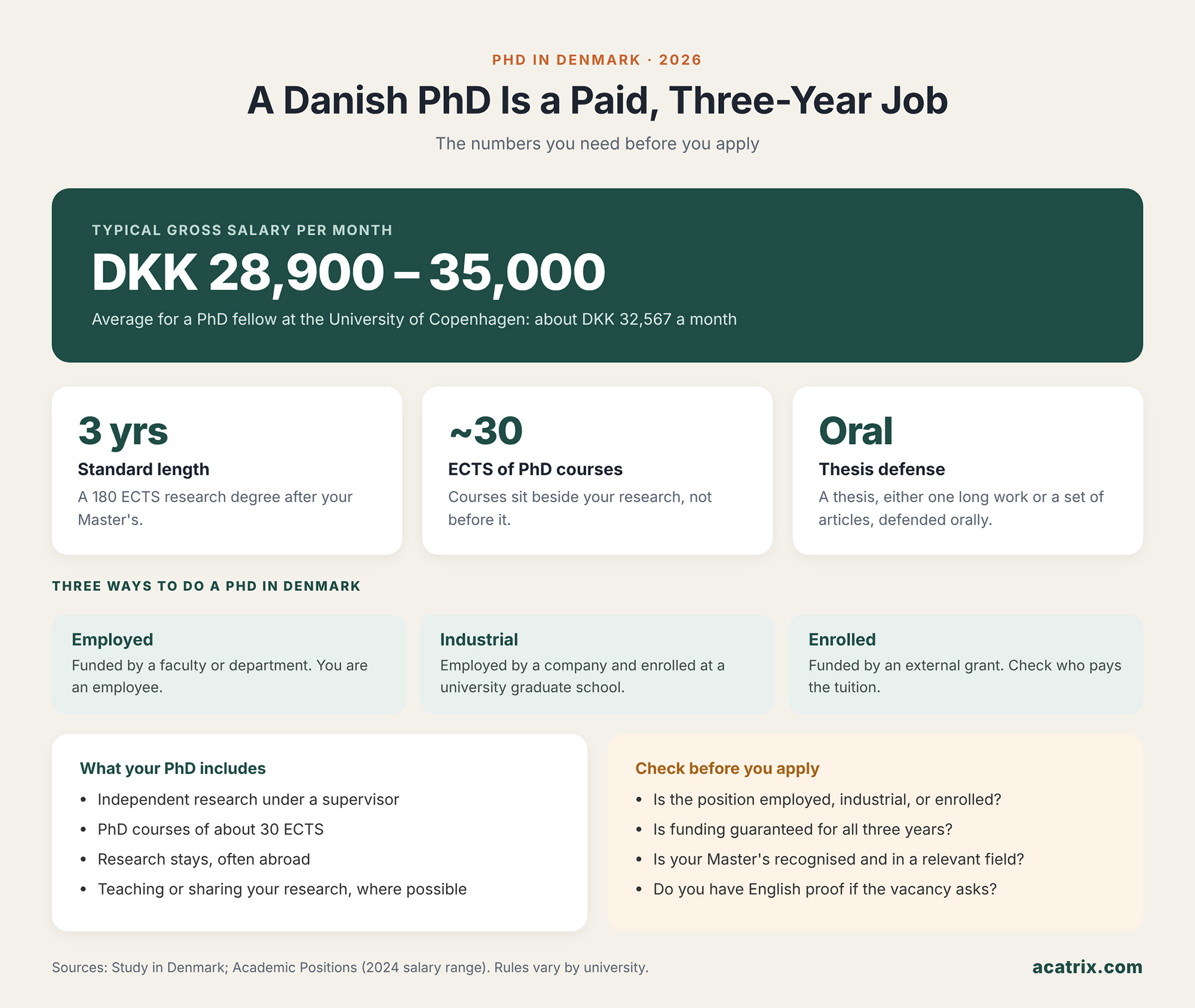
In Denmark, a PhD is a three-year research degree, and most people who do one are paid for it. A typical salary is about DKK 28,900 to 35,000 a month before tax. You work on your own project from the first week.
Before you apply, there is one thing to understand: not every Danish PhD is the same kind of position. Some are jobs, some are industry projects, and some are scholarship-style enrolments. Each one changes your pay, your visa, and even who pays your fees.
Acatrix keeps every project, deadline, and document in one place while you apply. If you are still choosing a country, start with our guide to 10 European countries to consider for a PhD in 2026.
Start organizing your application for free
How a Danish PhD Works
A standard Danish PhD takes three years and is worth 180 ECTS. You do independent research under a supervisor, and you take PhD courses worth about 30 ECTS. Many programmes also expect a research stay at another institution, often abroad, and some teaching or sharing your research with the public.
At the end, you write a thesis. It can be one long work, or a collection of shorter articles. You defend it orally in front of an assessment committee. Most PhD fellows start their research straight away. You usually need a Master's degree in a relevant subject first, plus good English. Each university sets its own exact rules.
Employed, Industrial, or Enrolled? Know Which One You're Applying For
This is the most important part of applying in Denmark. The three types look similar in an advert, but they are not the same.
Type | How it works |
|---|---|
Employed | Funded by a faculty or department. You are an employee of the university, with a salary. |
Industrial PhD | You are employed by a private company and enrolled at a university's graduate school. The company applies for funding from Innovation Fund Denmark on your behalf. |
Enrolled with a grant | Funded by an external grant. You are enrolled at the university, and the grant provider has to cover the costs. |
Check who pays the tuition
For students from outside the EU, EEA, and Switzerland, enrolled PhD students can be charged tuition of DKK 50,000 a year. The grant provider must guarantee payment of all three years when you apply. If the position is employed, ask the contact person to confirm that you will not pay fees yourself.
Not sure which one a vacancy is?
Read the "terms of employment" section, and ask the contact person before you apply. It takes one email.
How Much a PhD Pays in Denmark in 2026
Danish PhD fellows are paid employees, and the pay is similar across universities. A 2024 salary overview lists a range of DKK 28,900 to 35,000 per month before tax, depending on seniority. According to Study in Denmark, the average monthly salary for a PhD fellow at the University of Copenhagen is about DKK 32,567.
What you get | How it works |
|---|---|
Gross monthly salary | About DKK 28,900 to 35,000, depending on seniority |
University of Copenhagen average | About DKK 32,567 a month |
Contract | 3 years, 180 ECTS |
Status | Employee, not a student (for employed positions) |
"Ten projects, ten funding types, ten different rules. Acatrix keeps them in one place, so you always know which one is which."
The Application Process, Step by Step
Step 1: Find an Advertised Project
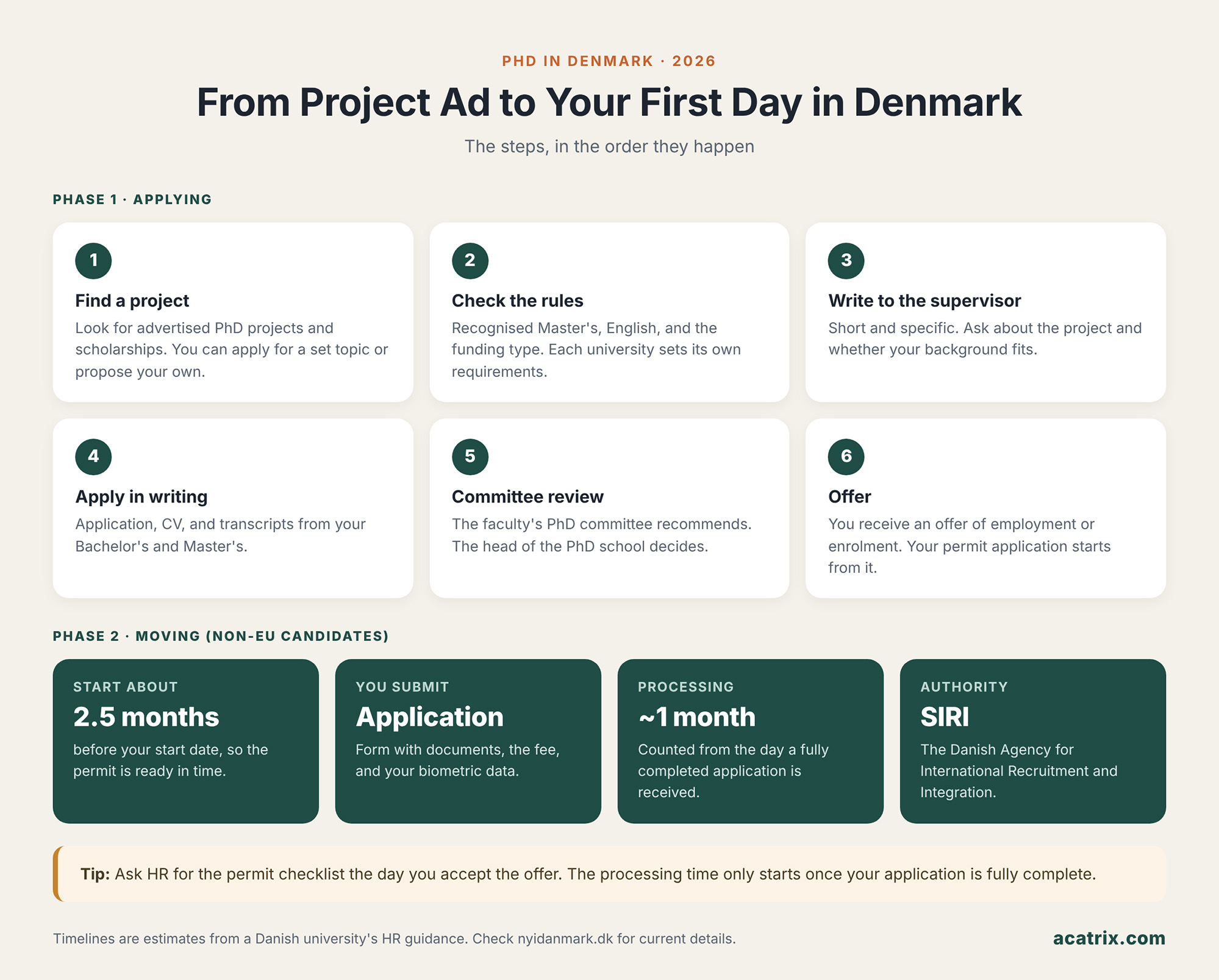
Danish universities advertise PhD projects and scholarships, often with a fixed deadline. You can apply for a project with a set topic, and in some cases you can also propose your own. Check each university's job page, and set alerts for your field so you don't miss short deadlines.
Not sure how many to apply for?
Read how many PhD positions you should apply to.
Step 2: Check That You Qualify
You usually need a recognised Master's degree in a relevant subject, and good English. The vacancy lists exact requirements. If you are unsure whether your degree counts, ask the contact person before you spend time on the application.
Step 3: Write to the Supervisor
Contacting the supervisor first is normal, and it helps you check that your background fits. Keep the email short and specific. Name the project, say why you fit, and ask one clear question.
Our guide on how to write a cold email to a professor shows what a good one looks like. If you don't hear back, here is how to follow up. And read whether to attach your CV in the first email before you send it.
Step 4: Prepare Your Application
You apply in writing. A typical application includes a motivation letter, your CV, and transcripts from your Bachelor's and Master's degrees. Some projects also ask for a research proposal or references.
Have your CV checked. Acatrix's CV Review & Feedback shows how a committee will read it.
Make your letter personal. Here is how to make your SOP more specific and personal.
No publications yet? See how to apply for a PhD with no publications.
Step 5: Submit Before the Deadline
Upload everything through the university's application system before the deadline. Before you submit, run through our PhD application checklist and 5 red flags in a graduate application.
Step 6: The Committee Decides
The faculty's PhD committee reviews the applications and recommends candidates. The head of the PhD school makes the final decision. Shortlisted candidates are usually invited to an interview.
If the idea makes you tense, read how to stop feeling nervous before academic interviews, then 10 PhD interview mistakes and how to introduce yourself in a PhD interview.
For a real practice session, Acatrix's Interview Preparation service lets you run mock interviews by text, audio, or video.
Step 7: Accept the Offer and Start the Permit
If you are selected, you receive an offer of employment or enrolment. If you are from outside the EU, your permit application starts from that offer, so reply quickly and ask for the next steps.
Application due in two weeks?
Acatrix's Research Statement and SOP Drafting service helps you write a letter that fits the exact project, not a generic template.
Can You Start Before You Finish Your Master's?
Some Danish universities offer combined routes that let you begin a PhD earlier. According to Study in Denmark, there are two main ones:
The 3+5 route: you start the PhD and the Master's together, after a Bachelor's.
The 4+4 route: you start the PhD after one year of Master's study.
Each university sets its own rules for these, and not every programme offers them. If you are still finishing your Master's, check the university's PhD page and ask the PhD school directly whether such a route exists in your field.
Your Visa: The Work and Residence Permit
If you are from outside the EU, EEA, Nordic countries, or Switzerland, you need a work and residence permit before you start. You apply to SIRI, the Danish Agency for International Recruitment and Integration. Your university's HR office guides you, and the steps usually go like this:
Get the offer. The PhD administration issues an offer of employment or enrolment once you are academically approved, with proof of your passed Master's and funding for three years.
Receive the permit guide. HR sends you instructions on how to apply.
Submit your application. That includes the fee, the application form with documents, and your biometric data.
Wait for processing. At one Danish university, HR estimates about one month, counted from the day the agency receives a fully completed application.
The same guidance recommends starting about two and a half months before your start date.
Start early!
The processing time only starts once your application is fully complete, so gather every document before you submit. Ask HR for the checklist the day you accept the offer. Timelines change, so check the immigration agency's website for current details.
Your First Weeks in Denmark
Your university's HR or international office usually runs a welcome process for new international staff. Go through it as soon as you arrive. It typically covers registering as a resident, getting your tax and payment details sorted, opening a bank account, and learning how health care works in Denmark. Ask your contact person what you need to do first, and in which order. Many steps depend on each other.
Some offices also run welcome events for international researchers. They are a good way to meet people in your first month.
Where to Live and What It Costs
Housing is the hardest part for most newcomers. Copenhagen is the most expensive city and has a shortage of affordable rooms. Aarhus, Odense, and Aalborg are usually cheaper and have strong universities.
Ask your university about housing. Many have a housing service or contacts for new international staff.
Start looking as soon as you get the offer. Good rooms go quickly.
Never pay a deposit before seeing the place. Rental scams aimed at newcomers exist everywhere.
Thinking About Other Countries? Compare Before You Decide
Netherlands: A PhD is a paid job with a contract and a salary. You apply to a vacancy, not a call.
Germany: No tuition, salaried positions, and many research institutes. Good if you want lots of options.
France: A paid three-year contract, and it often starts from your Master’s research internship.
Spain: Funded through national programs like FPU and FPI, with lower living costs than most of Europe.
Sweden: A PhD is a job with a contract, a salary, and a four-year plan. You apply to an advertised position.
Norway: One of the highest PhD salaries in Europe, but strict grade rules. Many vacancies ask for a B average or better.
Switzerland: Well-paid positions at top research universities, with competitive applications.
United Kingdom: Shorter PhDs of three to four years, but funding depends on the university and the project.
Canada: Funding is usually part of your admission offer, and you often need a supervisor before you apply.
United States: Longer programs with coursework first, and most admitted students get a stipend plus tuition waiver.
Australia: Research-focused PhDs of three to four years. Funding comes through scholarships that cover tuition and a living stipend, and you usually need a supervisor’s support before you apply.
Finland: a Nordic option with a two-part application path. Read the full guide on applying as an international student.
The 7 Universities in Denmark Where You Can Do a PhD
Denmark is small, and it has eight universities. These are the ones to look at:
University of Copenhagen (UCPH): The largest and broadest, strong across health, natural sciences, social sciences, and humanities.
Technical University of Denmark (DTU): Engineering, technology, and natural sciences.
Aarhus University (AU): A broad research university with strengths from science to arts.
University of Southern Denmark (SDU): Spread across several cities, with strengths in health, engineering, and social sciences.
Copenhagen Business School (CBS): Business, economics, and management.
IT University of Copenhagen (ITU): Computer science, software, and digital design.
Roskilde University (RUC): Interdisciplinary research across social sciences, humanities, and natural sciences.
After Your PhD: Staying in Denmark
After a PhD, many graduates move into a postdoc. At the University of Copenhagen, for example, a postdoc can last up to four years. Others move into jobs in industry. Denmark also has a job search permit for people who want to stay and look for work after their studies. Check the immigration agency's website for the current conditions, since they change.
How Acatrix Helps You Track Danish PhD Projects
Danish PhD applications mix different funding types, deadlines, and document lists. Acatrix's Application Tracking System keeps every project, supervisor, and deadline in one dashboard. The Application Q&A service is there when an advert raises a question you can't answer yourself. If you are new to the platform, see our guide to using the application tracking system.
This module is part of the Acatrix Application System, which also includes:
Research Statement & SOP Drafting
For a complete step-by-step guide, learn how to use Acatrix for academic applications and manage everything from finding opportunities to preparing your documents and interviews.
Frequently Asked Questions
1. Is a PhD in Denmark paid?
In most cases, yes. Employed PhD fellows receive a salary, typically about DKK 28,900 to 35,000 per month before tax. Check the vacancy, because some positions are enrolments funded by an external grant.
2. How long is a PhD in Denmark?
Mostly, three years, worth 180 ECTS, after your Master's degree.
3. Do I need a Master's degree?
Usually yes, in a relevant subject, plus good English. Some universities offer combined routes (3+5 and 4+4) that let you start earlier. Each university sets its own rules.
4. Do I need to speak Danish?
Usually not for the PhD itself. Research groups often work in English, and the vacancy states the language. Danish helps in daily life, but it is rarely required to get the job.
5. Will I pay tuition as a non-EU student?
For employed positions, you should not pay fees yourself, but confirm this with the contact person. For enrolled PhD students from outside the EU, EEA, and Switzerland, tuition can be DKK 50,000 a year, and the grant provider must guarantee payment of all three years.
6. How long does the permit take?
One Danish university estimates about one month from the day a fully completed application is received, and recommends starting about two and a half months before your start date. Timelines change, so check the immigration agency's site.
7. Where can I find PhD projects in Denmark?
On the job and PhD pages of each Danish university. Set up alerts for your field so you don't miss short deadlines.