Applying for a PhD in Switzerland
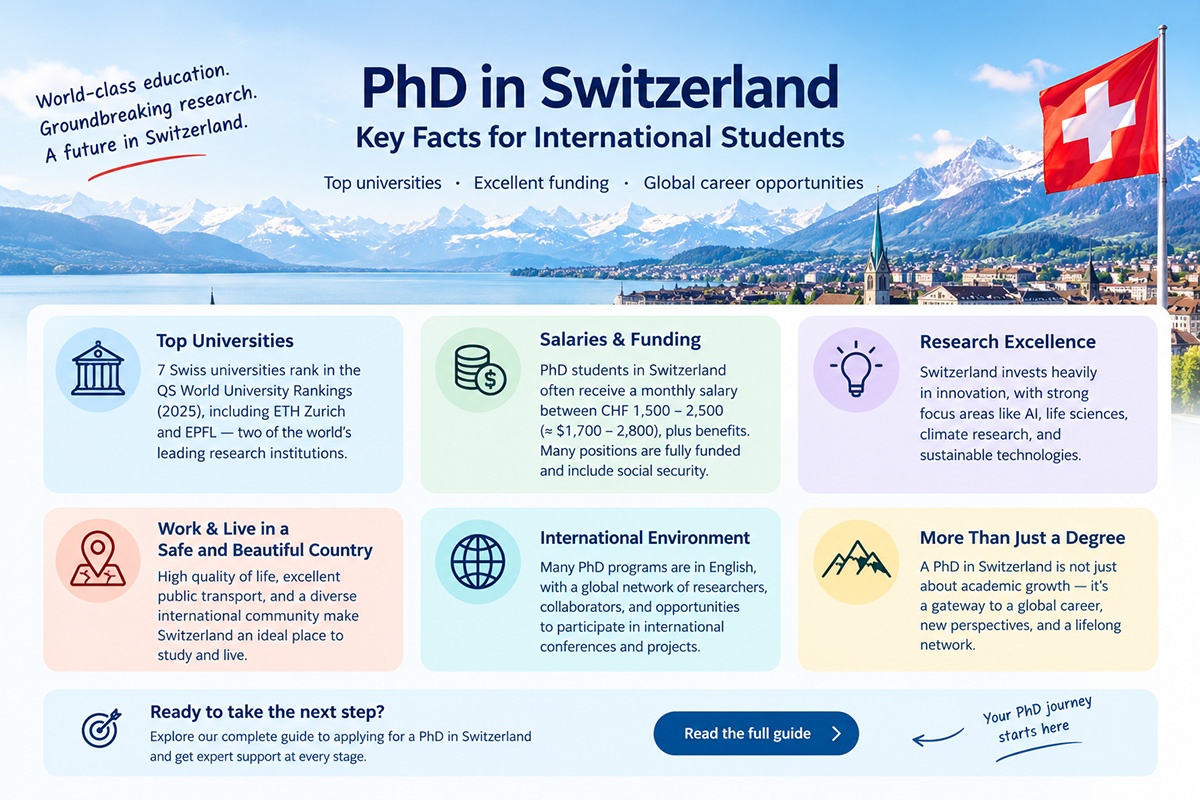
Switzerland is an attractive destination for international PhD candidates because of its internationally recognized universities, well-funded research institutions, and opportunities to work on advanced research projects. Many doctoral positions are advertised as paid employment, particularly in STEM fields, although funding arrangements vary by institution, discipline, and project.
To apply for a PhD in Switzerland, you generally need a relevant master's degree, a strong academic background, and research interests that match a particular supervisor, research group, or advertised position. Depending on the university and opportunity, you may apply directly to a doctoral program, contact a potential supervisor, or submit an application for an advertised PhD vacancy.
This guide of Acatrix, explains how to find PhD opportunities in Switzerland, understand admission and funding requirements, prepare your documents, compare salaries with living costs, and navigate visa and residence procedures as an international applicant.
Planning to apply?
Create your free ACATRIX account to organize potential PhD positions, prepare application documents, and keep track of important deadlines.
Why Choose Switzerland for a PhD?
Switzerland offers a research environment built around internationally connected universities, specialized research institutes, and collaboration between academia and industry. Its universities attract researchers in fields such as engineering, computer science, artificial intelligence, life sciences, medicine, physics, economics, and environmental science.
For international applicants, one of the most important advantages is the availability of funded and salaried doctoral positions. Instead of paying for a doctorate independently, many candidates are recruited to work on a specific research project and receive a salary under an employment contract. However, not every doctoral program follows this model, so funding arrangements must be checked individually.
Switzerland may be particularly suitable if you want to:
Work in an internationally recognized research group.
Pursue doctoral research in a specialized or interdisciplinary field.
Apply for a paid research position rather than rely entirely on personal savings.
Collaborate with research institutes, hospitals, or industry partners.
Build academic and professional connections across Europe.
If you are still comparing destinations, our guide to 10 European countries to consider for a PhD in 2026 can help you compare research environments, funding models, and living costs before deciding where to apply.
How Does a PhD in Switzerland Work?
Unlike some countries with a single national doctoral application system, Switzerland gives individual universities substantial responsibility for doctoral admission. Requirements and procedures can differ by university, faculty, doctoral school, and research field.
According to swissuniversities' overview of doctoral studies, universities organize their own doctoral structures and assess applicants according to their qualifications and institutional requirements. In practice, international candidates generally encounter two main routes.
Route 1: Apply for an Advertised PhD Position
In this model, a university, professor, laboratory, or research institute advertises a specific doctoral vacancy. The project already has an identified research direction and may have funding available.
The advertisement usually describes:
The research topic and expected responsibilities.
Required academic qualifications and technical skills.
The research group or supervisor.
Funding or employment conditions, if applicable.
Application documents and submission instructions.
The deadline and expected starting date.
This route is common in many scientific and technical disciplines, although advertised positions also exist in other fields.
A paid position can be attractive because the employment contract may provide a salary and social benefits. Nevertheless, applicants should confirm the contract duration, employment percentage, gross salary, and funding arrangements rather than assume every PhD vacancy is fully funded.
Route 2: Apply Through a Doctoral Program or Contact a Supervisor
Some universities organize doctoral admission through structured programs, graduate schools, or faculty-specific procedures. Other opportunities may involve identifying a professor whose research aligns with your interests and obtaining confirmation of supervision.
In these cases, you may need to establish contact with a supervisor before completing the formal university application. You should also determine whether funding is already available or whether you must secure a scholarship or another funding source.
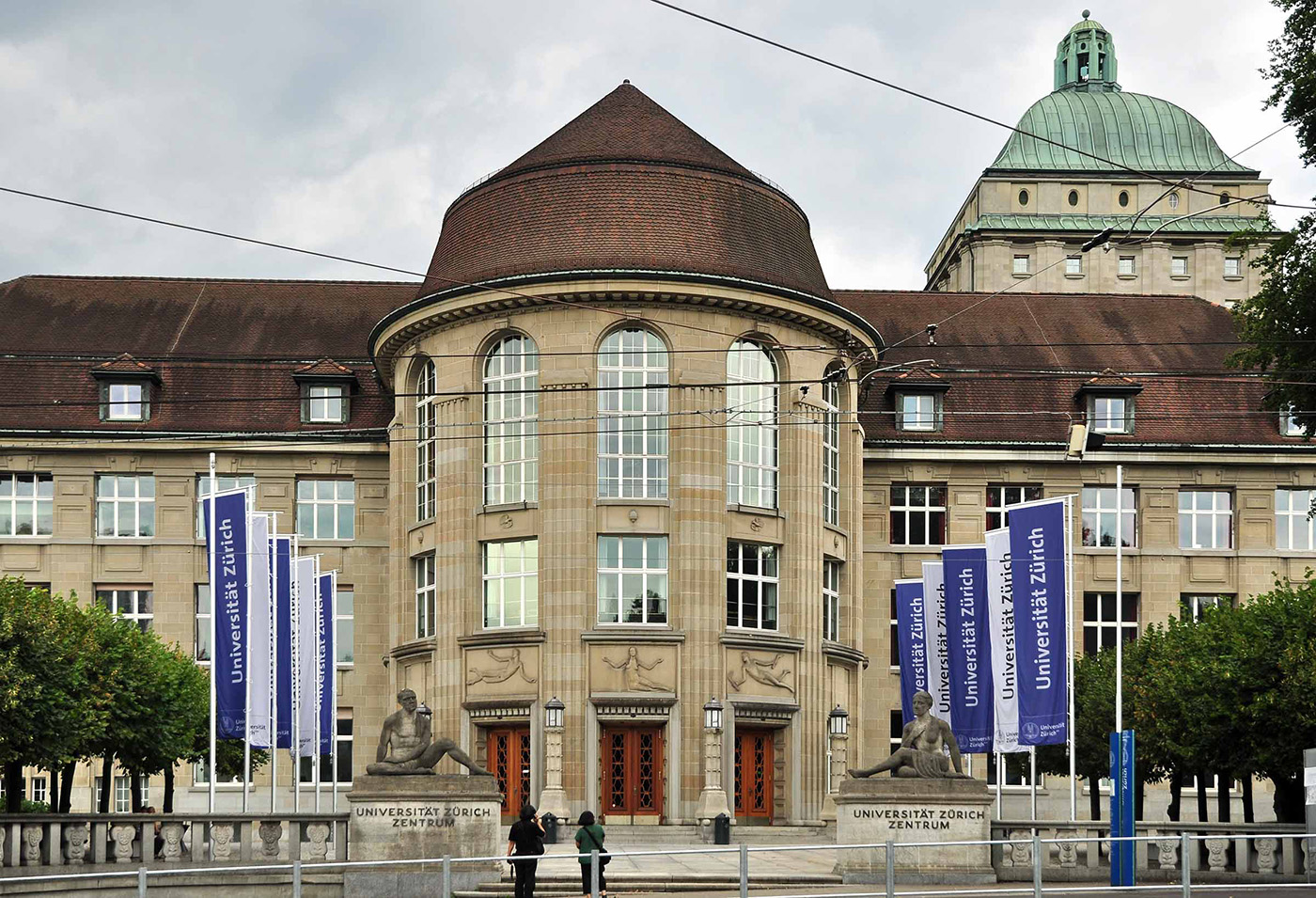
The University of Zurich's doctoral admission guidance illustrates why applicants should check both formal admission requirements and the additional requirements of the relevant faculty or doctoral program.
Before choosing your route, read our guide on how to find a PhD supervisor to learn how to identify researchers whose current work matches your interests.
PhD Admission Requirements in Switzerland
There is no single set of admission requirements that applies to every Swiss university. Your eligibility depends on your previous qualifications, discipline, intended doctoral program, and the university's rules.
1. A Relevant Master's Degree
Most conventional PhD routes require a master's degree or an equivalent qualification in a relevant field. The university may evaluate your degree, academic record, and previous coursework to determine whether your background meets its requirements.
For example, the University of Zurich specifies a master's degree from a state-accredited university among its formal doctoral admission requirements.
Some programs may consider alternative qualifications or additional conditions, but you should never assume that a bachelor's degree alone is sufficient for direct doctoral admission.
Check the official admission requirements of your target institution before preparing a full application.
2. Strong Academic Performance
A competitive academic record can help demonstrate that you are prepared for advanced research. However, selection committees often consider more than grades.
Depending on the field and position, they may assess:
The relevance of your previous degree.
Your master's thesis or other substantial research work.
Your knowledge of the proposed research area.
Your methodological and technical skills.
Your academic references.
Your motivation and ability to work independently.
If you do not have publications, you may still be a viable candidate. A strong thesis, relevant research experience, and evidence of your ability to conduct independent work can help demonstrate your potential. Read our guide on how to apply for a PhD with no publications for more advice.
3. Research Experience and Research Fit
Your research experience should connect clearly with the doctoral opportunity.
For advertised vacancies, selection committees want to understand how your background prepares you to contribute to the project's objectives. For supervisor-led applications, you need to demonstrate a credible connection between your research interests and the supervisor's current work.
Before applying, review the group's recent publications, research methods, ongoing projects, and available facilities.
A generic application that simply expresses an interest in the university is unlikely to communicate this fit effectively. Your application should explain why the specific research topic is appropriate for your experience and future goals.
4. English or Local-Language Requirements
English is widely used in international research groups, particularly in scientific and technical disciplines. Nevertheless, language requirements vary by university, program, and position.
Some opportunities may require proof of English proficiency through an accepted test. Others may grant exemptions under specific conditions, such as previous education in English.
German, French, or Italian may be necessary or advantageous for certain research environments, particularly when the project involves clinical work, teaching, local institutions, or public-facing responsibilities.
Always follow the language requirements in the official vacancy or program description.
🎓 Applying to PhD positions in Switzerland?
Let Acatrix track your vacancies, supervisors, and deadlines in one place.
How to Find Funded PhD Positions in Switzerland
Finding the right vacancy is often one of the most time-consuming stages of the application process. Positions may appear on university career pages, doctoral program websites, research institute portals, and academic job boards.
Where to Search for Swiss PhD Opportunities
Start with the following official university and research career pages:
ETH Zurich: a major research university with opportunities across engineering, natural sciences, architecture, computer science, and related fields.
EPFL: a research-intensive institution with doctoral opportunities in engineering, technology, life sciences, and other disciplines.
University of Zurich: offers doctoral study across a broad range of academic fields.
University of Basel: provides doctoral study and research opportunities across multiple faculties.
University of Geneva: offers research opportunities across sciences, humanities, social sciences, and other disciplines.
University of Bern: provides doctoral opportunities in a wide range of research areas.
University of Lausanne: offers doctoral research across several faculties and interdisciplinary areas.
Academic Positions: an academic recruitment platform where you can search for doctoral vacancies in Switzerland and other countries.
These links are starting points, not a guarantee that a particular institution currently has a vacancy in your field. Availability and deadlines change, so review the official advertisement before applying.
You should also search individual research institute websites and the career pages of laboratories whose work aligns closely with your interests.
For a broader strategy, see our guide on how to find open PhD positions in Europe in 2026. It explains how to search across institutions, identify funded opportunities, and manage a more targeted application process.
How to Search More Strategically
Rather than applying to every available position, build a shortlist based on research fit and realistic eligibility. For each vacancy, record:
University and department.
Research group and potential supervisor.
Project title and research objectives.
Required qualifications and skills.
Funding and employment conditions.
Required application documents.
Deadline and expected start date.
Contact person and application portal.
If you are applying to several universities simultaneously, our article on how many PhD positions you should apply to can help you develop a realistic application strategy.
Make your PhD search easier to manage: organize your opportunities, keep application information together, and track the next steps in your application journey.
How Much Does a PhD in Switzerland Pay?
Switzerland is known for relatively high salaries, but doctoral compensation varies substantially across institutions, disciplines, funding arrangements, and employment percentages.
Many universities employ doctoral researchers through fixed-term contracts. Others may offer scholarships, grants, or different funding arrangements. A vacancy's advertised salary should therefore be treated as the authoritative starting point for evaluating a particular opportunity.
What Determines a PhD Salary?
The most important factors include:
Institution: Universities and research institutions may use different salary scales.
Employment percentage: A position advertised at 60%, 80%, or 100% will have different gross pay.
Year of doctoral study: Some institutions use salary scales that increase over time.
Funding source: Project funding, institutional contracts, and scholarships may have different financial conditions.
Discipline and position: Responsibilities and employment arrangements can vary by field.
Before accepting an offer, check whether the advertised amount is gross or net, whether it applies to a full-time position, and whether pension contributions and social insurance are deducted.
Can You Do a PhD in Switzerland Without Funding?
It may be possible to pursue doctoral studies through a scholarship, personal funding, or another arrangement, depending on the university and program. However, admission and funding are separate questions in many cases.
An academic department may consider you eligible for doctoral study without having a funded position available. In that situation, you need to understand how tuition or semester fees, living expenses, insurance, and residence requirements will be covered.
For most international applicants, it is sensible to prioritize positions with clearly documented funding before committing to a move.
Before contacting a potential PhD supervisor, make sure your application materials are ready. Read our guide on whether you should attach your CV in the first email to a professor to learn when to include your academic CV and how to make a professional first impression.
Scholarships and Funding for International PhD Students
International candidates may have several potential funding routes, but eligibility depends on nationality, academic field, institution, and the purpose of the funding.
1. University-Funded PhD Positions
For many candidates, the most direct funding route is an advertised doctoral position that includes an employment contract.
In this arrangement, the research group has a project or funding structure that supports the position. The vacancy should explain the role, required qualifications, and employment conditions.
Always confirm whether the funding covers the expected doctoral period and whether extensions depend on performance, project needs, or renewed funding.
2. Swiss Government Excellence Scholarships
The Swiss Government Excellence Scholarships support eligible international researchers and scholars under country-specific and program-specific rules.
The available categories, eligibility requirements, and application procedures vary. Prospective doctoral candidates should consult the official Swiss Government Excellence Scholarships information and check whether a relevant scholarship is available to applicants from their country.
Importantly, a scholarship application is not necessarily the same as an application for admission to a Swiss university. You may need to manage both processes separately and coordinate their deadlines.
3. Research Grants and External Funding
Depending on your discipline and project, additional opportunities may be available through research foundations, international programs, institutional partnerships, or grants.
The Swiss National Science Foundation (SNSF) provides information about its funding programs. However, not every SNSF funding scheme is designed for prospective PhD applicants, so carefully check the eligibility criteria before investing time in an application.
How to Evaluate a Funding Offer
Do not rely on the phrase "fully funded" alone. Confirm what the offer actually covers.
Funding detail | What to check |
|---|---|
Salary or stipend | Monthly amount, gross or net, and payment frequency |
Duration | Initial contract length and extension conditions |
Tuition and fees | Semester fees or other university charges |
Insurance | Health insurance and any employer contributions |
Social benefits | Pension and other applicable employment benefits |
Research expenses | Conference travel, equipment, and research costs |
Relocation | Whether moving expenses or initial support are available |
Step-by-Step: How to Apply for a PhD in Switzerland
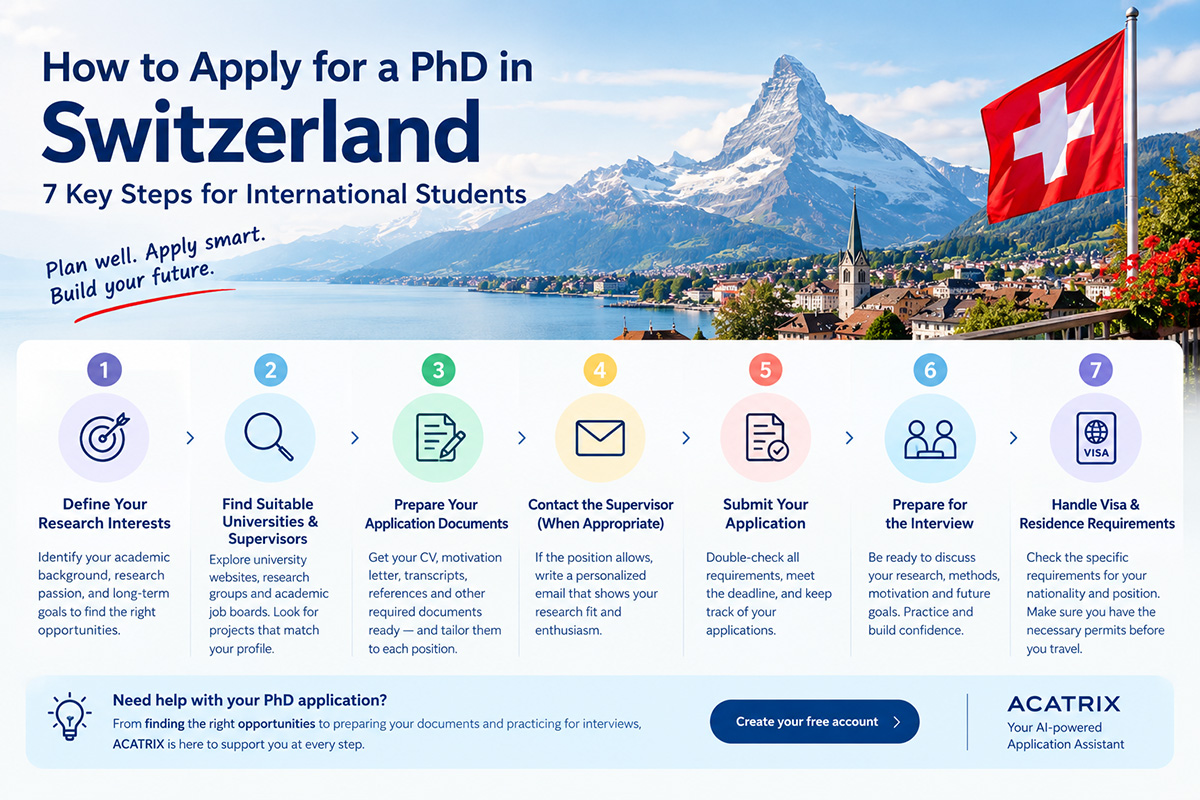
A strong application starts with a clear understanding of the opportunity. The following steps can help you prepare a focused and organized application.
Step 1: Define Your Research Interests
Before searching for vacancies, identify the research topics you want to pursue and the skills you can contribute. Consider your master's thesis, research experience, technical methods, and long-term academic or professional goals.
You do not need a completely finalized PhD research proposal for every advertised position. Some vacancies already have a defined project. In those cases, your task is to show how your experience aligns with the project's aims.
Step 2: Identify Suitable Universities and Supervisors
Search university career pages, doctoral program websites, and research groups. Read recent publications and look for projects that connect with your background.
Evaluate each opportunity using three questions:
Does my academic background meet the stated requirements?
Can I demonstrate relevant research skills or experience?
Does this project align with my interests and longer-term goals?
This initial screening helps you focus your effort on opportunities where you can make a credible case for your candidacy.
Step 3: Contact the Supervisor When Appropriate
Some advertised positions explicitly invite applicants to contact the project leader. Other institutions prefer candidates to apply through a formal portal without contacting the supervisor first.
Follow the instructions in the advertisement. When contact is appropriate, write a concise email that identifies the position, explains your relevant background, and establishes a clear connection between your experience and the project.
Avoid sending the same generic message to multiple professors. A thoughtful, personalized email is more likely to demonstrate that you understand their research.
Our guide on how to write a cold email to a professor explains how to structure your first message. You can also review what to put in a PhD email subject line before sending your email.
Step 4: Prepare Your Application Documents
The required documents vary by position, but a typical application may include:
Academic CV.
Cover letter or motivation letter.
Master's and bachelor's transcripts.
Degree certificates.
Contact details for academic referees or reference letters.
Research statement or proposal, if requested.
English-language test results, where required.
Writing samples, publications, or other evidence of research ability, if requested.
Do not submit every possible document automatically. Follow the vacancy's instructions and make sure each required item is included in the requested format. For a complete document-by-document preparation process, use our PhD application checklist.
Your academic CV should make your research experience, education, technical skills, publications, and relevant achievements easy to assess. Our academic CV review service explains how structured feedback can help you improve your CV before applying.
Step 5: Write a Tailored Motivation Letter or Research Statement
Your motivation letter should explain why you are applying for this specific opportunity, what you bring to the research group, and how the position fits your academic direction.
Avoid repeating your CV line by line. Instead, select the most relevant experiences and explain what they demonstrate about your research abilities and motivation.
If the vacancy requests a research statement or proposal, follow its instructions carefully. The expected level of detail can differ considerably between a defined project vacancy and an open doctoral application.
For more guidance, read how to write a letter of motivation for a PhD and how to make your SOP more specific and personal.
Step 6: Submit Before the Deadline
Check the application portal and confirm that your documents have uploaded successfully.
Before submitting, verify:
Your documents refer to the correct project and institution.
Your CV and motivation letter contain consistent information.
Your degree records and references meet the stated requirements.
Your files follow the requested format and naming conventions.
Your referees have been contacted if recommendations are required.
You have saved the vacancy details and submission confirmation.
If you are applying to several positions, keep a record of each submission and its next steps. Our guide on tracking multiple university applications without missing deadlines explains how to create a more reliable system.
Step 7: Prepare for the Interview
Shortlisted candidates may be invited to an online or in-person interview. Depending on the position, the interview may involve a discussion of your previous research, a presentation, technical questions, or questions about your motivation and future plans.
Prepare to explain:
The research question you investigated previously.
The methods you used and why you selected them.
The results and limitations of your work.
Why this particular project interests you.
How your skills fit the research group's needs.
How you would approach a research challenge or failed experiment.
You should be ready to discuss your work critically, not just describe it.
To prepare, explore our guides on how to answer "Why do you want a PhD?" in 2026 and how to stop feeling nervous before academic interviews. You can also explore ACATRIX Interview Preparation to practice explaining your research and responding to interview questions.
Visa and Residence Permits for International PhD Candidates
Visa and residence requirements depend on your nationality, the nature of your doctoral arrangement, and whether your position includes employment.
Candidates should distinguish between entry permission, residence authorization, and permission to work. These requirements are related but are not interchangeable.
If You Are an EU or EFTA Citizen:
EU/EFTA citizens generally follow different entry, residence, and employment procedures from nationals of other countries. Registration and permit requirements can still apply, particularly when taking up employment.
Check the instructions provided by your university and the relevant cantonal authorities before moving.
If You Are a Non-EU/EFTA Citizen:
You may need a visa and/or residence and work authorization before beginning your doctoral studies or employment.
For employed doctoral candidates, the university or its human resources department may coordinate parts of the procedure. The exact process depends on the institution and canton.
ETH Zurich provides specific guidance on immigration and housing for doctoral candidates, while the University of Zurich explains its procedures for international students and doctoral candidates.
Before making travel arrangements, confirm the sequence of admission, employment, visa authorization, registration, and permit issuance with the institution and the appropriate authorities. Do not assume that an offer letter alone gives you permission to begin work.
Important: Immigration requirements can change and may differ by canton and individual circumstances. Use official government and university guidance for your own situation rather than relying solely on general online advice.
Thinking About Other Countries? Compare Before You Decide
Netherlands: A PhD is a paid job with a contract and a salary. You apply to a vacancy, not a call.
Germany: No tuition, salaried positions, and many research institutes. Good if you want lots of options.
France: A paid three-year contract, and it often starts from your Master’s research internship.
Spain: Funded through national programs like FPU and FPI, with lower living costs than most of Europe.
United Kingdom: Shorter PhDs of three to four years, but funding depends on the university and the project.
Canada: Funding is usually part of your admission offer, and you often need a supervisor before you apply.
United States: Longer programs with coursework first, and most admitted students get a stipend plus tuition waiver.
Australia: Research-focused PhDs of three to four years. Funding comes through scholarships that cover tuition and a living stipend, and you usually need a supervisor’s support before you apply.
Sweden: A PhD is a job with a contract, a salary, and a four-year plan. You apply to an advertised position.
Norway: One of the highest PhD salaries in Europe, but strict grade rules. Many vacancies ask for a B average or better.
Switzerland: Well-paid positions at top research universities, with competitive applications.
Denmark: A three-year PhD, with three types of position: employed, industrial, or enrolled with a grant. Check which one you are applying for.
Italy: You apply through an official call (a bando), and funded places come with a monthly scholarship.
Finland: a Nordic option with a two-part application path. Read the full guide on applying as an international student.
Cost of Living in Switzerland: What PhD Applicants Should Know
Switzerland has high living costs, particularly in major university cities such as Zurich, Lausanne, and Geneva. Even when a doctoral position offers a competitive salary, your financial situation will depend on rent, insurance, taxes, transportation, and other expenses.
1. Housing
Accommodation can be a major expense, and suitable housing may be difficult to secure near some universities. Start researching accommodation as soon as your application progresses, especially if you are relocating from abroad. Ask the university whether it provides student housing, staff accommodation, or guidance for incoming doctoral researchers.
ETH Zurich's immigration and housing guide notes that accommodation options can be limited and that doctoral candidates may need to arrange their own housing.
2. Health Insurance
Health insurance requirements depend on your residence status and individual circumstances. Many people living in Switzerland are subject to compulsory health insurance rules, although exemptions and special arrangements may apply.
Review the information provided by your university and the Swiss Federal Office of Public Health before budgeting for your stay.
3. Building a Realistic Budget
Before accepting an offer, estimate your monthly expenses, including:
Rent and utilities.
Health insurance.
Food and household expenses.
Public transportation.
Telephone and internet.
Taxes and social contributions, where applicable.
University fees and research-related costs.
Initial relocation expenses and an emergency reserve.
Compare these costs with your expected take-home income, not just the gross salary advertised in the vacancy. A well-funded position can make doctoral study in Switzerland financially viable, but the details of the contract and your living arrangements matter more than a headline salary.
Best Universities in Switzerland for a PhD
The best university for your doctorate depends on your research topic, the supervisor, the available funding, and the specific doctoral position. The institutions below are useful starting points for exploring opportunities, not a universal ranking.
1. ETH Zurich
ETH Zurich is particularly relevant to applicants in engineering, computer science, mathematics, physics, architecture, and natural sciences.
Explore its doctoral study information and relevant department or research-group vacancies.
2. EPFL
EPFL, based in Lausanne, has a strong research environment in engineering, computer science, life sciences, and related interdisciplinary areas.
Visit its doctoral education website to review program information and explore opportunities.
3. University of Zurich
The University of Zurich offers doctoral study across a wide range of disciplines, including medicine, life sciences, social sciences, economics, humanities, and natural sciences.
Start with its official doctoral admission guidance.
4. University of Basel
The University of Basel is a useful destination to explore for applicants in life sciences, medicine, humanities, social sciences, and other research fields.
Visit the university's doctoral study information and search for relevant faculty or research-group opportunities.
5. University of Geneva
The University of Geneva offers research opportunities across sciences, international relations, social sciences, humanities, and other disciplines.
Begin with the official university website and navigate to the relevant faculty or doctoral program.
6. University of Bern
The University of Bern provides doctoral opportunities in a broad range of subjects, including science, medicine, climate research, humanities, and social sciences.
Explore the University of Bern website to find doctoral requirements and current research opportunities.
7. University of Lausanne
The University of Lausanne is worth considering for applicants in life sciences, medicine, social sciences, humanities, and interdisciplinary research.
Visit the official university website and check the doctoral opportunities offered by the relevant faculty.
When comparing institutions, prioritize the research group and the terms of the opportunity. A less familiar department with an excellent supervisor and appropriate funding may be a better fit than a more famous university with limited alignment to your research interests.
Common Mistakes to Avoid When Applying for a PhD in Switzerland
Even strong applicants can weaken their chances by overlooking important details. Avoid these common mistakes:
1. Applying Without Checking the Funding Model
A doctoral admission offer does not necessarily mean you have a salary or scholarship. Confirm how the position is funded, what it pays, and how long the funding lasts.
2. Sending Generic Applications
A generic motivation letter rarely demonstrates why you are suitable for a particular project. Tailor your documents to the research objectives, required skills, and expectations of the institution.
3. Contacting Professors Without Researching Their Work
Before emailing a potential supervisor, review their recent publications and current projects. Your message should show a genuine and specific connection to their research.
4. Ignoring the Vacancy's Instructions
Some positions require a particular combination of documents, references, or application procedures. Missing a mandatory item can undermine an otherwise strong application.
5. Focusing Only on University Rankings
Research fit, supervisor availability, funding, laboratory resources, and the quality of mentorship can be more relevant to your doctoral experience than a university's overall ranking.
6. Underestimating Living Costs and Administrative Requirements
Research housing, insurance, and residence procedures early. Do not wait until your intended start date to clarify whether you have the documents and authorizations required to relocate and begin work.
For a final review before submitting, see our guide to five red flags in a graduate application.
How ACATRIX Helps You Manage Your Swiss PhD Applications
Applying for a PhD in Switzerland can involve multiple universities, research groups, application portals, deadlines, and document requirements. Keeping everything organized becomes increasingly important when you apply to several opportunities at the same time.
ACATRIX is an AI-powered Application Assistant designed to help you manage the academic application process more systematically.
You can use ACATRIX to support key stages of your application journey, including organizing opportunities, reviewing application documents, preparing emails, summarizing research papers, and practicing for interviews.
For example, before contacting a potential supervisor, you can use a structured workflow to connect the opportunity with your academic background and research interests. As you progress, you can keep track of application steps and upcoming deadlines instead of relying on scattered notes and email threads.
Start organizing your Swiss PhD applications today. Create your free ACATRIX account and begin building a more structured application workflow.
How ACATRIX Supports Your Complete PhD Application
A successful application requires more than finding an open position. You also need to demonstrate research fit, communicate your motivation, present your experience clearly, and prepare to discuss your work with a selection committee.
ACATRIX brings several application-support tools together in one platform:
Opportunity and application tracking: Keep your target positions and application steps organized.
Academic CV review: Improve the clarity and relevance of your research experience and qualifications.
SOP and research statement support: Develop more focused application documents tailored to the opportunity.
Email assistance: Prepare clearer, more relevant messages to potential supervisors.
Research paper summaries: Review relevant academic literature more efficiently.
Interview preparation: Practice communicating your research experience, motivation, and academic goals.
These tools are designed to support your preparation, not replace your judgment or guarantee admission. You remain responsible for checking the accuracy of your documents, following each university's instructions, and ensuring that your application reflects your own experience and ideas.
Explore the ACATRIX services to see how the platform can fit into your application workflow.
Your next step? Sign up for free and start organizing the opportunities, documents, and deadlines that matter to your PhD search.
This module is part of the Acatrix Application System, which also includes:
Research Statement & SOP Drafting
For a complete step-by-step guide, learn how to use Acatrix for academic applications and manage everything from finding opportunities to preparing your documents and interviews.
Read More about Academic Apply
1. Acatrix vs. ChatGPT: Which AI Tool Is Better for Applications?
2. What If You Don’t Know the Answer to a Question in a PhD Interview?
3. What to Wear to a PhD Interview
4. How to Prepare for an Academic Interview
5. How to Apply for a PhD in Canada as an International Student (2026)
6. How to Apply for PhD in US as an International Student
7. How to Apply for a PhD in Germany as an International Student
8. How to Apply for a PhD in Australia as an International Student 2026
9. How to Apply for a PhD in the Netherlands as an International Student (2026)
10. How to Apply for a PhD in France as an International Student (2026)
11. How to Get a Fully Funded PhD in Spain as an International Student (2026)
Frequently Asked Questions About PhD Applications in Switzerland
1. Is Switzerland a good destination for international PhD students?
Switzerland can be an excellent destination for candidates whose research interests align with its universities and research institutes. It offers internationally connected research environments and many funded or salaried doctoral opportunities, although competition, living costs, and funding arrangements vary.
2. Can international students get a fully funded PhD in Switzerland?
Yes, funded doctoral opportunities are available to international candidates. Many advertised positions include employment contracts, while other opportunities rely on scholarships or external funding. Always check the funding details and eligibility requirements of the specific position.
3. Do I need a master's degree to apply for a PhD in Switzerland?
Most traditional doctoral routes require a relevant master's degree or an equivalent qualification. Requirements vary by institution and program, so check the official admission rules before applying.
4. How much does a PhD student earn in Switzerland?
There is no single salary that applies to every Swiss PhD candidate. Compensation depends on the university, discipline, funding arrangement, employment percentage, and year of study. Consult the current salary scale and employment conditions published by the institution advertising the position.
5. Do I need to contact a professor before applying?
It depends on the opportunity. Some positions require or encourage contact with the supervisor, while others require candidates to apply through a formal recruitment portal. Follow the instructions in the official vacancy or doctoral program.
6. Do I need IELTS or TOEFL for a PhD in Switzerland?
Not necessarily. Language requirements vary by institution, program, and research position. Some require a recognized English-language test, while others may accept exemptions under specific conditions. Check the official requirements before submitting your application.
7. Can I apply for a PhD in Switzerland without publications?
Yes. Publications can strengthen an application, but they are not a universal requirement. Your master's thesis, research experience, methods, technical skills, references, and fit with the project may also demonstrate your research potential.
8. Are PhD students in Switzerland employees or students?
Both arrangements exist. Many doctoral candidates hold employment contracts, while others pursue doctoral study through scholarships or alternative funding structures. Check whether the opportunity is an employment-based position and review the associated salary, benefits, and obligations.
9. Do international PhD candidates need a visa?
Visa and residence requirements depend on nationality, employment status, and the planned stay. Some candidates need visa authorization and a residence or work permit. Consult the relevant Swiss authorities and your university before making travel arrangements.
10. Is it expensive to live in Switzerland during a PhD?
Switzerland has relatively high living costs, particularly in major university cities. Before accepting an offer, compare your expected take-home income with housing, health insurance, transportation, and other expenses.
11. When should I start applying for a PhD in Switzerland?
Start searching as early as possible, particularly if you need time to identify suitable projects, prepare documents, contact referees, and arrange immigration paperwork. Advertised positions have their own deadlines, while structured doctoral programs may follow separate application cycles.
12. How can I improve my chances of getting a PhD in Switzerland?
Focus on opportunities that match your qualifications and research interests, prepare tailored application documents, demonstrate relevant research skills, and follow the vacancy's instructions carefully. Prepare for interviews by practicing how to explain your previous work, research methods, and motivation.
No approach can guarantee admission, but a focused and well-organized application strategy can help you present your strengths more effectively.
Final Thoughts
Applying for a PhD in Switzerland requires careful research, a clear understanding of funding, and a targeted approach to each opportunity. Start by identifying suitable research groups, checking the official admission requirements, and confirming how each position is funded.
Prepare your documents around the specific project, keep track of deadlines, and plan for housing and immigration requirements well before your intended start date.
You do not need to manage every step from memory or through disconnected files. With a clear application workflow, you can spend more time evaluating research opportunities and preparing a strong case for your candidacy.
Ready to take the next step? Start your first application for free with ACATRIX and bring your PhD opportunities, documents, and application steps into one organized workflow.