
How to Apply for a PhD in Finland as an International Student (2026)
In Finland, getting into a doctoral programme and getting paid for it are two different steps. You can win one and still miss the other. Many applicants only find this out halfway through.
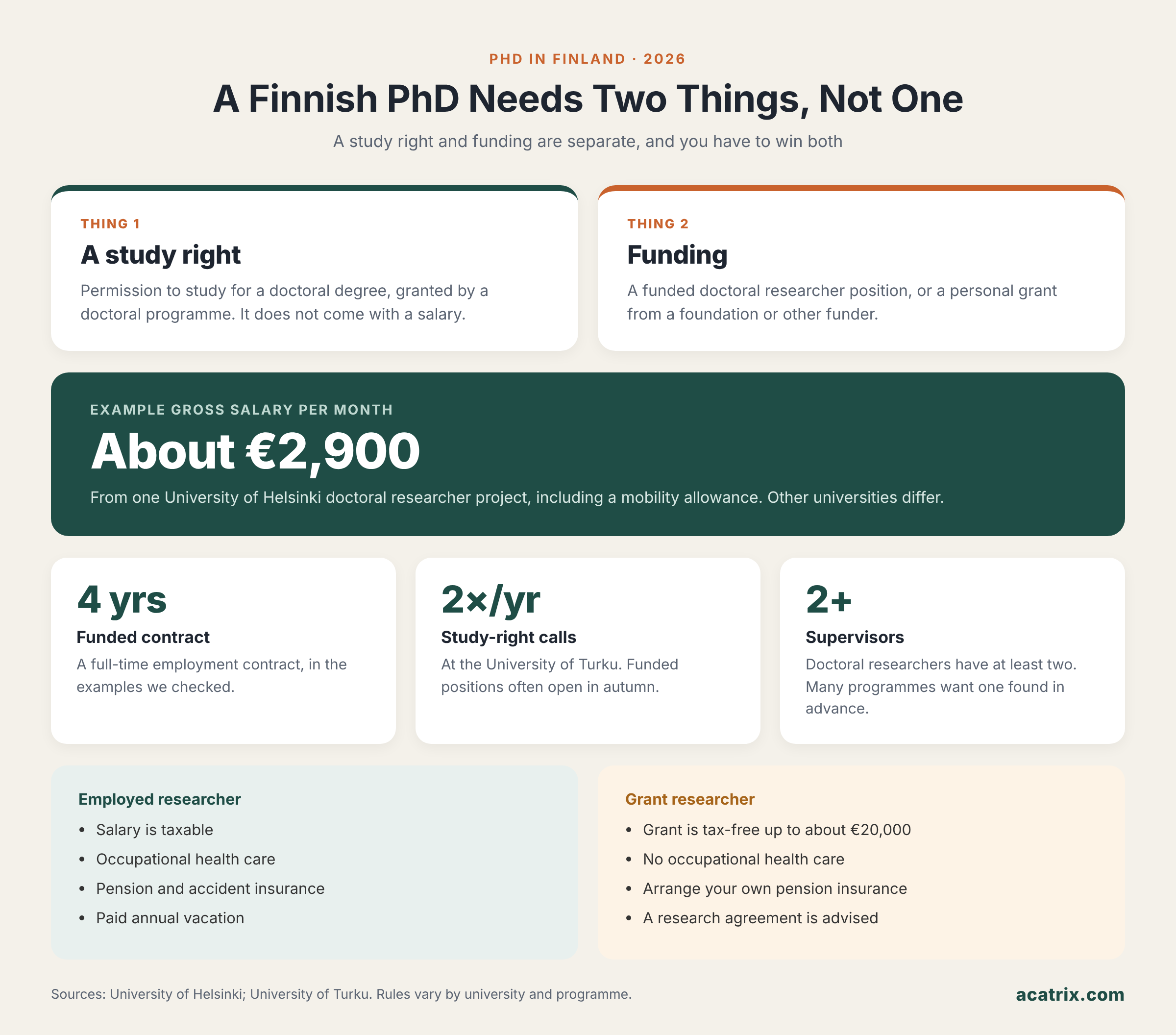
The first step is a study right, which lets you work toward a doctoral degree. The second is funding, which is usually a salaried position as a doctoral researcher. Most of the work in your application is about winning both.
Acatrix keeps every programme, position, and deadline in one place while you do it. If you are still choosing a country, start with our guide to 10 European countries to consider for a PhD in 2026.
How a Finnish PhD Works
You are called a doctoral researcher. If you hold a funded position, you are an employee of the university, with a contract that follows the national university collective agreement. In the examples we checked, funded contracts are full-time and last up to four years.
Your work is planned with your supervisors. At the University of Turku, for example, every doctoral researcher has at least two supervisors, and many programmes ask you to find a supervisor before you apply. Your daily duties are set in an individual work plan, and the annual workload in a Helsinki project is about 1,612 hours.
Some contracts start with a six-month trial period. In that Helsinki example, selected candidates must be granted the right to pursue a doctoral degree no later than the end of the trial period. So the study right and the job are linked, but they are not the same thing.
Many Finnish programmes expect you to have a supervisor before you apply, so finding the right PhD supervisor is your real first step.
Study Right vs. Funding: The Part Nobody Explains
This is the most important thing to understand about Finland. A study right and a funded position are separate, and each has its own application.
Study right | Funding | |
|---|---|---|
What it is | Permission to study for a doctoral degree at a university | A salaried position, or a personal grant |
Who decides | The doctoral programme | The university or the funder |
Includes a salary? | No | Yes, if it is a position |
When to apply | Some programmes run calls twice a year | Funded positions are often advertised in autumn |
10 Universities in Finland Where You Can Do a PhD
Finland has strong research universities across the country. These come up most often for international candidates:
University of Helsinki: The largest and broadest, strong across sciences, humanities, and social sciences.
Aalto University, Espoo: Engineering, technology, business, and design.
Tampere University: Technology, health, and social sciences.
University of Turku: A broad research university with strengths in life sciences and biomedicine.
University of Oulu: Technology and information technology, and Arctic research.
University of Jyväskylä: Sciences, education, and humanities.
LUT University: Energy, industrial engineering, and business.
Åbo Akademi University: A Swedish-language university in Turku, with strengths in engineering and the sciences.
University of Vaasa: Business and energy.
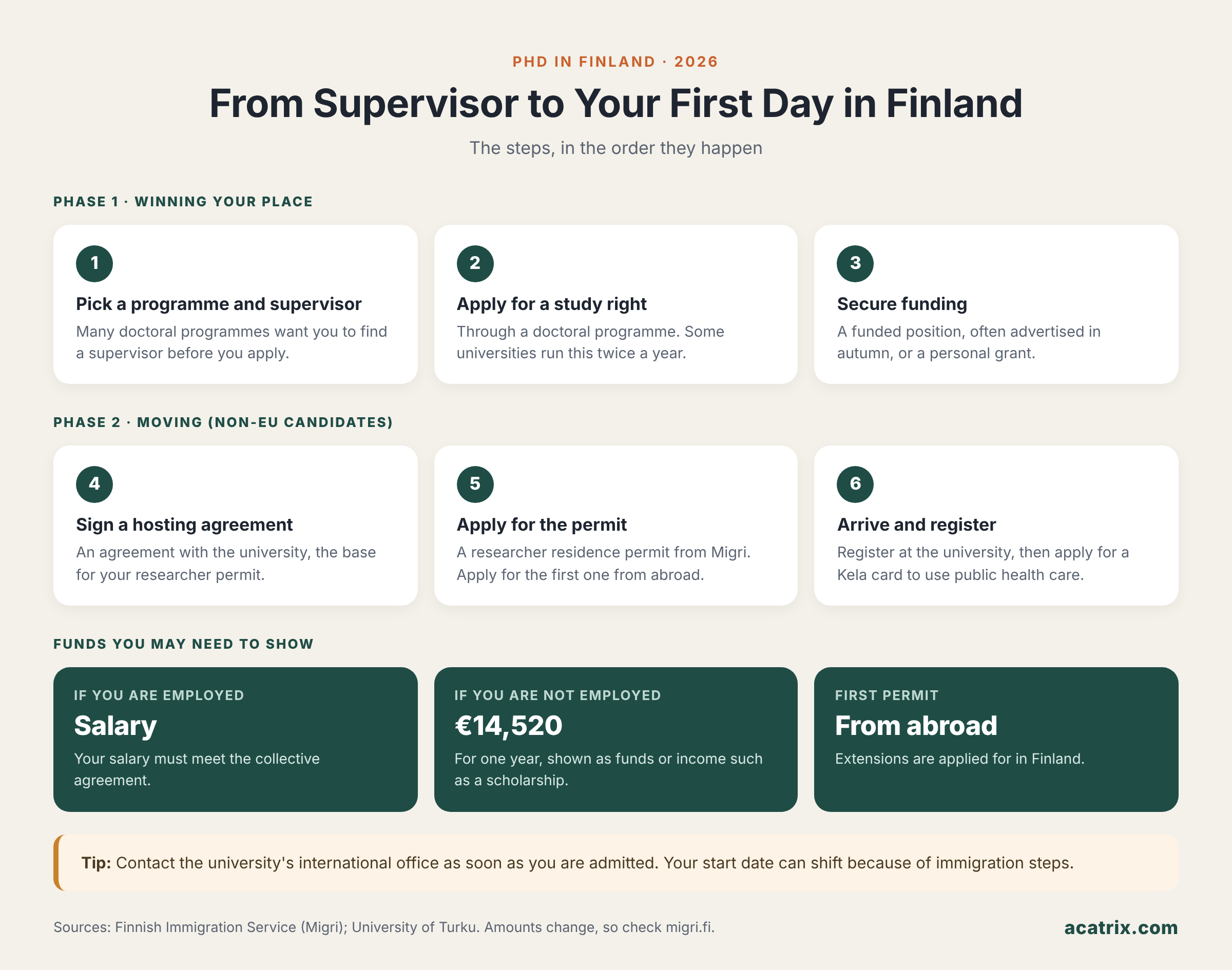
The Finnish PhD Application Process, Step by Step
Step 1: Pick a Supervisor First, Then a Programme
In Finland, the supervisor often comes before the application. Many doctoral programmes want you to have one in advance, so start there.
Here is a simple way to do it:
Search the university's research group pages in your field.
Open each supervisor's last three papers. Check whether your topic fits theirs.
Look for a sign that they are taking new people, such as an open call, a funded project, or a recent doctoral graduate.
Make a shortlist of five to eight names across two or three universities.
Funded positions are advertised in different places, so it helps to know how to find open PhD positions in Europe before you start your search.
Step 2: Write a Short, Specific Email
Your first email has one job: get a reply. Keep it under 150 words and make it about their work.
Here is a structure that works:
Subject: Doctoral researcher enquiry: [your topic] and your work on [their topic]
Dear Professor [Name],
I am finishing my master's in [field] at [university]. My thesis looked at [one sentence on your thesis]. I read your paper on [paper title] and I would like to build on [specific idea].
I plan to apply to the [programme name] doctoral programme. Are you supervising new doctoral researchers for the next call?
I have attached my CV. Thank you for your time.
[Name]
3 Important Rules:
Name one paper, ask one question, and do not write "I am passionate about research."
If you want more examples, here is how to email a professor for a PhD.
No reply after 10 to 14 days? Send one short follow-up. Then move on.
Step 3: Prepare the Documents
Every call lists its own documents, so read it before you start. Most ask for the same core set:
CV: two pages, with your research experience first.
Degree certificates and transcripts: get certified copies or translations early, because this can take weeks.
Research plan: usually two to five pages. State the problem, your method, and a rough timeline.
Motivation letter: one page on why this group and why this topic.
References: ask two or three referees now, and tell them the deadline.
Language proof: check whether the programme asks for an English test.
The research plan is the part that decides most applications. Write it with your supervisor, not alone. Send them a one-page draft first and ask for feedback. Most supervisors will respond, and it also shows you are serious. If you need help structuring the letter, see how to write a letter of motivation for a PhD.
Step 4: Apply for the Study Right
This is the application to the doctoral programme. At some universities, such as Turku, calls run twice a year. Others have one call. Check the date for your programme, not the university's general page.
Before you submit:
Confirm the supervisor agrees to be named in your application.
Check whether the call needs a second supervisor. At Turku, doctoral researchers have at least two.
Match every document to the call's file format and page limits.
Submit a day early. Portals slow down on deadline day.
Go through our PhD application checklist once before you press send.
Step 5: Apply for Funding, Separately
A study right does not pay you. You need funding on top of it. You have three routes, and you can use more than one:
A funded doctoral researcher position. The university advertises these, and in the examples we checked the main call is often in autumn. You are employed, with a salary.
A project position. A professor with a funded project hires a doctoral researcher directly. Your supervisor email from Step 2 often leads here.
A personal grant. You apply to a foundation or other funder. This usually needs a supervisor's support and a strong research plan.
Step 6: Prepare for the Interview
Shortlisted candidates are usually interviewed by a panel, often online. Expect these questions:
Why this topic, and why this group?
Walk us through your research plan. What could go wrong?
How would you split the four years?
Tell us about a time a project did not work.
Why Finland?
Practise answering out loud. A written answer and a spoken one are very different. Acatrix's Interview Preparation lets you run a mock interview by text, audio, or video before the real one.
Step 7: Accept the Offer and Start the Permit
If you are selected, read the offer carefully before you reply. Check:
Is it a study right, a funded position, or both?
How long is the contract, and is there a trial period?
What is the gross monthly salary, and does it follow the collective agreement?
Who will sign the hosting agreement for your permit?
If you are from outside the EU, the hosting agreement is the base for your researcher residence permit. Ask the international office to send it as soon as you accept. Your start date can shift because of immigration steps, so do not book flights or end your lease until the permit is approved.
Research plan due in two weeks?
Acatrix's Research Statement and SOP Drafting service helps you write one that fits the exact programme, not a generic template.
How Much a Doctoral Researcher Earns in Finland
Salaries follow the university collective agreement, so they are similar across universities. One University of Helsinki doctoral researcher project lists a gross salary of about €2,900 per month. That figure includes a mobility allowance for relocation costs, and it is a single example, not a national rate. The same project adds an annual travel budget for conferences and international meetings.
What you get | How it works |
|---|---|
Gross monthly salary | About €2,900 in one Helsinki project, before deductions |
Deductions | Income tax, pension, and unemployment insurance come off automatically |
Contract | Full-time, up to four years in the examples we checked |
Extras | Travel budget, occupational health care, paid annual vacation |
Your Visa: The Researcher Residence Permit
If you are from outside the EU, EEA, or Switzerland, you need a residence permit before you start. Doctoral researchers apply for a residence permit for a researcher, which covers people who come to Finland to prepare a doctoral dissertation.
You apply to the Finnish Immigration Service, Migri. EU and EEA citizens do not need a permit, but they register their right of residence.
Sign a hosting agreement. This is an agreement with the research organisation, usually the university. It is the base for your application.
Show sufficient funds. If you are employed, your salary must meet the collective agreement. Migri's 2026 minimum, if no agreement applies, is a gross salary of €1,463 a month. If you are not employed, Migri lists amounts such as €14,520 for one year, which you can show as savings, income, or a research scholarship.
Apply for the first permit from abroad. Extensions are applied for in Finland.
Start work after the permit is issued. You must work as a researcher full time and make progress.
Your First Weeks: Registration and the Kela Card
Finnish universities usually have an international office that helps new doctoral researchers. Contact it as soon as you are admitted. Here is what to expect:
Register with the university. At Turku, annual registration is done through an online system.
Apply for a Kela card. Once you are a resident of a Finnish municipality, you can apply for a Kela card to use public health care.
Join the orientation. Many universities run welcome sessions and buddy programmes for new international researchers.
Ask your contact person what you need to do first, and in which order. Many steps depend on each other.
Where to Live?
Helsinki is the largest and most expensive city. Cities like Tampere, Turku, Oulu, and Jyväskylä usually cost less and still have strong universities. Ask your university about housing for new international staff, start looking as soon as you get an offer, and never pay a deposit before you see the place.
After Your PhD: Staying in Finland
Many graduates move into postdoc positions or jobs in Finnish industry. Migri also has a permit option for people who have completed research in Finland. Check its website for the current conditions, since rules change.
Thinking About Other Countries? Compare Before You Decide
Netherlands: A PhD is a paid job with a contract and a salary. You apply to a vacancy, not a call.
Germany: No tuition, salaried positions, and many research institutes. Good if you want lots of options.
France: A paid three-year contract, and it often starts from your Master’s research internship.
Spain: Funded through national programs like FPU and FPI, with lower living costs than most of Europe.
Sweden: A PhD is a job with a contract, a salary, and a four-year plan. You apply to an advertised position.
Norway: One of the highest PhD salaries in Europe, but strict grade rules. Many vacancies ask for a B average or better.
Switzerland: Well-paid positions at top research universities, with competitive applications.
United Kingdom: Shorter PhDs of three to four years, but funding depends on the university and the project.
Canada: Funding is usually part of your admission offer, and you often need a supervisor before you apply.
United States: Longer programs with coursework first, and most admitted students get a stipend plus tuition waiver.
Australia: Research-focused PhDs of three to four years. Funding comes through scholarships that cover tuition and a living stipend, and you usually need a supervisor’s support before you apply.
Denmark: a Nordic option with a different application path. See how to apply for a PhD in Denmark as an international student.
How to Keep a Finnish PhD Application Under Control
A Finnish application is not one form. For each target you may have a study-right call, a funding call, a supervisor conversation, and later a permit. Different dates, different portals. It is easy to lose one.
Track these for every programme or position:
What the call offers: study right, funding, or both.
Deadline: one date for the study right and a separate one for funding, if they differ.
Supervisor: name, the date you wrote, and whether they replied.
Documents: CV, transcripts, research plan, letter, references. Mark which are ready.
Status: shortlisted, interview date, offer.
Next action: one line, such as “send follow-up on 5 December.”
Add each position to the Application Tracking System as soon as you find it, then fill in these details. Open it once a week and check only the next action column. You will see what is due before it becomes urgent.
Stuck on a question the call does not answer, like whether your degree meets the requirement or which supervisor to name? That is what the Application Q&A service is for.
Acatrix is your PhD application assistant, from the first supervisor email and interview preparation to the first day!
What to Do If You Get a Study Right but No Funding
This happens in Finland more than in many other countries. A programme accepts you and grants a study right. But nobody has offered you a salary. Do not panic. You still have options.
First, check what you actually received. A study right lets you work toward a doctoral degree. It does not include a funded position or a grant. If your offer letter does not mention a salary, you do not have funding yet.
Here is what to do next:
Ask your supervisor about open calls. Ask directly: “Are there funded doctoral researcher positions or projects I can apply to this year?” Supervisors often know about calls before they are public.
Check the next funded call. Some universities open most of their funded positions in one main call, often in autumn. If you missed it, find the date of the next one.
Look for project positions. Professors with funded projects sometimes hire doctoral researchers directly. Ask your supervisor to introduce you to colleagues who might have one.
Apply for a personal grant. Private foundations fund doctoral researchers. This usually needs a strong research plan and your supervisor’s support, so plan several weeks for each application. Remember that grants are not the same as employment. Grant holders may not get occupational health care and must arrange their own pension insurance.
Do not move yet. Without funding, you may not qualify for the researcher residence permit. If you are not employed, Migri asks you to show you can support yourself, with amounts such as €14,520 for one year. Check the current figure before you plan your move.
How to Write a Research Plan for a Finnish Doctoral Programme
For many Finnish programmes, the research plan matters more than your grades. It shows the committee that you can think like a researcher. It is also the document most applicants write too late.
Each programme sets its own length and format, so read the call first. Most plans cover the same parts:
The problem (about 20%). What question are you trying to answer, and why does it matter? Start with the gap, not the history of the field.
What is already known. Cite five to ten key papers. Show that you know the field and that your question is still open.
Research questions. Write two or three clear questions. If you cannot state them in one sentence each, the plan is not ready.
Methods. Say what data you will use, how you will collect or analyse it, and what tools you need. Be specific. “Machine learning” is vague. “Graph neural networks on traffic sensor data” is a method.
Timeline. Split the work across the contract. Many funded contracts in Finland last up to four years, so show roughly what you will finish each year, including the thesis writing.
Expected results and risks. Name one thing that could go wrong and how you would handle it. Committees trust candidates who see risks.
Fit with the group. Explain why this supervisor and this lab are the right place. Mention their project or a recent paper.
Three rules that make a plan stronger:
Write it with your supervisor. Send a one-page outline first and ask for feedback. This is normal in Finland and shows you can work with others.
Keep it realistic. A plan that tries to solve everything looks naive. Pick one focused problem you could finish in the contract.
Write for a reader outside your subfield. Panel members are not always experts in your exact topic. Define key terms and avoid heavy jargon.
Before you submit, read it aloud and ask: could a smart person from a neighbouring field explain my project back to me? If not, simplify.
Not sure whether to send your CV right away?
Read whether you should attach your CV in the first email to a professor.
From First Email to First Day: How Acatrix Supports Your Finnish PhD
A Finnish PhD application is long. You need a supervisor, a study right, funding, and often a permit. Each step has its own documents and deadlines. Acatrix is your application assistant for all of them. Here is where it helps, in the order you will need it.
1. When you write to supervisors
The Email Assistant writes emails based on your own background and the group you are targeting. So each message is specific to that supervisor, not a template.
2. When you prepare your documents
CV Review & Feedback shows how a selection committee will read your CV and what to fix.
Research Statement and SOP Drafting helps you shape a research plan and motivation letter for the exact programme.
3. When you juggle many applications
The Application Tracking System keeps every programme, supervisor, and deadline in one dashboard. This matters in Finland, where the study right and funding can have separate calls and dates.
4. When a call raises a question
Not sure if your degree qualifies, or what a requirement means? Ask through the Application Q&A service instead of guessing.
5. When you are invited to an interview
Interview Preparation lets you practise a mock interview by text, audio, or video, in any language, before the real one.
Why it works?
Most applicants lose time on small things: a missed date, a vague email, a document that does not match the call. Acatrix puts these steps in one place, so you spend your energy on the research plan and the conversation with your supervisor.
Your Finnish PhD starts with one good application. Start organising yours today.
For a complete step-by-step guide, learn how to use Acatrix for academic applications and manage everything from finding opportunities to preparing your documents and interviews.
Frequently Asked Questions
1. Is a PhD in Finland paid?
Funded positions are. You are an employee with a salary, health care, and vacation. In one University of Helsinki project, the gross salary was about €2,900 a month. Some doctoral researchers are funded by grants instead, which work differently.
2. What is a study right?
It is permission to study for a doctoral degree, granted by a doctoral programme. It does not include funding, so you need a funded position or a grant as well.
3. How long is a PhD in Finland?
Funded contracts in the examples we checked last up to four years, full time.
4. Do I need a supervisor before I apply?
Many programmes ask you to find one in advance. Check each programme's call, and write to your target supervisor first.
5. Do I need to speak Finnish?
Usually not for the PhD itself. Many doctoral programmes work in English. Finnish helps in daily life, but it is rarely required.
6. Which visa do I need?
A residence permit for a researcher, from the Finnish Immigration Service, based on a hosting agreement with the university. Apply for the first one from abroad.
7. When should I apply?
It depends on the university. Some run study-right calls twice a year, and funded positions are often advertised in autumn. Check the current call.