How to Apply for a PhD in Norway as an International Student (2026)
A Norwegian PhD is a paid employment contract, usually three years, with a possible fourth year that includes about 25% of other work, such as teaching. You apply to advertised vacancies, mostly through Jobbnorge. Vacancies set clear grade and degree requirements. An expert committee reviews applications and picks who to interview. The visa is a skilled worker permit, and your first weeks include registering with the tax office within eight days. This guide covers all of it, step by step.
How to Apply for a PhD in Norway as an International Student (2026)
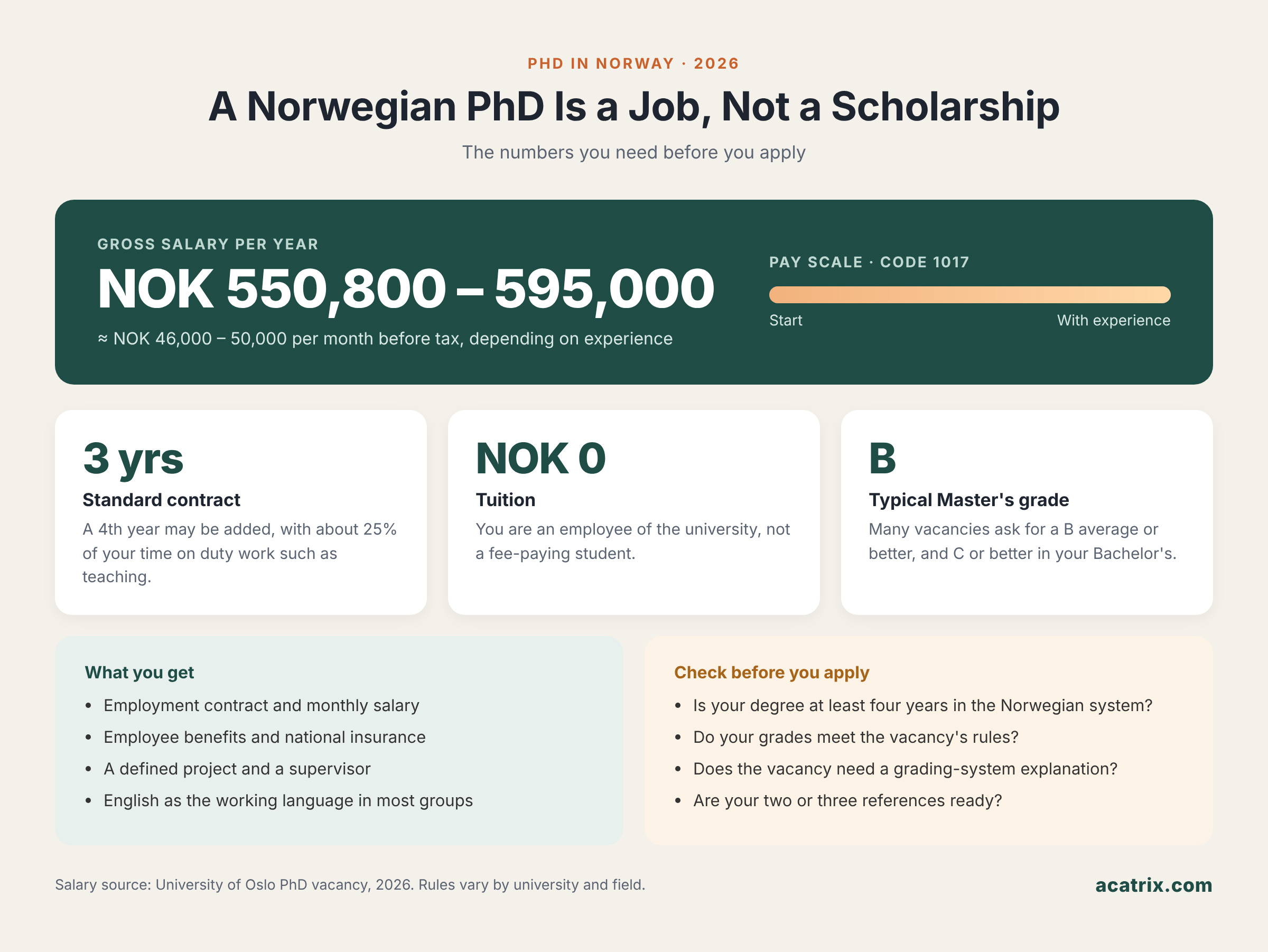
In Norway, a PhD is a job. You are hired as a "PhD research fellow," with a contract, a salary, and the same rights as other employees. There is no tuition and no scholarship to chase.
The pay is high. A 2026 vacancy at the University of Oslo lists NOK 550,800 to 595,000 per year. That is why the competition is serious, and why the details of your application matter.
You are a PhD research fellow, employed by the university. Most positions are three years. In some, a fourth year can be added, and about 25% of your time in that year goes to duty work, such as teaching or supervising students.
Your project is usually already defined in the vacancy. That is different from countries where you write your own proposal from scratch. You still write a strong cover letter, but its job is to show why you fit this project.
Most Norwegian PhDs also include a training component with courses and seminars. Your university explains what it includes, so check the vacancy and the programme page.
How Much a PhD Pays in Norway in 2026
PhD salaries are set by a national pay scale, so they are similar across universities. A 2026 University of Oslo vacancy lists position code 1017 with a salary of NOK 550,800 to 595,000 per year, depending on your experience. That is roughly NOK 46,000 to 50,000 per month before tax.
What you get
How it works
Gross salary
About NOK 550,800 to 595,000 per year, depending on experience
Contract
3 years, with a possible 4th year including about 25% duty work
Tuition
None
Employment status
Employee, with national insurance and the usual employee benefits
💡 Worth knowing
Norway is expensive. A high salary goes further than it looks in another country, but not as far as the number suggests. Look at living costs for the city you are applying to before you decide.
Can You Meet the Grade Requirements?
This is the part that is most specific to Norway. Vacancies are often very clear about grades, and applications that don't meet them are filtered out before anyone reads your cover letter.
A typical University of Oslo vacancy asks for:
A Master's degree in a related field, or equivalent. For foreign degrees, a total study length equal to at least four years in the Norwegian system.
An average grade of B or better in the Master's courses and thesis.
A grade of C or better in the Bachelor's courses.
Fluent oral and written English.
Norway uses an A to F scale. If your university uses a different system, you need to include an official explanation of how it works, and you may need to convert your grades. Some vacancies ask you to attach this explanation. Do it, or your grades can be misread.
Before you spend a week on an application, compare your grades and degree length with the vacancy line by line. A strong profile with a degree that falls just short of the rules is often rejected automatically. If you are close, ask the contact person whether the requirement is flexible.
The Application Process, Step by Step
Step 1: Find the Vacancies
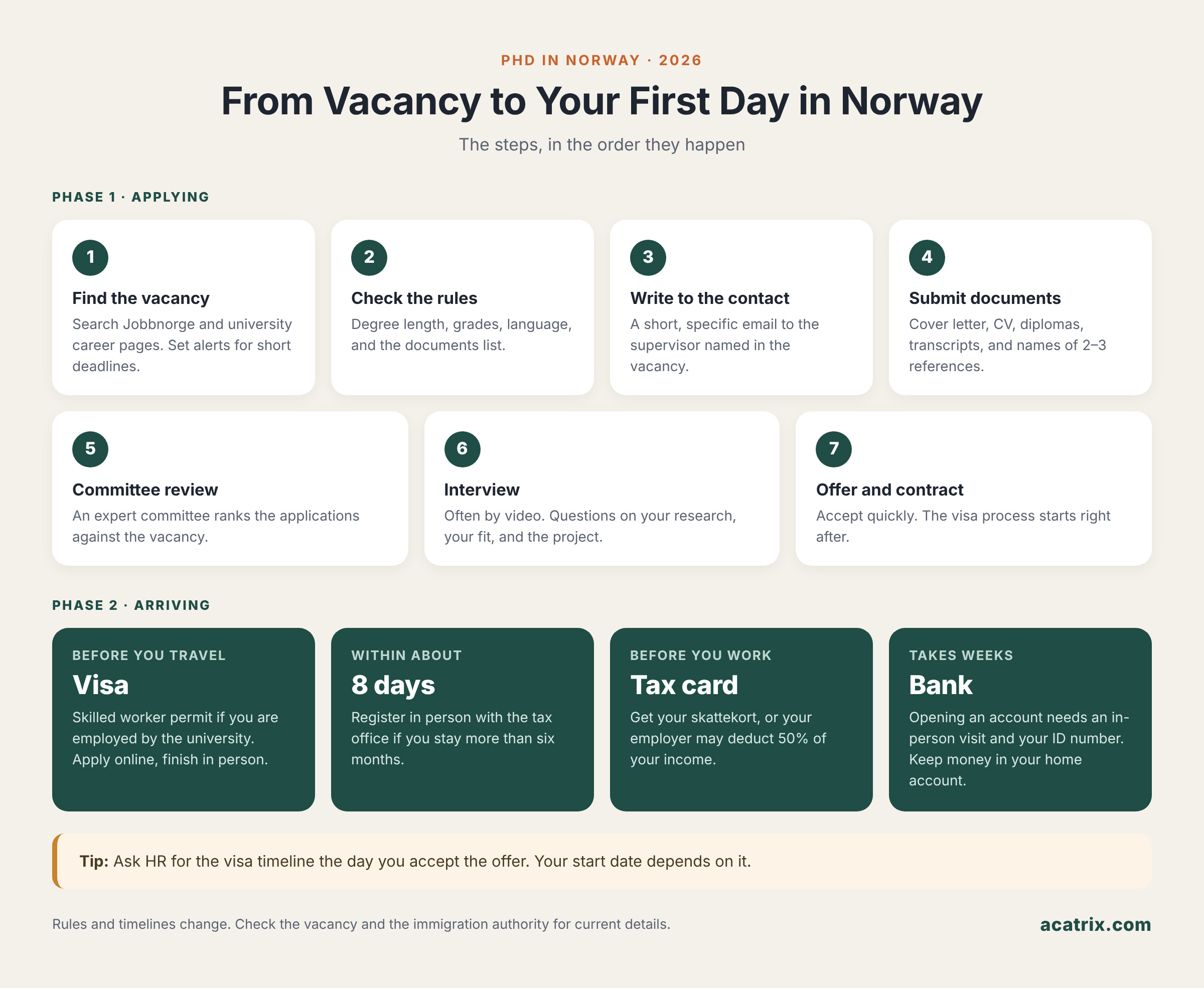
Norwegian PhD positions are advertised publicly, and most applications go through the portal Jobbnorge. Each university also lists its vacancies on its own career page. Positions are posted throughout the year, and deadlines are often only a few weeks away.
Jobbnorge: the main portal for public-sector academic jobs.
University career pages: for example, the University of Oslo, NTNU, the University of Bergen, and UiT.
Job alerts: set them up for your field, so you don't miss short deadlines.
The vacancy is your rulebook. Check the required degree, grades, skills, and language. Also check the documents list and the deadline. Norwegian vacancies are specific about all of these, and they expect you to follow them.
Step 3: Contact the Group Before You Apply
The vacancy lists a contact person, often the main supervisor. Writing to them is normal, especially if you want to ask about the project or whether the requirements are flexible. Keep it short, polite, and specific.
A cover letter on your motivation and research interests
A CV with your education, positions, and publications
Copies of your Bachelor's and Master's diplomas and transcripts
English proficiency proof, if your degree wasn't in English
A publication list, if you have one
Names and contact details of two or three references
For foreign degrees, an official explanation of your university's grading system
Many vacancies do not ask you to upload recommendation letters. They ask for references' names, and the committee contacts them only if you are shortlisted. So make sure your referees are ready for a call or an email.
Have your CV checked. Acatrix's CV Review & Feedback shows how a committee will read it.
After the deadline, an expert committee reviews the applications and ranks the candidates against the vacancy. The best ones are invited to an interview, often by video call. Expect questions about your research background, your fit with the project, and how you work in a team.
If you are selected, you receive an offer and an employment contract. The visa process starts right after you accept, so reply quickly and ask your contact person for the next steps.
✍️ Cover letter due in two weeks? Acatrix's Research Statement and SOP Drafting service helps you write one that fits the exact vacancy, not a generic template.
If you are from outside the EU or EEA, you need a residence permit. Because a Norwegian PhD is an employment contract, the usual route is a skilled worker permit. PhD students with external funding, and no employer in Norway, may instead need a study permit.
You apply online. Then you complete the process in person in Norway, and you can only start working after that. Your university's HR or international office guides you through it, so ask them early and follow their timeline.
If you bring family, they can get permits for the same period, but there is a minimum income requirement. One university page lists it at about NOK 256,000 a year. Check the current figure on the immigration authority's website, since it changes.
📌 Start early
Permits take time, and your start date depends on them. Ask HR for their expected timeline the day you accept the offer, and gather your documents in advance.
Your First Weeks: Registration, Tax Card, and Bank Account
Norway runs on a few steps that depend on each other. Do them in this order:
Register with the tax office (Skatteetaten). If you stay more than six months, you register in person, with an ID check, within about eight days of arrival. Your residence card and national identity number arrive by mail, usually after a few weeks.
Get a tax deduction card (skattekort). You need it before you work. Without it, your employer may have to deduct 50% of your income.
Open a bank account. This needs an in-person visit with your passport and identity number, and it can take weeks. Keep a few weeks of living money in your home bank account.
Health coverage. Once registered, you are enrolled in the national insurance scheme. Until then, get travel insurance.
Where to Live and What It Costs
Norway has some of the highest living costs in Europe, and Oslo is the most expensive city. Rent takes the biggest part of your salary. Cities like Trondheim, Bergen, and Tromsø are usually cheaper, and they have strong research groups.
Ask your university about housing. Many help new international staff find a room or a flat.
Expect high prices for food and eating out. Cooking at home saves a lot.
Never pay a deposit before seeing the place. Rental scams aimed at newcomers exist everywhere.
10 Best Universities in Norway for a PhD
Norway has a small number of strong research universities. These come up most often for international candidates:
University of Oslo (UiO): The largest and broadest university, strong in sciences, medicine, law, and humanities.
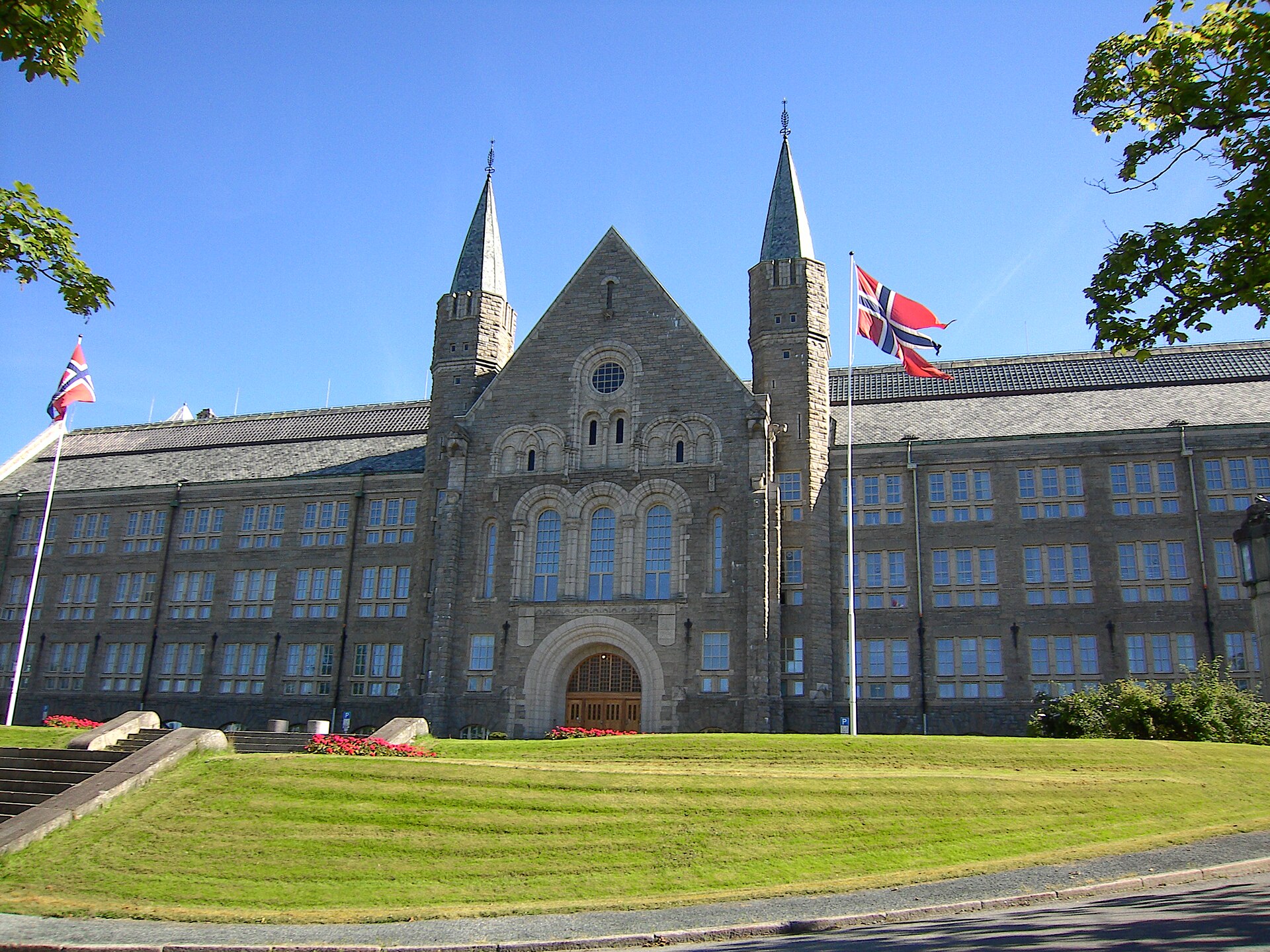
NTNU, Trondheim: Engineering, technology, and natural sciences.
How a Norwegian PhD Ends: The Trial Lecture and the Defense
At the end of your PhD, you submit your thesis, and it is reviewed by an expert committee. The final step is a public defense. In many Norwegian universities, it has two parts: a trial lecture on a topic given to you shortly before, and the defense itself, where opponents question your work.
It is formal, but it is also a celebration, and friends and family often attend. Your supervisor and group help you prepare, and many candidates say it is less scary than they expected.
After Your PhD: Staying in Norway
Many graduates move into postdoc positions, research jobs, or work in Norwegian industries like energy, marine, and technology. Norway also has permits for recent graduates and researchers who want to look for work. Check the immigration authority's website for the current conditions, since rules change.
How Acatrix Helps You Track Norwegian PhD Vacancies
Thinking About Other Countries? Compare Before You Decide
Netherlands: A PhD is a paid job with a contract and a salary. You apply to a vacancy, not a call.
Germany: No tuition, salaried positions, and many research institutes. Good if you want lots of options.
France: A paid three-year contract, and it often starts from your Master’s research internship.
Spain: Funded through national programs like FPU and FPI, with lower living costs than most of Europe.
United Kingdom: Shorter PhDs of three to four years, but funding depends on the university and the project.
Canada: Funding is usually part of your admission offer, and you often need a supervisor before you apply.
United States: Longer programs with coursework first, and most admitted students get a stipend plus tuition waiver.
Australia: Research-focused PhDs of three to four years. Funding comes through scholarships that cover tuition and a living stipend, and you usually need a supervisor’s support before you apply.
Sweden: A PhD is a job with a contract, a salary, and a four-year plan. You apply to an advertised position.
Switzerland: Well-paid positions at top research universities, with competitive applications.
Denmark: A three-year PhD, with three types of position: employed, industrial, or enrolled with a grant. Check which one you are applying for.
Italy: You apply through an official call (a bando), and funded places come with a monthly scholarship.
Finland: a Nordic option with a two-part application path. Read the full guide on applying as an international student.
This module is part of the Acatrix Application System, which also includes:
Yes. You are hired as a PhD research fellow, with a contract and a salary. A 2026 University of Oslo vacancy lists NOK 550,800 to 595,000 per year.
2. How long is a PhD in Norway?
Usually three years. In some positions, a fourth year can be added, with about 25% of your time spent on duty work such as teaching.
3. Do I need a Master's degree?
Yes. Most vacancies require a Master's, or an equivalent degree, with grades around B or better. Check the vacancy for the exact rule.
4. Do I need to speak Norwegian?
Usually not for the PhD. English is the working language in most research groups, and the vacancy states the requirements. Norwegian helps in daily life, but it is rarely required to get the job.
5. Where do I find PhD vacancies?
Mostly on Jobbnorge and on the career pages of Norwegian universities. Set up alerts so you don't miss short deadlines.
6. Which visa do I need?
If you are employed by a Norwegian university, usually a skilled worker permit. Externally funded PhD students may need a study permit. Your university's HR or international office guides you.
7. Is Norway expensive for a PhD student?
Living costs are high, especially in Oslo. The salary is also high, so most PhD candidates live comfortably, but you should plan your budget and look at cheaper cities.