How to Apply for a PhD in Sweden (2026)
A PhD in Sweden is different from doctoral study in many other European countries. In most cases, you do not apply to a traditional PhD programme and pay tuition. Instead, you apply for an advertised doctoral position at a Swedish university. Most doctoral candidates are employed by the university, receive a monthly salary, and have access to employment benefits.
A Swedish PhD normally takes four years of full-time research (240 ECTS credits). Many positions include up to 20% departmental duties, such as teaching, which can extend the employment period to five years.
To apply, you generally need a relevant Master's degree, academic transcripts, a CV, and evidence that you meet the specific research and language requirements. Some departments also request a research proposal, references, or a statement of purpose.
International applicants from outside the EU/EEA generally need a residence permit for doctoral studies, although different rules may apply to doctoral candidates with an eligible research hosting agreement.
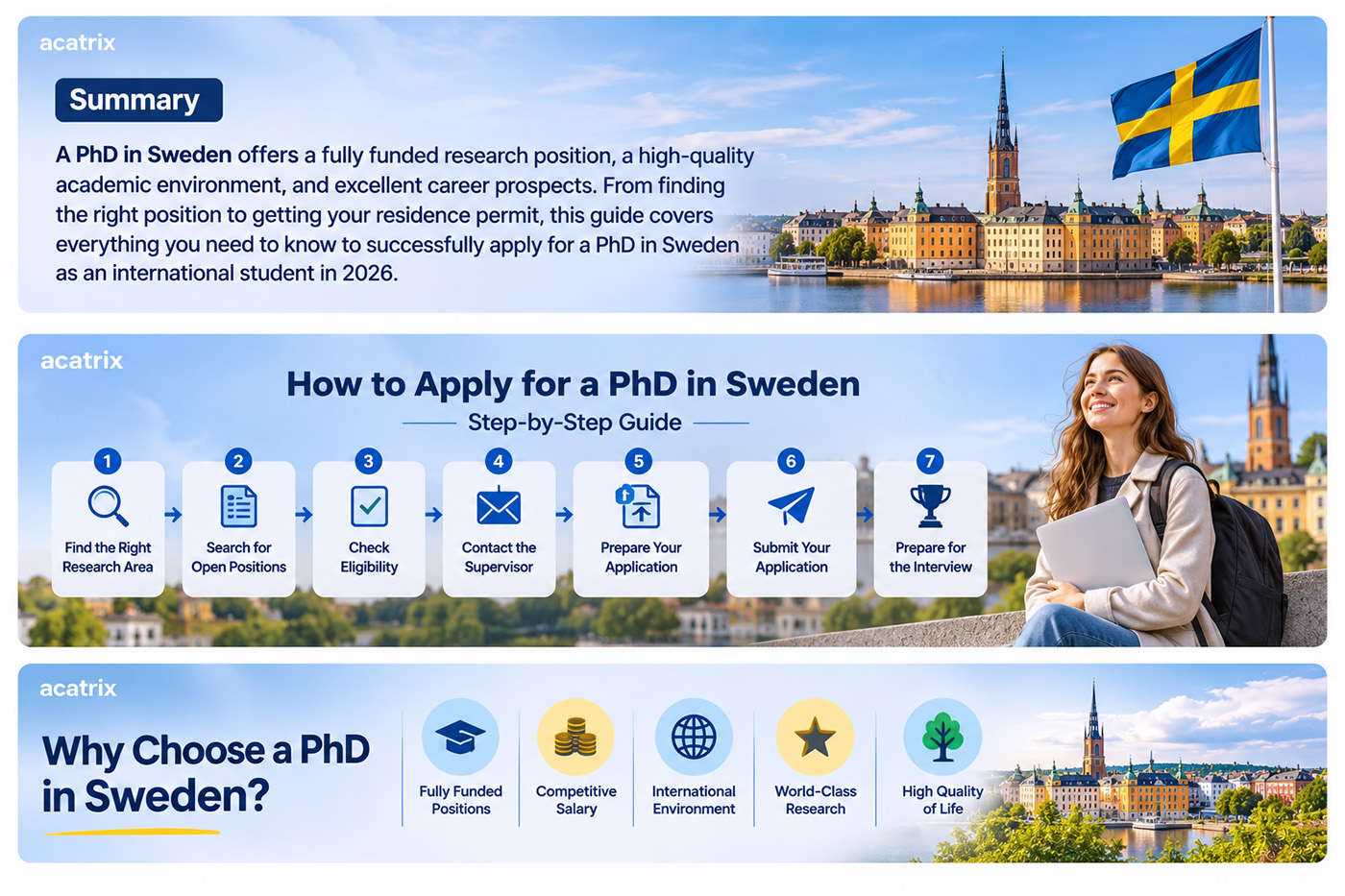
This guide explains how to find funded positions, prepare your application, contact supervisors, understand doctoral salaries, obtain a residence permit, and settle in Sweden.
Acatrix keeps every deadline, and document list in one place while you apply. If you are still choosing a country, start with our guide to 10 European countries to consider for a PhD in 2026.
How a PhD in Sweden Works
A Swedish PhD is primarily a research position rather than a conventional university course. When you are accepted as a doctoral student (doktorand), you normally join a research department, work under the supervision of one or more professors, and complete an individual study plan.
The standard doctoral degree requires 240 ECTS credits, equivalent to four years of full-time study. However, there is an important difference between Sweden and countries such as Italy, Spain, and France.
In Sweden, most doctoral candidates are employed by their universities. This means you receive a monthly salary instead of relying on a traditional student scholarship.
Your employment may include:
Independent research and dissertation writing.
Doctoral-level courses and seminars.
Regular supervision and progress assessments.
Teaching, research assistance, or administrative responsibilities.
Conference participation and academic collaboration.
Departmental duties can account for up to 20% of your working time. When this happens, your employment period may be extended accordingly. The exact conditions depend on the university, department, and employment contract.
Not sure how many positions to apply for?
Read how many PhD positions you should apply to.
How to Find Funded PhD Positions in Sweden
The first thing to understand is that Swedish universities generally advertise PhD opportunities as job vacancies. You should not rely only on university admission portals or send the same email to dozens of professors.
Instead, search for doctoral vacancies that match your academic background and research interests.
Where to Search for Swedish PhD Vacancies
Start with the official career pages of Swedish universities. Some useful places to look include:
University of Gothenburg: Doctoral positions across sciences, humanities, social sciences, and medicine.
Lund University: Research opportunities in engineering, medicine, economics, humanities, and natural sciences.
Uppsala University: Doctoral vacancies across a wide range of academic disciplines.
Stockholm University: Opportunities in social sciences, humanities, law, natural sciences, and other fields.
KTH Royal Institute of Technology: Engineering, technology, architecture, and computer science.
Chalmers University of Technology: Engineering, innovation, energy, and applied sciences.
Karolinska Institutet: Medical research, public health, neuroscience, and life sciences.
Linköping University: Engineering, computer science, medicine, and interdisciplinary research.
Swedish University of Agricultural Sciences (SLU): Agriculture, environmental sciences, forestry, and veterinary medicine.
You can also use the Swedish academic job portal EURAXESS and university-specific recruitment platforms.
A useful strategy is to search for terms such as:
PhD position
Doctoral student
Doctoral candidate
Doctoral researcher
PhD vacancy
Doktorand
Remember that not every university publishes all its vacancies at the same time. Positions are advertised throughout the year, depending on research funding and departmental needs.
What Does a Swedish PhD Vacancy Include?
A typical doctoral job advertisement explains:
The research project and its objectives.
The department and research group.
Eligibility and admission requirements.
Required academic qualifications.
Language requirements.
Employment conditions and salary information.
Application documents.
Application deadline.
Contact details for the recruiting department.
Read the entire advertisement before applying. Some positions are open to applicants from any research background, while others require specific technical skills, publications, laboratory experience, or previous research in a particular area.
One important point: A funded PhD vacancy is not automatically a good match. Your academic background and research experience must fit the advertised project.
PhD Admission Requirements in Sweden
Swedish universities have general doctoral admission requirements, but individual departments can add specific criteria. For most international applicants, the following qualifications are important:
1. A Relevant Master's Degree
You generally need a Master's degree or an equivalent qualification. Under Sweden's general eligibility rules, you can qualify for doctoral studies if you have:
A second-cycle qualification (Master's degree).
Completed courses worth at least 240 higher education credits, including at least 60 credits at the second-cycle level.
Equivalent knowledge acquired through education or professional experience, subject to the university's assessment.
Your previous education must also be relevant to the research position. For example, a computer science PhD vacancy may require a Master's degree in computer science, software engineering, mathematics, or a closely related subject.
2. Academic Transcripts and Degree Certificates
Prepare your official academic documents before you begin applying.
Most universities require:
Bachelor's degree certificate.
Master's degree certificate.
Academic transcripts.
Information about your grading system, where requested.
Certified translations if your documents are not in English or Swedish.
Some departments may request additional evidence of your Master's thesis or previous research projects.
3. English Language Proficiency
Many Swedish doctoral positions use English as their working language. Depending on the university and vacancy, you may need to demonstrate English proficiency through:
IELTS Academic.
TOEFL iBT.
Previous university education conducted in English.
Other qualifications accepted by the recruiting university.
There is no single IELTS score that applies to every Swedish PhD position. Always follow the language requirements in the actual advertisement.
4. Research Experience
Research experience can make a significant difference, particularly when competition is strong. Relevant experience may include:
A Master's thesis.
Published academic papers.
Conference presentations.
Research assistant positions.
Laboratory or fieldwork experience.
Relevant professional projects.
Not every PhD vacancy requires publications. A strong Master's thesis and a clear understanding of the proposed research can be sufficient for some positions.
If you have no publications yet, read our guide on How to Apply for a PhD Without Publications.
Is a PhD in Sweden Fully Funded?
In most cases, yes. The Swedish doctoral employment model is one of the most attractive features of doing a PhD in the country.
Unlike traditional scholarship-based doctoral systems, many Swedish universities hire doctoral candidates as employees.
This usually means you receive:
A monthly gross salary.
Paid annual leave.
Access to employment-related social security benefits.
Pension contributions.
Sick leave benefits under applicable rules.
Parental leave benefits under applicable rules.
However, not every doctoral candidate has the same funding arrangement. Some positions are financed through external scholarships, research grants, or other arrangements. Always check the employment and funding conditions before accepting an offer.
Keep the email short and specific. Our guide on how to write a cold email to a professor shows how. If you don't get a reply, here is how to follow up. And read whether to attach your CV in the first email before you send it.
How Much Does a PhD Student Earn in Sweden?
There is no single national PhD salary. Each university has its own salary agreement, and salaries generally increase as you progress through your doctoral studies.
For example, Stockholm University's published doctoral salary scale provides the following monthly gross salaries from October 2026:
PhD progress | Monthly salary |
|---|---|
Starting salary | SEK 32,900 |
After 50% of doctoral requirements | SEK 34,000 |
After 80% of doctoral requirements | SEK 35,000 |
These figures are specific to Stockholm University and should not be treated as a guaranteed salary at every Swedish institution. Your actual salary depends on the university, department, employment agreement, and any relevant experience.
Can You Apply for a PhD in Sweden Without Funding?
Technically, doctoral studies can have different funding arrangements. However, you should be careful about accepting an unfunded position.
Swedish universities are expected to ensure that doctoral candidates have adequate funding for their studies. In many cases, this is provided through employment as a doctoral student.
Before accepting an offer, confirm:
Whether you will be employed by the university.
Whether you will receive a salary or scholarship.
How long the funding will last.
Whether the funding covers the full doctoral period.
Whether teaching duties are included.
What happens if your doctoral studies take longer than expected.
Do not assume that admission automatically means a paid PhD contract. Confirm the funding arrangement in writing.
The Application Process: Step by Step
Applying for a PhD in Sweden is usually a vacancy-based recruitment process.
Step 1: Identify the Right Research Area
Start by narrowing down your academic interests.
Instead of searching for every available PhD position, focus on research areas that match your previous education and experience.
For example, if your Master's degree is in environmental engineering, you might search for:
Sustainable energy systems.
Climate change research.
Environmental modelling.
Water resource management.
Circular economy.
Renewable energy technologies.
Create a shortlist of universities and departments working in these areas.
Step 2: Search for Open PhD Positions
Visit university career pages and search for doctoral vacancies.
Read the job description carefully and record:
Position title.
University and department.
Research topic.
Required qualifications.
Funding and salary.
Application deadline.
Required documents.
Do not wait until the final days to prepare your application.
Some positions remain open for several weeks, while others have relatively short recruitment periods.
If you are unsure how many positions to apply for, read our guide on How Many PhD Positions Should You Apply To?
Step 3: Check Your Eligibility
Before writing your application, compare your academic background with the vacancy requirements.
Ask yourself:
Does my Master's degree meet the general eligibility requirements?
Is my academic field relevant to the project?
Do I have the required research experience?
Can I demonstrate the required English proficiency?
Do I have the technical skills mentioned in the advertisement?
If a vacancy asks for experience with statistical modelling, laboratory techniques, programming languages, or specific research methods, explain your relevant experience clearly. Do not apply based on the job title alone.
Step 4: Contact the Potential Supervisor
In Sweden, you usually apply through the official vacancy rather than securing informal approval from a professor first.
However, contacting the recruiting supervisor can still be useful.
A short and relevant email can help you understand the research project, clarify eligibility questions, and learn whether your background fits the department's needs.
Your email should include:
A brief introduction.
Your current academic qualification.
Your relevant research experience.
Why the advertised project interests you.
One or two specific questions about the position.
Keep the email short and specific. Our guide on how to write a cold email to a professor shows how. If you don't get a reply, here is how to follow up. And read whether to attach your CV in the first email before you send it.
Step 5: Prepare Your CV and Application Documents
Your academic CV should be tailored to the specific research position. Include:
Education.
Master's thesis and research topic.
Research experience.
Publications, if applicable.
Academic presentations.
Technical and methodological skills.
Relevant employment experience.
Language proficiency.
References, when requested.
Do not turn your CV into a list of every activity you have ever completed. Focus on evidence that demonstrates your ability to conduct independent research.
"From your first email to a professor to your permesso di soggiorno, Acatrix is the application assistant that stays with you."
Step 6: Write a Strong Motivation Letter or Research Statement
Some Swedish PhD vacancies require a motivation letter, while others ask for a research statement or a project-specific application.
Your document should explain:
Why you are interested in the research topic.
How your previous education prepared you.
What relevant research experience you have.
Which methods or skills you can contribute.
Why you are a good match for the department.
Avoid using the same motivation letter for every university. A successful application connects your background to the specific research project.
If you need help, read our guide on How to Write a Personal Statement for a PhD Application.
Step 7: Submit Your Application Through the University Portal
Most Swedish universities use their own recruitment systems. You will usually need to:
Create an applicant account.
Complete the application form.
Upload your CV and supporting documents.
Provide reference details if requested.
Answer any project-specific questions.
Submit before the deadline.
Some universities require all documents in PDF format. Check the submission confirmation and keep a copy of everything you upload. Use our PhD Application Checklist before submitting.
Step 8: Prepare for the Interview
If your application is shortlisted, you may be invited to an academic interview. The interview panel may include the principal supervisor, other researchers, and departmental representatives.
Expect questions about:
Your previous research.
Your Master's thesis.
Your understanding of the project.
Your research methods.
Your motivation for joining the department.
How you approach research problems.
Your ability to work independently and collaboratively.
You may also be asked to give a short presentation about your previous research. Read our guides on 10 Common PhD Interview Questions and How to Introduce Yourself in a PhD Interview.
Step 9: Receive the Offer and Complete Your Employment Formalities
If you are selected, the university will contact you with an offer or employment-related information. Before accepting, check:
Your monthly gross salary.
Employment start date.
Contract duration.
Expected research duties.
Teaching responsibilities.
Annual leave and other employment conditions.
The expected doctoral study period.
Once you have accepted the offer, coordinate with the university's HR and international offices about your residence permit and arrival arrangements.
Your PhD application is not complete when you receive an offer. You must also prepare for the practical and immigration requirements of moving to Sweden.
Your Swedish Residence Permit for Doctoral Studies
If you are a citizen of a country outside the EU/EEA, you will generally need a residence permit for doctoral studies if you are admitted to a Swedish doctoral programme.
However, Sweden's immigration rules distinguish between doctoral students and researchers. Since 11 June 2026, eligible doctoral students with a hosting agreement from an approved research principal may also be able to apply for a residence permit for research. The correct permit depends on your admission and hosting arrangements.
What Are the Requirements?
For a residence permit for doctoral studies, you generally need:
A valid passport.
Final admission to full-time doctoral studies in Sweden.
Evidence that you can support yourself financially.
Comprehensive health insurance if your studies will last less than one year, where required.
If you receive a doctoral salary, your university's enrolment certificate can be used to demonstrate your financial support.
How Much Money Do You Need to Show?
For applications submitted in 2026, the Swedish Migration Agency's maintenance requirement is at least SEK 10,656 per month.
This amount is the immigration authority's financial maintenance threshold. It is not the same as the salary you may receive as an employed doctoral student.
If you have an employment contract and an appropriate doctoral salary, the university can provide the necessary documentation. The financial requirement may be higher if family members are accompanying you.
How to Apply for a Swedish Residence Permit
The general process is:
Receive your final admission decision from the university.
Obtain the relevant enrolment and funding documents.
Prepare your passport and other supporting documents.
Submit your application through the Swedish Migration Agency.
Complete any required passport checks, interviews, or biometric procedures.
Wait for the decision before making travel arrangements that depend on your permit.
The application fee for adults is SEK 1,500 under the 2026 rules. Processing times can vary. An application that is complete may be processed faster than one requiring additional documents or verification.
Always check the latest requirements directly with the Swedish Migration Agency.
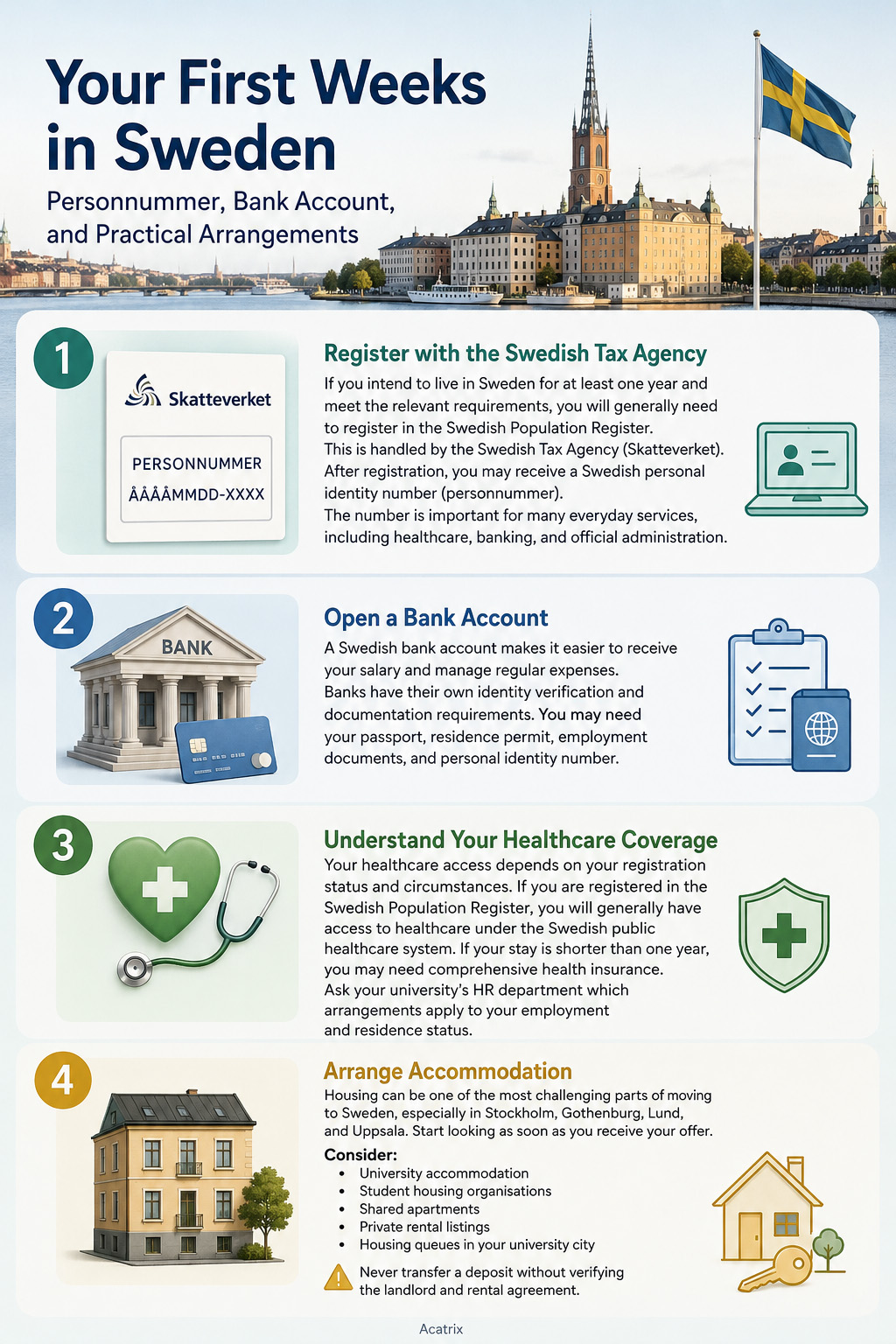
Your First Weeks in Sweden: Personnummer, Bank Account, and Practical Arrangements
Moving to Sweden involves several administrative steps.
Your university's international office and HR department can help you understand which procedures apply to your situation.
1. Register with the Swedish Tax Agency
If you intend to live in Sweden for at least one year and meet the relevant requirements, you will generally need to register in the Swedish Population Register.
This is handled by the Swedish Tax Agency (Skatteverket). After registration, you may receive a Swedish personal identity number (personnummer).
The number is important for many everyday services, including healthcare, banking, and official administration.
2. Open a Bank Account
A Swedish bank account makes it easier to receive your salary and manage regular expenses. Banks have their own identity verification and documentation requirements. You may need your passport, residence permit, employment documents, and personal identity number.
3. Understand Your Healthcare Coverage
Your healthcare access depends on your registration status and circumstances. If you are registered in the Swedish Population Register, you will generally have access to healthcare under the Swedish public healthcare system. If your stay is shorter than one year, you may need comprehensive health insurance.
Ask your university's HR department which arrangements apply to your employment and residence status.
4. Arrange Accommodation
Housing can be one of the most challenging parts of moving to Sweden, especially in Stockholm, Gothenburg, Lund, and Uppsala. Start looking as soon as you receive your offer.
Consider: University accommodation, Student housing organisations, Shared apartments, Private rental listings, and Housing queues in your university city. Never transfer a deposit without verifying the landlord and rental agreement.
Cost of Living: How Much Does It Cost to Live in Sweden as a PhD Student?
Sweden offers competitive doctoral salaries, but living costs vary considerably by city.
Stockholm is generally more expensive than many smaller university towns, particularly when it comes to accommodation.
Your monthly expenses may include:
Expense | What to consider |
|---|---|
Accommodation | Usually your largest monthly expense |
Food | Groceries and occasional dining out |
Transportation | Public transport or cycling |
Utilities | Electricity and internet, depending on your rental |
Mobile phone | Monthly subscription |
Personal expenses | Clothing, entertainment, and other needs |
Your actual budget depends on your accommodation, lifestyle, and city. Before accepting an offer, compare the gross salary with estimated after-tax income and local rent. A salary that looks attractive on paper may feel very different in an expensive city.
Stockholm vs. Lund vs. Gothenburg vs. Uppsala
Stockholm: A major research hub with strong opportunities in technology, medicine, social sciences, and business. Housing can be expensive and competitive.
Lund: A strong academic environment with an international research community. A popular choice for science, engineering, and medicine.
Gothenburg: Particularly attractive for engineering, maritime research, medicine, and sustainability.
Uppsala: A historic university city with strong research traditions in medicine, life sciences, humanities, and natural sciences.
Start using Acatrix today and take full control of your university applications, before deadlines take control of you.
10 Best Universities in Sweden for a PhD
Sweden has several internationally recognised research universities. The best choice depends on your academic field and the specific doctoral project.
KTH Royal Institute of Technology: Engineering, computer science, architecture, energy, and technology.
Lund University: Medicine, engineering, natural sciences, social sciences, and humanities.
Uppsala University: Life sciences, medicine, physics, chemistry, humanities, and social sciences.
Stockholm University: Natural sciences, environmental research, social sciences, humanities, and law.
Karolinska Institutet: Medicine, neuroscience, public health, and biomedical research.
Chalmers University of Technology: Engineering, sustainable energy, materials science, and technology.
University of Gothenburg: Social sciences, medicine, humanities, education, and natural sciences.
Linköping University: Engineering, computer science, medical technology, and interdisciplinary research.
Swedish University of Agricultural Sciences (SLU): Agriculture, forestry, environmental science, and veterinary medicine.
Umeå University: Life sciences, medicine, environmental research, social sciences, and humanities.
Swedish Academic Terms You Will See in PhD Advertisements
Understanding a few Swedish terms can make it easier to navigate university websites and recruitment portals. Here are some useful words:
Doktorand: Doctoral student or PhD candidate.
Doktorandanställning: Employment as a doctoral student.
Doktorandutbildning: Doctoral education.
Doktorsexamen: Doctoral degree.
Licentiatexamen: Licentiate degree, a qualification that can be completed before the full doctoral degree.
Handledare: Supervisor.
Institution: Department.
Utlysning: Vacancy announcement or call for applications.
Behörighet: Eligibility.
Sista ansökningsdag: Application deadline.
Anställningsvillkor: Employment conditions.
Forskningsprojekt: Research project.
Personnummer: Swedish personal identity number.
Thinking About Other Countries? Compare Before You Decide
Netherlands: A PhD is a paid job with a contract and a salary. You apply to a vacancy, not a call.
Germany: No tuition, salaried positions, and many research institutes. Good if you want lots of options.
France: A paid three-year contract, and it often starts from your Master’s research internship.
Spain: Funded through national programs like FPU and FPI, with lower living costs than most of Europe.
United Kingdom: Shorter PhDs of three to four years, but funding depends on the university and the project.
Canada: Funding is usually part of your admission offer, and you often need a supervisor before you apply.
United States: Longer programs with coursework first, and most admitted students get a stipend plus tuition waiver.
Australia: Research-focused PhDs of three to four years. Funding comes through scholarships that cover tuition and a living stipend, and you usually need a supervisor’s support before you apply.
Norway: One of the highest PhD salaries in Europe, but strict grade rules. Many vacancies ask for a B average or better.
Switzerland: Well-paid positions at top research universities, with competitive applications.
Denmark: A three-year PhD, with three types of position: employed, industrial, or enrolled with a grant. Check which one you are applying for.
Italy: You apply through an official call (a bando), and funded places come with a monthly scholarship.
Finland: a Nordic option with a two-part application path. Read the full guide on applying as an international student.
Do You Need to Speak Swedish for a PhD?
Usually, no. Many doctoral research groups use English as their main working language, particularly in engineering, medicine, computer science, natural sciences, and internationally oriented research.
However, language requirements depend on the position. You may encounter situations where Swedish is important:
Research involving Swedish legislation or public institutions.
Projects involving interviews with Swedish-speaking participants.
Humanities and social science research using Swedish-language sources.
Teaching undergraduate courses in Swedish.
Administrative and everyday communication outside the university.
Even when Swedish is not required for admission, learning the language can make your life easier. Many universities offer Swedish language courses for international employees and students. The best approach is to check the language requirements in the job advertisement and ask the department if you are unsure.
After Your PhD: Can You Stay in Sweden?
Completing a PhD in Sweden can open several career opportunities. Depending on your research field, you may continue with:
Postdoctoral research.
University teaching and academic positions.
Research roles in private companies.
Technology and innovation.
Government research institutions.
International research organisations.
Sweden also has residence permit options for certain doctoral graduates who want to remain in the country to look for work or explore starting a business. The rules depend on your previous residence permit and personal circumstances.
Under the migration rule changes introduced on 11 June 2026, the period for seeking employment after completing doctoral studies or research has been extended from 12 to 18 months for eligible applicants.
This does not mean that every doctoral graduate automatically receives a new residence permit. You must meet the applicable requirements and submit the appropriate application. Check the latest conditions with the Swedish Migration Agency before your current permit expires.
How Can ACATRIX Help You Secure a PhD Position in Sweden?
Applying for a PhD in Sweden involves more than finding an open position. You need to identify research opportunities that match your academic background, prepare a compelling academic CV, write tailored motivation letters, communicate effectively with potential supervisors, and manage multiple application deadlines.
ACATRIX helps you simplify and organise every stage of this process. With tools for tracking PhD vacancies, improving your academic CV, drafting research statements and emails to professors, summarising research papers, and preparing for PhD interviews, you can manage your applications more efficiently and present yourself as a stronger candidate.
Whether you are applying to universities in Stockholm, Lund, Gothenburg, Uppsala, or other Swedish research centres, ACATRIX gives you the tools to move forward with greater confidence.
Ready to start your PhD journey in Sweden?
This module is part of the Acatrix Application System, which also includes:
Research Statement & SOP Drafting
For a complete step-by-step guide, learn how to use Acatrix for academic applications and manage everything from finding opportunities to preparing your documents and interviews.
Read More about Academic Apply
1. Why Professors Don’t Reply to Emails
2. 10 PhD Email Examples: Accepted vs. Ignored (2026)
3. Acatrix vs. ChatGPT: Which AI Tool Is Better for Applications?
4. Should I Attach My CV in the First Email to a Professor?
5. Personal Statement vs SOP: What’s the Difference?
6. How to Write a Cold Email to a Professor
7. How Long Should a PhD SOP Be?
8. Personal Statement vs SOP: What’s the Difference?
9. How to Turn Any Research Paper into a High-Quality Summary in Minutes
Frequently Asked Questions
1. Is a PhD in Sweden free for international students?
Most doctoral positions are funded through university employment or other approved funding arrangements. Doctoral education is generally not treated like a regular fee-paying Master's programme. Always check the funding terms of the specific position.
2. Do PhD students get paid in Sweden?
Yes, most doctoral candidates are employed by their universities and receive a monthly salary. The amount depends on the university, department, and stage of doctoral studies.
3. How long does a PhD take in Sweden?
A Swedish doctoral degree normally requires four years of full-time study (240 ECTS credits). Departmental duties, such as teaching, may extend the employment period to five years.
4. Can I apply for a PhD in Sweden without a Master's degree?
You may qualify through alternative academic routes, such as completing 240 higher education credits with at least 60 credits at the advanced level, or demonstrating equivalent knowledge. The university assesses eligibility.
5. Do I need IELTS for a PhD in Sweden?
Not necessarily. English requirements vary by university and position. Some applicants can demonstrate proficiency through previous education in English, while others may need an accepted language test.
6. When should I apply for a PhD in Sweden?
There is no single national application period. Swedish universities advertise doctoral vacancies throughout the year, depending on project funding and recruitment needs. Check university career pages regularly.
7. Do I need to contact a professor before applying?
Usually, no. You generally apply through the official job advertisement. However, contacting the recruiting supervisor can help clarify the project and your eligibility.
8. Can I bring my family to Sweden during my PhD?
In many cases, eligible family members can apply for residence permits to accompany a doctoral student. Their applications and financial requirements should be checked with the Swedish Migration Agency.
9. Can I work while doing a PhD in Sweden?
Most doctoral students are already employed by the university. Their employment can include teaching, research, and administrative responsibilities, generally up to 20% of full-time work.
10. Can I stay in Sweden after completing my PhD?
Eligible graduates may apply for a residence permit to look for work or explore starting a business. The applicable conditions and duration depend on the immigration rules in force when you apply.
Ready to Start Your PhD Application in Sweden?
Your next PhD opportunity could already be open. Start organising your applications, prepare your academic documents, and keep every deadline in one place.